
Zohran Mamdani and the Jewish Community: A New York Mayoralty Forged in the Crucible of Conflict
Zohran Mamdani’s election as New York City mayor presents a profound challenge to its large Jewish community, defined by his longstanding, identity-driven advocacy for the Palestinian cause. While he affirms Israel’s right to exist “with equal rights for all,” supports the BDS movement, and labels Israel’s Gaza campaign a “genocide,” he simultaneously condemns antisemitism, pledges to protect all faith communities, and promises to appoint an antisemitism adviser.
This creates a complex paradox: his administration must reconcile his vehement criticism of Israeli policy—which many Jews perceive as delegitimizing—with his concrete commitments to combat the very antisemitism that some of his allied movements and past associations are accused of fueling, leaving Jewish New Yorkers cautiously scrutinizing how he will govern a city where their safety and his political ideology are on a collision course.
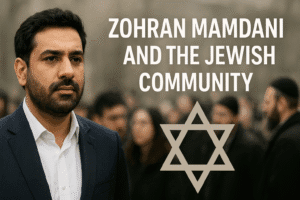
Zohran Mamdani and the Jewish Community: A New York Mayoralty Forged in the Crucible of Conflict
The election of Zohran Mamdani as the next mayor of New York City is more than a political shift; it is a cultural and ideological watershed moment. For the city with the world’s largest Jewish population, his ascent prompts a deep and necessary examination of the man behind the headlines. Mamdani’s identity is inextricably linked to the Palestinian cause, a connection that places him at the epicenter of one of the most polarizing issues in modern politics. Understanding his nuanced, and often controversial, positions on Jews, Israel, and antisemitism is crucial to foreseeing the character of his administration and its relationship with a foundational community of the city.
The Foundation: A Politicized Identity and the “Right to Exist”
Mamdani’s worldview was not formed in the backrooms of New York politics but in the post-colonial landscapes of Uganda and South Africa. He has openly described wearing a keffiyeh as a “natural thing,” a sartorial symbol of a political consciousness shaped by the struggle against apartheid. This background informs his entire political framework, including his qualified acknowledgment of Israel’s right to exist.
His standard formulation—that Israel has a right to exist but must adhere to international law—is a diplomatic tightrope walk. When pressed on whether it should exist as a Jewish state, his answer, “with equal rights for all,” and his discomfort with any state that establishes a “hierarchy of citizenship on the basis of religion,” reveals a foundational principle. For many mainstream Jewish organizations, this stance challenges the very definition of Israel as a Jewish homeland, equating its self-identification with discriminatory statecraft. For his supporters, it is a principled stand for universal equality. This isn’t a minor semantic difference; it’s a philosophical chasm that will underpin every interaction his administration has with pro-Israel groups.
The Litmus Test: BDS and the “Not On Our Dime!” Act
Mamdani’s support for the Boycott, Divestment, and Sanctions (BDS) movement is not a recent campaign conversion but a long-held conviction. Dating back to his college days, where he co-founded a Students for Justice in Palestine chapter, he has framed BDS as a “legitimate,” “nonviolent” tactic to pressure Israel into compliance with international law. He draws a deliberate distinction between Israeli institutions, which he views as complicit in “settler-colonial” projects, and individual Israelis.
This intellectual framework was translated into concrete policy with his sponsorship of the “Not On Our Dime!” act. The bill aimed to strip New York-based non-profits of their tax-exempt status if their funds were used for Israeli settlement activity. While Mamdani argued it targeted illegal outposts under international law, a majority of his Democratic colleagues in the state Assembly condemned it as an attack on Jewish charities providing humanitarian aid. The fierce backlash highlights the core tension: where Mamdani sees a targeted sanction against a political project, much of the Jewish establishment sees a broad-brush assault on their community’s philanthropic arms.
The Fault Line: October 7th and the Language of “Genocide”
Perhaps no issue is more defining than Mamdani’s response to the Hamas-led attacks of October 7, 2023, and the subsequent war in Gaza. His initial statement mourning losses “across Israel and Palestine” was followed by a swift condemnation of Netanyahu’s declaration of war. He has since consistently and unequivocally labeled Israel’s military campaign a “genocide,” a term that is incendiary and, for many Jews, a profound distortion of intent and fact that cheapens the historical meaning of the word.
His condemnation of the early DSA rally that celebrated Hamas’s actions was a necessary boundary-setting for many observers. By quoting Noy Katsman, an Israeli who lost his brother on October 7th and advocates for shared humanity, Mamdani attempts to position himself as a mourner for all lives. Yet, his persistent use of “genocide” overshadows these gestures for many in the Jewish community, framing the conflict in a moral absolute that leaves little room for the complexity of Jewish trauma and self-defense.
Policing Language vs. Policing Hate: The Antisemitism Conundrum
Mamdani’s approach to combating antisemitism presents a paradox. He has rightly called it a “crisis,” pledged to create a Department of Community Safety, and promised to appoint a senior adviser on the issue. He has condemned specific, violent attacks on Jewish institutions, from Washington D.C. to England. In his victory speech, he firmly declared that “hate has no place in New York.”
However, his initial reluctance to condemn the slogan “Globalise the intifada” revealed a critical blind spot. For a significant portion of the Jewish community, the word “intifada” is not an abstract call for “shaking off” oppression; it is synonymous with bus bombings, pizza shop massacres, and a wave of terror that claimed hundreds of Israeli civilian lives. Mamdani’s initial stance—that a mayor’s role isn’t to “police language”—ignored the potent power of words to intimidate and alienate. His later walk-back, acknowledging the “bridge that is too far” between intent and interpretation, was a critical evolution, demonstrating a capacity to listen, but the initial hesitation remains a point of deep concern.
The Unforced Errors: Associations and Lyrical Missteps
Mamdani’s political persona is also shaped by his associations and past. His three-hour interview with Hasan Piker, a streamer with a history of vile antisemitic remarks about Orthodox Jews, was defended as speaking to “each and every person.” While politically expedient for reaching a young, online audience, it raised questions about the company he keeps. Similarly, his 2017 rap song giving a “shout-out” to the “Holy Land Five”—individuals convicted of funneling money to Hamas—suggests a past sympathy for causes far beyond the mainstream Palestinian solidarity movement. While perhaps youthful expression, these actions contribute to a composite image that his critics use to question his judgment and his commitment to a truly inclusive city.
The Road Ahead: Governing a City of Contradictions
Zohran Mamdani’s election is a testament to a shifting political landscape in New York, one where progressive, anti-establishment politics have triumphed. For the Jewish community, his mayoralty will be a litmus test of his promises. The fundamental question is whether his administration can rigorously combat the very real threat of antisemitism while simultaneously advancing a foreign policy critique that many Jews experience as hostile and delegitimizing.
Can he ensure the safety of Jewish New Yorkers who feel threatened by the very slogans some of his allies champion? Can he engage with mainstream Jewish organizations whose views on Israel he fundamentally rejects? His pledge to “protect every community of faith” must be backed by actions that demonstrate an understanding of Jewish vulnerability that is as deep as his critique of Israeli policy.
The Mamdani era promises to be one of the most closely watched in modern New York history. It will force a city of immense diversity to grapple with the difficult balance between the right to protest, the imperative of safety, and the complex, often painful, intersections of identity and politics. How he navigates this will define not just his legacy, but the social fabric of New York itself.
You must be logged in to post a comment.