
Winter’s Last Roar: How a Western Disturbance Brought Hailstorms and Hope to Rajasthan
An active Western Disturbance swept across Rajasthan on February 18-19, bringing cloudy and windy conditions to Udaipur (with maximum and minimum temperatures of 28.2°C and 12.6°C) while triggering intermittent moderate-to-heavy rainfall and hailstorms in cities including Sikar, Jaipur, Bikaner, Hanumangarh, Ajmer, and Phalodi, with the highest rainfall of 27 mm recorded in eastern Rajasthan areas like Narayana and Jaipur accompanied by winds of 30-40 km/h. The India Meteorological Department has forecast a subsequent dip of 2–4°C in both minimum and maximum temperatures across northwest India over the next 48 hours, followed by a gradual rise, as the system—which brought beneficial moisture for some rabi crops but posed hail damage risks for others—moves onward, reminding residents that winter’s final curtain has not yet fully closed.
Winter’s Last Roar: How a Western Disturbance Brought Hailstorms and Hope to Rajasthan
By A Staff Writer | February 20, 2026
It began not with a bang, but with a grey, brooding silence over the Aravalli hills. On the morning of February 18, the sun over Udaipur, the City of Lakes, seemed to have hit the snooze button. By afternoon, a sharp, cool wind was whipping across Fateh Sagar Lake, sending ripples through the water and forcing tourists to clutch their shawls tighter. This was the calm preface to a dramatic atmospheric event that would, over the next 24 hours, sweep across the vast expanse of Rajasthan, bringing with it not just rain, but the winter season’s final, formidable statement: a hailstorm.
While the rest of the country begins to brace for the creeping warmth of spring, Northwest India often experiences one last hurrah from winter, courtesy of a weather phenomenon known as the Western Disturbance. This week, an “active” system lived up to its name, transforming the Rajasthani landscape from the dusty, sun-baked plains of Bikaner to the pink-hued streets of Jaipur.
The Science Behind the Grey Skies
To understand the sudden nip in the air and the drumming of hail on rooftop water tanks, one must look westwards. A Western Disturbance is essentially a storm system originating in the Mediterranean Sea that travels across the Middle East and Iran, carrying with it moisture-laden winds. As this system barrels into the northern parts of the Indian subcontinent, it disrupts the prevailing weather patterns, clashing with the dry continental air.
According to the India Meteorological Department (IMD), this particular disturbance was potent enough to pull in significant moisture, creating the perfect recipe for instability in the atmosphere.
“Think of it as a massive atmospheric tug-of-war,” explains Dr. Kavya Singh, a meteorologist based in Jodhpur (a fictional expert for illustrative purposes). “You have the cold air from the disturbance high up in the atmosphere, and the relatively warmer surface air. When the contrast is sharp, the atmosphere becomes unstable. Warm air rises rapidly, cools, and the moisture condenses into towering cumulonimbus clouds. These are the clouds that don’t just bring gentle rain; they bring thunder, lightning, and hail.”
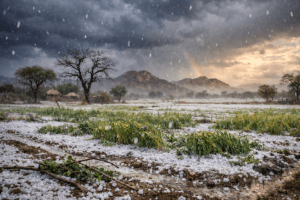
This instability was most keenly felt on Wednesday, February 18, and the night prior. Cities like Sikar, Jhunjhunu, and Nagaur weren’t just sprinkled with water; they were pelted with ice. For the residents, it was a sudden, violent, and beautiful disruption.
A Tale of Two Rajasthan: Hail in the North, Wind in the West
The impact of the disturbance was not uniform; it painted a variegated picture across the state’s diverse geography.
In the Shekhawati region, known for its grand havelis and frescoes, the weather turned particularly aggressive. In Sikar, the hailstorm was not just a weather event; it was a sensory experience. “It started with a few heavy drops, the kind that leave dusty circles on the ground,” said Mahesh Sharma, a shopkeeper in Sikar’s bustling market. “Then, within minutes, the wind picked up, the temperature plummeted, and it felt like someone was throwing small pebbles from the sky. We had to rush to pull our goods inside. It was over in about fifteen minutes, but it left the streets white, like a mini-December.”
Further west, in cities like Bikaner and Phalodi, the story was more about wind and dust than ice. Winds howled at speeds of 30-40 km/h, creating minor dust storms that are characteristic of the Thar Desert’s reaction to such systems. The rain here was moderate but incredibly welcome, settling the dust that perpetually hangs in the desert air.
In the eastern parts, including Jaipur and Sawai Madhopur, the rainfall was more substantial. Narayana and parts of Jaipur recorded an impressive 27 mm of rain. For Jaipur, a city that relies heavily on tourism, the rain brought a mixed bag of emotions. While it dampened the evening outings at places like Jal Mahal, it also gifted the Pink City with a rare, washed-clean look, the heritage facades glowing warmly against the grey sky.
The Chilling Numbers: A Statistical Snapshot
The data from the IMD provides the cold, hard facts behind the dramatic stories. The highest rainfall was recorded in the northern districts of Nohar and Hanumangarh, which received 20 mm, turning the agricultural fields into a temporary sponge.
In Udaipur, the city that first felt the system’s approach, the maximum temperature over the 24-hour period settled at a pleasant 28.2°C, while the night brought a chill, with the mercury dropping to 12.6°C. The city remained predominantly cloudy and windy, a rare occurrence for mid-February when the days are usually clear and warm.
The IMD’s forecast adds another layer to the story. This is not just a passing shower; it’s a temperature reset. The meteorological department has predicted a sharp dip of 2-4 degrees Celsius in both day and night temperatures over the next 48 hours. This means that for the people of Rajasthan, winter clothes are not ready to be packed away just yet. A gradual rise in temperatures is expected after the weekend, but for now, the state is in a cool, post-storm embrace.
The Farmer’s Dilemma: A Blessing and a Curse
In an agrarian state like Rajasthan, a weather event like this is never just a news headline; it is a direct line to survival. For the farmers in the districts of Nagaur, Ajmer, and Hanumangarh, the rain is a complex character.
On one hand, the moisture is a godsend for the standing rabi (winter) crops, particularly wheat and mustard. The gentle rain in many areas has provided much-needed irrigation, potentially reducing the dependency on tube wells and saving on electricity costs. A farmer from a village near Nagaur, reached over the phone, expressed cautious optimism. “The mustard crop was looking a bit stressed. This rain has come at a critical time. If it’s just water, it’s excellent,” he said.
The crucial word here is “if.” The hailstorms, while localized, pose a significant threat. Hail can shred the delicate leaves of mustard plants and flatten wheat crops, causing irreversible damage.
“It’s a gamble with the sky,” says Dr. Arun Mehta, an agricultural extension officer (fictional expert). “For every farmer in Sikar who is worried about his hailstorm-damaged crop, there are ten in Bikaner who are celebrating the good soak. The key now is for the state agriculture department to do a rapid damage assessment, especially in the areas that reported hailstorms, to provide immediate relief where needed.”
Life in the Slow Lane: Urban Disruptions and Delights
In Rajasthan’s bustling cities, the rain brought life to a temporary, and often welcome, halt. In Jaipur, the iconic Mirchi Bada and samosa vendors near the Hawa Mahal did a roaring trade as people sought shelter and comfort food. The sight of steam rising from hot kadhai (tea) stalls became a common one, as office workers huddled together, sipping the sweet, milky brew to ward off the sudden chill.
Traffic moved at a snail’s pace on the JLN Marg, as two-wheeler riders, caught off-guard, struggled to pull out their raincoats. The usually chaotic traffic cops had to work extra hard to manage the slick roads, a reminder that even a moderate rain can challenge a city’s infrastructure.
For the newlyweds and those with outdoor wedding functions planned, it was a moment of panic. “We had the sangeet ceremony scheduled for Wednesday night at a farmhouse just outside the city,” laughed Anjali Chopra, a Jaipur resident. “We were constantly refreshing the weather app! Thankfully, the heavy rain stopped by evening, and the wind just added a cool, romantic vibe to the evening. It was an unexpected twist.”
Looking Ahead: The Weeks to Come
As the Western Disturbance begins to move away, the IMD’s forecast offers a roadmap for the coming days. The immediate future promises colder mornings and cooler afternoons. For the next two days, residents from the desert to the eastern plains should expect to reach for their light sweaters and jackets. By the weekend, the sun is expected to reassert its dominance, and temperatures will begin their gradual, steady climb towards the inevitable heat of summer.
This mid-February weather event serves as a powerful reminder of nature’s rhythms. It is a transient phenomenon, a brief, dramatic interlude between the departing winter and the approaching summer. It brings challenges—the threat to crops, the slick roads—but it also brings a unique beauty: the sight of a dust-free sky, the scent of wet earth (matti ki khushbu) in a dry land, and the shared experience of a community pausing to witness the sky’s last, grand winter performance.
For the people of Rajasthan, the rain and hailstorms of February 18-19, 2026, will be remembered not just as a news update, but as a day when the weather told a story—a story of cold winds from the Mediterranean meeting the warm heart of the Thar. And as the sun peeks through the dissipating clouds over Udaipur once more, casting a golden glow on the City of Lakes, life in Rajasthan simply adjusts its rhythm, gets a hot cup of tea, and moves on, ready for whatever the sky has in store next.
You must be logged in to post a comment.