
Winter Crisis in Gaza: Ten Nations Urge Israel to Lift Aid Restrictions as Deadline Looms
On December 30, 2025, the foreign ministers of ten nations—Canada, Denmark, Finland, France, Iceland, Japan, Norway, Sweden, Switzerland, and the United Kingdom—issued a joint statement expressing grave concern over the catastrophic and deteriorating humanitarian conditions in Gaza as winter sets in, with 1.3 million people lacking adequate shelter and 1.6 million facing acute food insecurity. The statement urgently calls on the Israeli government to take four essential steps: prevent the deregistration and closure of critical international NGOs facing a December 31 deadline, ensure UN agencies like UNRWA can operate without impediment, lift restrictive “dual-use” import bans on vital medical and shelter supplies, and fully open crossings like Rafah to significantly boost the flow of aid beyond current inadequate targets. The ministers warn that without immediate action to remove these access constraints, it will be impossible to meet the vast scale of civilian suffering, undermining both the humanitarian response and the path to lasting peace outlined in the Comprehensive Plan to End the Gaza Conflict.
Winter Crisis in Gaza: Ten Nations Urge Israel to Lift Aid Restrictions as Deadline Looms
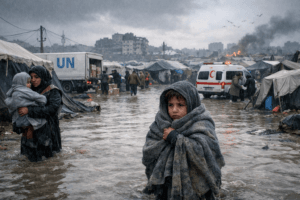
As temperatures plummet and winter rains flood makeshift camps, ten allied nations have issued an urgent appeal to Israel: remove barriers to life-saving aid in Gaza or risk a humanitarian catastrophe. In a joint statement released on December 30, 2025, the foreign ministers of Canada, Denmark, Finland, France, Iceland, Japan, Norway, Sweden, Switzerland, and the United Kingdom expressed “serious concerns about the renewed deterioration of the humanitarian situation in Gaza which remains catastrophic”.
This coordinated diplomatic intervention arrives at a critical inflection point. On December 31, 2025—the day after the statement’s release—a contentious deadline takes effect: many established international NGOs face deregistration by Israel, which could force their operations in Gaza and the West Bank to close within 60 days. This potential dismantling of the aid architecture occurs just as Gaza’s population, weakened by years of conflict and displacement, confronts a brutal winter.
The Scale of the Crisis: A Population on the Brink
The grim statistics cited by the ministers paint a picture of a society clinging to survival. A staggering 1.3 million people—well over half of Gaza’s population—still require urgent shelter support. More than half of health facilities are only partially functional, crippled by shortages of essential equipment and supplies. The situation is compounded by a total collapse of sanitation infrastructure, leaving 740,000 people vulnerable to toxic flooding from winter rains.
These immediate dangers are set against a backdrop of pervasive food insecurity. A December 19 report from the Integrated Food Security Phase Classification (IPC) found that while famine conditions have eased since August, the situation remains desperate. Approximately 1.6 million people in Gaza still face high levels of acute food insecurity. Winter has magnified the suffering; heavy rains and strong winds have destroyed waterlogged tents, and in recent days, collapsing buildings have killed at least 20 people seeking shelter from the severe weather.
Humanitarian efforts since the October 2025 ceasefire have brought some measurable, yet fragile, improvements. The table below highlights key changes during the first month of the ceasefire compared to the period immediately before it:
| Humanitarian Metric | Month Prior to Ceasefire | First Month of Ceasefire | Impact |
| Pallets of Aid Collected | 28,007 | 64,776 | 131% increase |
| Truckloads Collected | 2,066 | 3,926 | 90% increase |
| Litres of Diesel Collected | 1,630,310 | 4,314,315 | 165% increase |
| People Assisted with Monthly Food Aid | 0 | 935,000 | Resumed after 6-month pause |
Despite this progress, the joint statement is clear: “The response remains severely constrained by persistent impediments on humanitarian access”. The ministers outline four specific, urgent demands aimed at removing these impediments.
The Core Demands: A Roadmap for Humanitarian Access
- Ensure International NGOs Can Operate
The most time-sensitive demand concerns the operation of International Non-Governmental Organizations (INGOs). Israel introduced a new registration system in March 2025 with criteria that aid groups argue are “vague, arbitrary, and highly politicized”. Grounds for rejection include “denying the existence of Israel as a Jewish and democratic state” and “supporting the prosecution of Israeli security forces in foreign or international courts”.
Organizations like Doctors Without Borders (MSF) and Save the Children, which provide critical medical care and family support, now face an uncertain future. As of late December, only 21 of roughly 100 applications had been approved, with 14 rejected and the rest under review. Israel’s Ministry of Diaspora Affairs claims the departure of “rogue organisations” will not affect aid delivery, but the data suggests otherwise.
INGOs are not a supplementary part of the humanitarian response; they are its backbone. They work with UN and Palestinian organizations to deliver approximately $1 billion in aid across Palestine each year. Their potential removal would have devastating, sector-by-sector consequences:
- Health: 1 in 3 health facilities in Gaza would close. INGOs run or support 60% of field hospitals and provide hundreds of thousands of medical consultations monthly.
- Nutrition: All five inpatient stabilization centers for children with life-threatening severe acute malnutrition are supported by INGOs.
- Shelter: INGOs have implemented 74% of all shelter activities since early 2025.
- Allow the UN and Its Partners to Continue Vital Work
The ministers stressed the essential role of UN agencies, including UNRWA, in ensuring the “impartial, neutral, and independent delivery of aid throughout the whole of Gaza”. This call comes amid longstanding tensions between Israel and UNRWA. The statement implicitly argues that constraining UN operations, on top of threatening INGOs, would push an already fractured humanitarian system past its breaking point.
- Lift Restrictions on “Dual-Use” Imports
A persistent bottleneck involves restrictions on items Israel considers to have potential “dual-use” (civilian and military applications). This category includes urgently needed medical equipment, shelter materials, water pipes, and spare parts for sanitation systems. While intended for security, these restrictions are paralyzing recovery. The UN reports that as of November 2025, $46.9 million worth of approved humanitarian supplies were stuck awaiting entry, with key equipment for logistics and infrastructure repair “systematically rejected”. This prevents the repair of water systems, leaving hundreds of thousands at risk of disease.
- Open Crossings and Boost Aid Flow
Finally, the nations call for a major increase in the volume of aid entering Gaza. They welcome the partial opening of the Allenby crossing but note that other critical corridors, including Rafah, remain closed or severely restricted. They argue that bureaucratic processes and extensive screenings cause unnecessary delays. Their request is straightforward: lift the arbitrary caps. The current target of 4,200 trucks per week “should be a floor not a ceiling” to meet the vast scale of need.
The Political Fault Lines: Security vs. Survival
Israel has firmly rejected the joint statement. Its Foreign Ministry labeled the criticism “false but unsurprising,” framing it as “one-sided demands” that ignore “the essential requirement of disarming Hamas”. This highlights the central political tension: Israel views the registration process and import controls as legitimate security measures to prevent Hamas from diverting aid, while aid agencies and the signatory nations see them as unlawful collective punishment that violates international humanitarian law.
The diplomatic push coincides with Israeli Prime Minister Benjamin Netanyahu’s visit to the United States, where he reiterated that a future for Gaza is only possible “if you disarm Hamas”. For its part, Hamas has rejected calls for disarmament, with a spokesperson stating its people “will not give up their weapons as long as the occupation remains”.
A Fragile Future at the Turn of the Year
The joint statement from these ten nations—which includes close allies of Israel like the UK, Canada, and Japan—is a significant marker of international concern. It underscores that improved aid flow during a ceasefire is not the same as unfettered humanitarian access. The ministers conclude by linking immediate humanitarian action to long-term stability, urging Israel to “deliver and honour the Comprehensive Plan to End the Gaza Conflict” as necessary for “lasting peace and stability”.
As the December 31 registration deadline passes, the world watches to see whether operational bureaucracy will trigger a man-made disaster within a natural one. Will security protocols be adjusted to allow life-saving work to continue, or will the primary structures delivering food to the hungry, medicine to the sick, and shelter to the displaced be dismantled in the coldest days of winter? The answer will determine the survival of countless vulnerable civilians caught in the crossfire of a protracted political conflict. The coming 60 days will be a critical test of whether a glimmer of humanitarian progress can be sustained or snuffed out.
You must be logged in to post a comment.