
Why Worldmark at Aerocity Isn’t Just Another Business Park: Decoding India’s Shift to Global Business Districts
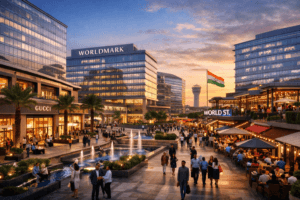
Worldmark at Aerocity exemplifies India’s shift from traditional Central Business Districts to Global Business Districts—integrated, human-centric urban ecosystems that combine work, leisure, culture, and connectivity in a 24/7 live-work-play environment. Strategically located near Delhi’s international airport, it leverages hyper-connectivity, curated mixed-use development, and large-scale planning to meet global standards demanded by multinational firms and mobile talent.
Unlike legacy CBDs that empty after office hours, Worldmark is designed as a vibrant micro-city with premium offices, luxury retail, entertainment, hospitality, and public spaces that foster interaction and community. Its rise signals a broader transformation in India’s urban blueprint—one that enhances talent attraction, eases pressure on old city cores, and positions Indian cities as competitive, future-ready hubs in the global economy.
Why Worldmark at Aerocity Isn’t Just Another Business Park: Decoding India’s Shift to Global Business Districts
For decades, the Indian urban professional’s compass pointed squarely at the city’s Central Business District (CBD). These zones, often characterized by towering office blocks, congested streets, and a rhythm that died with the evening commute, represented a singular idea: work is a place you go to, not a place you live in. Today, that concept is being profoundly rewritten. India is now embracing the model of the Global Business District (GBD)—a holistic ecosystem where work, life, innovation, and culture converge into a 24-hour live-work-play environment. At the forefront of this urban revolution is Worldmark at Aerocity, New Delhi, a development that doesn’t just house companies but curates an entire micro-city for the future.
The Global Blueprint: Why CBDs Are No Longer Enough
The traditional CBD was a product of the 20th-century industrial and financial age. It prioritized density of commercial space over quality of life. After 7 PM, these areas often turned into ghost towns, devoid of social energy or community. Globally, the response to this sterile model has been the rise of GBDs. Think of London’s Canary Wharf or New York’s Hudson Yards—they are not just clusters of offices. They are destinations with waterfront promenades, luxury retail, public art, residential towers, and green parks. They are designed for the human experience, understanding that innovation thrives in collisions—not just of ideas, but of people from different disciplines in relaxed, inspiring settings.
This shift is driven by a new global workforce: digitally-native, mobile, and valuing flexibility and experience over rigid corporate structures. For them, a long, draining commute to a segregated office district is an archaic tax on productivity and well-being. The GBD, by integrating everything within walking distance, gives time back—the ultimate modern luxury.
India’s Urban Inflection Point
India’s meteoric economic rise and its deepening integration into global supply chains have created a pressing need for spaces that mirror international standards. Our cities are competing not just with each other, but with Singapore, Dubai, and Shanghai for talent, investment, and regional headquarters. The old CBDs, often plagued by infrastructural strain and limited space for expansion, cannot meet this new demand.
The answer lies in developing new, planned districts from the ground up. These GBDs are rising not in the chaotic heart of old cities, but at strategic nodes of connectivity, often near international airports and major transport corridors. They are built with modern infrastructure, sustainability benchmarks, and digital connectivity baked into their blueprint.
Worldmark at Aerocity: A Case Study in Intentional Urbanism
Worldmark at Aerocity is arguably India’s most ambitious attempt to build a true GBD from scratch. Its strategy reveals the core pillars of this new urban model:
- Hyper-Connectivity as a Foundation: Its location adjacent to the Indira Gandhi International Airport is its superpower. For global businesses, this translates to unparalleled access. A senior executive can land, be in a meeting within 30 minutes, and depart the same day—a critical advantage in time-sensitive industries. The surrounding cluster of over 40 embassies further cements its status as a diplomatic and global business gateway.
- Curated Mixed-Use, Not Random Mixing: The difference between a true GBD and a simple commercial complex with a food court is curation. Worldmark is being developed in phased mastery. Beyond grade-A office spaces (with Phase 2.0 adding a monumental 7 million sq. ft.), it introduces purpose-built zones:
- The Haute District: A dedicated luxury retail boulevard.
- World St.: A vibrant Food & Beverage promenade.
- India’s largest indoor location-based entertainment zone: Targeting leisure and family visits.
- The Mall at Worldmark (2027): Touted as India’s biggest entertainment-led retail destination.
This ensures economic activity and footfall are sustained around the clock, weekends included.
- Human-Centric Design & Placemaking: This is where Worldmark strives to leap beyond the transactional. The master plan emphasizes pedestrian-friendly boulevards, landscaped courtyards, and art corridors. The goal is to foster spontaneous interactions and a sense of community—to create a place people have an emotional connection to, not just a commute they endure. This focus on walkability and public realm quality is a direct import from the world’s most livable cities.
- Future-Proofing Through Scale & Flexibility: With a planned development of over 20 million sq. ft., Worldmark is creating an entire ecosystem. This scale attracts a self-reinforcing cycle of tenants: major corporates draw supporting consultancies, law firms, and tech services; their employees demand premium retail and F&B; this vibrancy attracts hotels and entertainment. It becomes a virtuous economic loop, resilient to isolated market downturns.
The Ripple Effect: Beyond Real Estate
The implications of successful GBDs like Worldmark extend far beyond property valuations.
- Talent Attraction & Retention: Companies here can offer a compelling proposition to top-tier, especially international, talent: a world-class work environment embedded in a dynamic lifestyle hub.
- Decongesting Old Cores: By creating new, full-service commercial hubs, pressure on aging city centers can be alleviated, allowing for their potential revitalization into more cultural or residential zones.
- Positioning India on the Global Map: Such districts send a powerful signal to the world: India is building infrastructure and ecosystems that meet global benchmarks, making it a more seamless place for multinationals to operate.
Challenges and the Road Ahead
The vision is grand, but the test lies in execution and long-term management. A GBD is not a “build-it-and-they-will-come” project. It requires:
- Impeccable Governance: Seamless coordination between private management and public authorities for security, cleanliness, and utilities.
- Authentic Cultural Integration: Beyond sleek glass facades, these districts must organically foster a cultural identity—through local art, festivals, and culinary diversity—to avoid feeling sterile or generic.
- Sustainability in Practice: The commitment must go beyond green building certifications to include efficient public transport integration, waste management, and water conservation in daily operations.
Conclusion: The New Urban Heartbeat
Worldmark at Aerocity is more than a real estate development; it is a manifesto for India’s urban future. It represents a move away from segregated, single-use urban planning toward integrated, human-centered ecosystems. As India’s economy continues to grow and globalize, the success of such GBDs will be a critical barometer of our cities’ ability to innovate, attract the best, and offer a quality of life that matches global aspirations.
The 24-hour city is no longer a foreign concept. It’s being built, phase by phase, at the gateway to the nation’s capital. The era of the deserted CBD is closing; the dawn of the vibrant, living, breathing Global Business District has arrived.
FAQs: India’s Global Business Districts & Worldmark at Aerocity
Q1: What exactly is a Global Business District (GBD)? How is it different from a regular CBD? A: A Central Business District (CBD) is typically a dense, often older, urban core dominated by commercial offices and financial institutions, which can become inactive after business hours. A Global Business District (GBD) is a planned, mixed-use ecosystem that integrates premium office spaces with high-end retail, luxury hospitality, fine dining, cultural venues, and public plazas. It’s designed for 24/7 activity, walkability, and fostering community, aiming to be a destination in itself for work, leisure, and living.
Q2: Why is the location near the airport so crucial for a GBD like Worldmark? A: Proximity to a major international airport is a strategic advantage for globally connected businesses. It facilitates swift travel for international executives, reduces logistical friction for time-sensitive industries (like aviation, consulting, and finance), and enhances the district’s appeal as a regional headquarters location. It literally places global business at the doorstep.
Q3: Who are the primary businesses attracted to such districts? A: GBDs attract a specific ecosystem: multinational corporations setting up regional or national headquarters, global banks and financial services firms, top-tier consulting and legal firms, luxury retail brands, flagship hospitality operators, and aviation-linked businesses. The presence of embassies also draws diplomatic missions and related services.
Q4: Does the rise of GBDs mean traditional city centers will decline? A: Not necessarily. It signifies a evolution in urban form. GBDs can help decongest overburdened traditional cores by absorbing new commercial growth. This can allow older CBDs to transform, potentially focusing more on culture, heritage, tourism, or residential conversion. A polycentric city model often emerges, with multiple nodes serving different purposes.
Q5: What does “human-centric design” mean in the context of a business district? A: It means prioritizing the experience and well-being of the people who use the space daily. This translates to wide, shaded pedestrian walkways, ample green spaces and parks, curated public art, comfortable seating areas, accessible retail and amenities, and design that encourages interaction and reduces the feeling of a purely transactional environment. It’s about building for people, not just corporations.
You must be logged in to post a comment.