
Why the Modi-Lula Phone Call Signals a New Phase in Global South Leadership
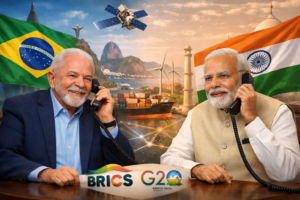
Why the Modi-Lula Phone Call Signals a New Phase in Global South Leadership
A Strategic Dialogue Beyond Diplomacy: Decoding the India-Brazil Partnership in a Multipolar World
On January 22, 2026, a telephone conversation between two leaders separated by geography but aligned by vision underscored a quiet geopolitical realignment. When Brazilian President Luiz Inácio Lula da Silva placed a call to Indian Prime Minister Narendra Modi, it was more than a routine diplomatic exchange. It was a reaffirmation of a strategic partnership that is increasingly becoming a cornerstone for a new kind of global governance—one led by major democratic economies of the Global South. The official readout, noting progress from trade to defence and a planned early visit by Lula to India, offers a blueprint for a relationship moving with renewed purpose and urgency.
The Context: A Partnership Re-energized
The India-Brazil Strategic Partnership, formally established in 2006, has historically been cordial but often operated in the long shadow of each nation’s other bilateral priorities. The recent dynamism, noted by both leaders, stems from a convergence of factors. Domestically, both Modi and Lula are in political phases where they are leveraging foreign policy for national development. Internationally, the persistent gridlock in traditional multilateral forums like the UN Security Council and the volatility of great power competition have pushed capable middle powers to seek reliable, alternative coalitions.
Their prior meetings in 2023—in Brasília and on the sidelines of the BRICS Summit in South Africa—were not mere pleasantries. They were working sessions that likely identified specific, actionable goals. The phone call, therefore, serves as a mid-course review and acceleration point. It’s a signal that bureaucratic machinery in both capitals is under instructions to deliver tangible outcomes.
Pillars of Progress: From Soybeans to Satellites
The breadth of sectors mentioned—trade, technology, defence, energy, health, agriculture—reveals a consciously diversified partnership designed for resilience and mutual growth.
- Trade & Investment: The core remains complementary economies. Brazil is a vital source of India’s energy and nutritional security (crude oil, soybeans, sugarcane ethanol). India, in return, exports value-added goods like pharmaceuticals, automotive parts, and IT services. The “significant progress” likely refers to navigating non-tariff barriers and fostering direct investment. Indian companies in agrochemicals, IT, and energy are deepening their Brazilian footprint, while Brazilian firms eye India’s vast consumer market and manufacturing links. The untapped potential lies in co-investing in third countries, particularly in Africa and Latin America.
- Technology & Defence: This is the high-growth frontier. In technology, collaboration spans digital public infrastructure (India’s Aadhaar and UPI models are of great interest to Brazil), space cooperation (ISRO and its Brazilian counterpart have a long history in satellite imagery for the Amazon), and joint innovation in biofuels and agricultural tech. Defence, once a nascent area, is gaining momentum. Brazil’s robust defence industry, particularly in aerospace (Embraer) and patrol aircraft, aligns with India’s goals of diversifying its procurement and co-developing platforms. Discussions likely extend to maritime security in the South Atlantic and Indo-Pacific, reflecting shared blue-economy interests.
- Energy & Health: A Model for South-South Cooperation: Here, the partnership directly impacts human security. Brazil’s prowess in renewable energy, especially biofuels, is a perfect match for India’s massive clean energy transition goals. Knowledge exchange on ethanol blending programs can help India with its agricultural waste management and energy independence. In health, the experience of both nations as pharmaceutical powerhouses—India as the ‘pharmacy of the world’ and Brazil with its strong public health system and vaccine production—creates a formidable alliance. Post-pandemic, their cooperation in generic medicines, vaccine R&D, and health surveillance is a counter-model to monopolized pharmaceutical supply chains.
- The Human Bridge: Often overlooked, the people-to-people ties form the cultural ballast. From the shared love for football (with Brazilian coaches and players frequenting India) to academic exchanges and growing tourism, this soft diplomacy builds lasting goodwill. The Indian diaspora in Brazil, though small, and the spiritual connections through yoga and meditation, provide a unique social fabric.
The Global Stage: A Unified Voice for Reformed Multilateralism
Perhaps the most profound part of their conversation was the exchange on global issues and the “importance of reformed multilateralism.” This is diplomatic code for a shared frustration with a world order designed in the mid-20th century. As leading voices of the G20, BRICS, and the G4 (for UNSC reform), India and Brazil are natural allies in advocating for institutions that reflect 21st-century realities.
Their mutual interest includes:
- Climate Justice: Arguing for sustainable development space and equitable burden-sharing.
- Trade Fairness: Resisting protectionism while ensuring rules accommodate developing economies.
- Food & Energy Security: Using their status as agricultural powerhouses to stabilize global markets during crises.
- Cyber Governance: Advocating for a multilateral, open, and secure internet.
Their coordinated stance prevents the narrative of the Global South from being fragmented, giving them greater negotiating heft against traditional Western blocs and other emerging powers.
The Road Ahead: The Significance of an Early Visit
PM Modi’s invitation for an “early date” visit is the critical next step. High-level visits are not just ceremonial; they force timelines, finalize pending agreements, and provide a media spotlight that galvanizes stakeholder interest. President Lula’s visit to India will likely see the signing of a slew of agreements, possibly including:
- A revised bilateral investment treaty.
- MoUs on bioenergy and green hydrogen cooperation.
- Further frameworks for defence industrial collaboration.
- A strategic dialogue mechanism on critical minerals.
The visit will also serve as a powerful visual symbol of South-South solidarity, resonating across Africa, Latin America, and the Global South.
Conclusion: More Than a Sum of Its Parts
The Modi-Lula phone call is a testament to a relationship maturing from one based on shared historical struggles to one focused on shared future ambitions. It moves beyond rhetorical solidarity to project-based partnership. In an era of supply chain reconfiguration and geopolitical uncertainty, a strong India-Brazil axis offers stability, market diversity, and intellectual synergy.
Their partnership is not anti-West; it is pro-rebalance. It demonstrates that middle powers, when strategically aligned, can shape agendas rather than just follow them. As both nations prepare for a landmark in-person summit, the world should watch closely. The India-Brazil strategic partnership is no longer just a diplomatic formality—it is a workshop for building a more multipolar, equitable, and innovative world order, one phone call, one trade deal, and one joint project at a time.
You must be logged in to post a comment.