
Why Sam Altman’s Quiet India Trip Signals a New Global AI Order
Sam Altman’s planned, discreet visit to India during the high-profile India AI Impact Summit symbolizes a critical strategic pivot in the global AI race, where India has become the essential arena beyond just a growth market. While the summit showcases the country’s investment ambitions, Altman’s closed-door meetings reveal the real battleground: a fierce fight for enterprise adoption and local partnerships as OpenAI faces eroding market share against rivals like Anthropic and Google, who have already embedded themselves deeply in India’s digital ecosystem. The trip underscores the dual challenge of converting India’s massive user base into sustainable revenue while navigating the severe infrastructure constraints and localization demands that will ultimately determine whether the future of AI is shaped by collaborative, on-the-ground adaptation or remains a distant, exported technology.
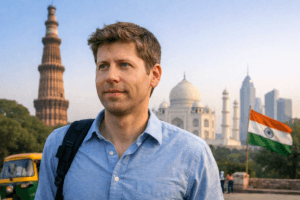
Why Sam Altman’s Quiet India Trip Signals a New Global AI Order
While the official agenda for the India AI Impact Summit 2026 sparkles with confirmed star power—Jensen Huang, Sundar Pichai, Dario Amodei—it’s the hushed planning of a side visit that may tell the more compelling story. Sam Altman’s anticipated, yet unannounced, journey to New Delhi in mid-February isn’t just another executive tour. It’s a strategic maneuver in a high-stakes game where India has rapidly evolved from a mere growth market to the central arena defining the next decade of artificial intelligence.
This convergence of AI’s most powerful leaders in one city underscores a pivotal shift: the era of building AI for the world is colliding with the imperative of building AI with the world. And India, with its vast user base, formidable developer community, and complex, real-world challenges, has become the indispensable testing ground and strategic prize.
Beyond the Summit: The Real Mission in Closed-Door Rooms
The summit itself is a symbol of India’s ambition. A $100 billion investment target, as floated by the IT minister, is a clarion call. But the real narrative will unfold in the parallel universe of private meetings and exclusive events that Altman and his peers are orchestrating. OpenAI’s closed-door sessions and its dedicated event on February 19 aren’t about keynote platitudes; they are reconnaissance and relationship missions aimed at the core pillars of Indian tech: enterprise captains, regulatory architects, and hungry startup founders.
This two-tiered engagement—public summit and private parlays—reveals a nuanced strategy. The public forum claims thought leadership, but the private gatherings are where deals are shaped, policy concerns are voiced, and partnerships are born. For Altman, this is particularly crucial. Despite ChatGPT’s staggering adoption in India (leading in downloads, second in users), the translation of that popularity into sustainable enterprise revenue and robust paid subscriptions remains an unfinished chapter. The introduction of the budget-friendly “ChatGPT Go” plan was a tactical move, but the real enterprise battlefield requires deep, localized integration.
The Enterprise Front: OpenAI’s Uphill Battle in a Crowded Field
Altman’s visit arrives at a moment of heightened vulnerability and fierce competition in the enterprise sector. Recent analyses reveal a startling trend: while OpenAI pioneered the enterprise AI offering with ChatGPT Enterprise, its market share in enterprise LLM usage has nearly halved, from 50% to 27%, as rivals like Anthropic have surged to a dominant 40%. Google’s steady encroachment with Gemini is explicitly noted as a concern within OpenAI’s internal memos.
In India, this battlefield is already active. Anthropic has planted its flag in Bengaluru with a seasoned local lead. Google and Perplexity have sealed telecom partnerships with Reliance Jio and Airtel, embedding AI into the daily digital lives of millions. Meta is a constant presence. For OpenAI, therefore, this trip is less a victory lap and more a critical campaign to secure strategic alliances. Meetings with figures like Mukesh Ambani aren’t mere photo-ops; they are essential to counter competitors who have already moved decisively into the connectivity layer that defines India’s digital ecosystem.
The Infrastructure Gambit: India’s Promise and Peril
Beyond software and subscriptions lies a harder, grittier frontier: physical infrastructure. Sources indicate OpenAI is evaluating India as a base for infrastructure expansion, following the multibillion-dollar data center commitments from Google and Microsoft. This is a recognition of India’s desire to control its AI destiny and reduce latency for a billion-plus users.
However, here Altman and others will confront India’s iron triangle of constraints: uneven power grids, high energy costs, and severe water scarcity in key regions. Building AI infrastructure is profoundly resource-intensive. The cooling demands of GPU clusters alone present a monumental challenge. This creates a paradoxical scenario: the market demand is undeniable, but the physical cost of serving it locally could be astronomically high, potentially slowing rollouts and squeezing margins. How OpenAI navigates this—through partnerships with local giants who understand the infrastructure landscape, innovative cooling solutions, or phased investments—will be a key determinant of its long-term capacity to “win” India.
The Localization Imperative: India Isn’t Just a Market, It’s a Muse
Perhaps the most profound insight from this gathering of AI titans is the tacit admission that the next leap in AI may not come from a purely Western context. The Indian government’s push for smaller, efficient models tailored to local languages, costs, and use cases is a direct challenge to the one-size-fits-all megamodel approach.
For leaders like Altman, this means engagement must evolve beyond sales. It must encompass collaboration. The “sweet enterprise dollars” Rebecca Szkutak wrote about will increasingly flow to those who can demonstrate an understanding of India’s unique challenges in education, agriculture, healthcare, and governance. The startups and developers Altman meets are not just potential customers or talent pools; they are co-creators who can teach global AI systems about complexity at a scale unimaginable in the West.
Conclusion: The Delhi Dialogue and the New AI World Order
Sam Altman’s upcoming trip, quietly arranged on the sidelines of a glittering summit, is a microcosm of a larger transformation. The global AI race is entering a new, more mature, and more geographically diverse phase. The rules are being rewritten not only in the research labs of San Francisco but also in the bustling tech hubs of Bengaluru and the policy corridors of New Delhi.
The convergence in Delhi this February is more than a conference; it’s a diplomatic summit for the digital age. The outcomes—the partnerships forged, the infrastructure plans hinted at, the policy dialogues initiated—will ripple far beyond India’s borders. They will signal whether the future of AI is one of centralized, exported intelligence, or a more pluralistic, collaborative model shaped by the diverse needs of the world.
For Altman and OpenAI, the mission is clear: to listen as much as to lecture, to partner as much as to sell, and to recognize that in the quest for artificial general intelligence, the most important intelligence of all may be a deep, genuine understanding of places like India. The side events, in the end, might just be where the main event truly happens.
You must be logged in to post a comment.