
Whispers of Winter’s Return: How a Western Disturbance Wove a Spell of Rain and Hail Over Rajasthan
An active Western Disturbance swept through Rajasthan on February 18, 2026, bringing cloudy and windy conditions to Udaipur (with temperatures ranging from 12.6°C to 28.2°C) while triggering intermittent moderate-to-heavy rain and hailstorms across several cities including Sikar, Jaipur, Bikaner, Ajmer, and Hanumangarh, with the highest rainfall of 27 mm recorded in eastern Rajasthan areas like Narayana. The sudden weather shift, accompanied by winds of 30-40 km/hr, disrupted daily life and urban rhythms while presenting a mixed blessing for farmers—providing beneficial soil moisture for Rabi crops but risking damage from hail to wheat, mustard, and gram fields. According to the India Meteorological Department, this marked a temporary return of winter conditions, with minimum and maximum temperatures expected to dip by 2-4°C over the following 48 hours before a gradual rise, reminding residents of the region’s deep connection to these meteorological rhythms.
Whispers of Winter’s Return: How a Western Disturbance Wove a Spell of Rain and Hail Over Rajasthan
Meta Description: Beyond the headlines, explore the story of the sudden rain and hailstorms that swept through Rajasthan in February 2026. From the romantic lanes of Udaipur to the parched fields of Shekhawati, discover the impact, the relief, and the rhythm of life dictated by an active Western Disturbance.
The sun had begun its steady ascent in the Rajasthani sky. February, in its final leg, usually teases the coming of spring, painting the days with warm, golden light. But nature, in its infinite unpredictability, had a different script written for the third week of the month. On February 18, 2026, an active player from the heavens—a Western Disturbance—swept into the northwestern landscape, casting a dramatic pall over the desert state and reminding everyone that winter was not ready to concede defeat just yet.
For the average person going about their day, the shift was abrupt. In Udaipur, the City of Lakes, the morning of February 18 did not dawn with its characteristic sharp clarity. Instead, it arrived wrapped in a thick, grey blanket of clouds. A gusty wind, cool and moist, swept across the Aravalli hills, chasing away the usual crowd of shikara wallahs and turning the placid waters of Lake Pichola into a rippling, dark mirror of the turbulent sky above. It was a day for chai and pakoras, for watching the weather from the jharokhas of havelis, and for shuttering the stalls that sold colourful trinkets to tourists now huddled in their hotels.
This wasn’t just a passing cloud. It was a full-blown meteorological event that reminded Rajasthanis of the profound connection between the heavens and their daily lives.
The City of Lakes Wrapped in Grey
Udaipur, often called the most romantic city in India, took on a melancholic, brooding charm. The maximum temperature plateaued at a comfortable 28.2°C, but the absence of the sun made it feel much cooler. As night fell, the mercury dipped to 12.6°C, a gentle reminder of the winter that was. For the vendors at the Bada Bazaar, who had just started stocking up on lighter fabrics and summer ware, the wind was a minor inconvenience, a sign to hold off on packing away the woollens just yet.
“It’s good for the city,” remarked Rajesh, a boatman at Lal Ghat, as he tied a tarpaulin over his shikara. “The tourists come for the ‘romance’ of Udaipur, and what’s more romantic than a cloudy day on the lake? But the wind is too sharp for long rides. Everyone just wants to sit by the water and watch from a cafe.” His perspective highlights a unique truth: in a city whose economy is built on aesthetics, even the weather is part of the product—a dramatic, ever-changing backdrop for a million memories.
The Sky’s Fury: When Hailstones Danced on Desert Soil
While Udaipur experienced a poetic grey, other parts of Rajasthan faced the sky’s more theatrical fury. From Tuesday night into Wednesday, a corridor of disturbance stretched across the state. The India Meteorological Department (IMD) had predicted the shift, but experiencing it was another matter entirely.
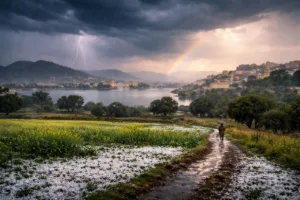
In the Shekhawati region, cities like Sikar and Jhunjhunu were caught off guard. The rain was not gentle; it was intermittent but often moderate to heavy. And then came the hailstones. For the residents of Sikar, the sound was unmistakable—a clattering against tin roofs, a sudden drumming on car bonnets, a frantic scramble to cover plants and vehicles.
These weren’t just meteorological events; they were sensory assaults. The air, thick with the smell of wet earth—that beloved petrichor—mixed with the sharp, cold sting of hail. Children, ever resilient, rushed out to collect the icy pellets, their laughter a stark contrast to the worry on the faces of farmers.
The cities of Jaipur, Sawai Madhopur, Bikaner, Nagaur, Hanumangarh, Ajmer, and Phalodi all found themselves on this weather map. In the Pink City, Jaipur, the usually bustling streets near Amer Fort and Hawa Mahal emptied as squalls of wind, gusting up to 30-40 km/hr, accompanied the downpour. The wind, a formidable force, tore through banners, sent loose chai glasses flying from stalls, and made the massive fort walls seem to groan under the assault.
The rain gauges told the story of the storm’s intensity. While Nohar and Hanumangarh in the north recorded a substantial 20 mm of rainfall, it was the eastern towns that saw a deluge. Narayana and parts of Jaipur city recorded a striking 27 mm. This sudden burst of water overwhelmed drains in low-lying areas for a few hours, turning roads into temporary rivulets.
The Farmer’s Gamble: A Blessing or a Curse?
To an outsider, rain in the desert seems like an unqualified blessing. But for the farmer in rural Rajasthan, it is a gamble, a high-stakes game played with nature.
For the Rabi (winter) crop, this late-February rain was a double-edged sword. The primary crops at this stage are wheat, barley, mustard, and gram. A light, soaking rain can be a godsend, filling the grain and boosting the final yield before harvest. The moisture replenishes the soil, potentially reducing the need for one last round of irrigation.
However, the hailstorm was the villain in this piece. Hailstones, even as small as peas, can be devastating. They can shred the broad leaves of mustard plants, bruise the tender wheat stalks, and flatten mature gram crops, causing lodging (bending over) which makes harvesting difficult and can lead to rot if the ground stays wet.
“It’s a test of our patience,” said a farmer from a village near Nagaur, speaking on condition of anonymity. “We welcomed the rain. The mustard fields were looking beautiful, all yellow. But the hail… it’s like small stones of salt being rubbed into a wound. We are just walking through our fields now, assessing the damage, hoping it’s not too bad.” This sentiment echoes across the state’s hinterlands, where the line between a bountiful harvest and a season of struggle is often drawn by the whims of a passing disturbance.
A Symphony of Disruption and Adaptation
The storm was a great disruptor of the urban rhythm. In Jaipur, the traffic crawled on the JLN Marg as visibility dropped. Office-goers, who had just started enjoying the morning sunshine, were forced to dig out their jackets once more. The “Chai-walas” did a brisk business as people sought refuge and warmth under their tarpaulin sheets.
For the Rajasthan State Road Transport Corporation (RSRTC), the winds meant caution. Buses plying on routes through the affected divisions of Bikaner, Jaipur, Bharatpur, Ajmer, and Kota had to slow down, their schedules thrown off by the inclement weather.
Yet, there is a resilience baked into the people of this land. By the evening of February 19, as quickly as the clouds had gathered, they began to disperse. The sun, though tentative, started to break through. The streets came alive again, the washed-clean look giving the sandstone cities a renewed vibrancy. The air was crisp, cool, and carried the scent of a land that had drunk its fill.
The Science and the Story Behind the Chill
The IMD’s forecast provided the scientific narrative for this dramatic turn. They attributed the event to an “active Western Disturbance.” For the uninitiated, these are extra-tropical storms that originate in the Mediterranean Sea region and travel eastward, bringing moisture and sudden winter precipitation to the Indian subcontinent. As they interact with the Himalayan barrier, they pull in moisture, affecting the vast plains of northwest India.
The data was clear: a gradual dip in minimum temperatures of 2-4°C was expected over the next 48 hours. The immediate aftermath would see maximum temperatures fall by a similar margin over the next 24 hours. It was a brief return to winter’s embrace, a final, firm handshake before the long goodbye. The forecast promised a gradual rise in temperatures thereafter, assuring the public that this was an interlude, not a permanent shift.
A Toast to the Unpredictable
As the people of Rajasthan moved on, the memory of February 18-19 lingered. For the residents of Hanumangarh, it was the sight of 20 mm of rain transforming their dusty town. For the people of Sikar, it was the rare thrill and occasional dread of a hailstorm. For the lovebirds in Udaipur, it was the perfect, moody backdrop for a photograph.
This weather event was more than just a statistic or a news headline. It was a shared experience that bound the state together. It was a conversation starter in buses and at dinner tables. It was a reminder that in a state often romanticized for its heat and sand, the cold and the wet can be just as powerful a storyteller. It showed that even as we track temperatures and monitor radar, the true measure of a storm is not in millimetres or degrees Celsius, but in the way it stops us in our tracks, makes us look up at the sky, and connect with the ancient, elemental rhythm of the land we live on.
The Western Disturbance moved on, its energy spent. But it left behind a freshly washed landscape, a slight chill in the air, and a story that would be retold for days to come—the story of the day winter came knocking one last time, unannounced and unforgettable.
You must be logged in to post a comment.