
When Winter Never Came: Delhi’s Scorching February and the Erosion of India’s Seasons
Delhi is enduring one of its warmest Februaries on record, with temperatures consistently soaring 5-7 degrees above normal, peaking at 31.6°C on February 16—the earliest breach of the 30°C mark in five years. This prolonged heat, driven by the absence of strong western disturbances and persistently clear skies, is more than a mere weather anomaly; it is a stark symptom of India’s deepening climate shift, disrupting the city’s ecological rhythms, straining infrastructure, and delivering a psychological blow to residents who feel their cherished winter has been stolen. The month serves as a disturbing preview of a “new normal,” where the predictable seasons of the past are rapidly being erased, replaced by a hotter, more uncertain future.
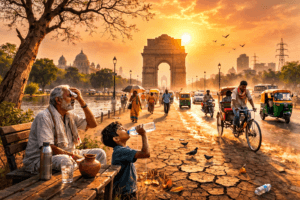
When Winter Never Came: Delhi’s Scorching February and the Erosion of India’s Seasons
The date was February 16, a day that should have been firmly entrenched in the heart of India’s brief, cherished winter. Instead, the mercury at Safdarjung, Delhi’s climate observatory, touched 31.6 degrees Celsius. It was a figure that didn’t just break the daily average; it shattered the psychological calendar of a city of 20 million people. For the first time in five years, the capital had breached the 30-degree mark in February, a threshold that feels less like a meteorological data point and more like a theft—a heist of the crisp, cool days that define the city’s identity.
As Delhi limps towards the end of February 2026, the headline is inescapable: this has been one of the warmest Februaries in recent memory. But to frame this simply as a weather event is to miss the point entirely. This is not a freak occurrence; it is a vivid, unsettling preview of India’s deepening climate shift. It’s a story told not just in degrees Celsius, but in the confused blooming of trees, the altered rhythms of street vendors, the strain on power grids, and the quiet, creeping anxiety of a population realizing that the seasons of their childhood are being erased.
The Anatomy of an Anomaly
To understand why this February feels like a betrayal, one must first understand what February is supposed to be. For North India, it is the season of Sufed Koheli—the white mist. It’s a time for late morning cups of adrak wali chai under a weak but welcome sun, for afternoon picnics in Lodhi Garden where a light jacket is still necessary in the shade, and for evenings that carry the last lingering whispers of winter. It is a transitional month, a gentle bridge between the harsh cold of January and the aggressive blast of summer that awaits in April.
The data from February 2026 paints a picture of a bridge that has collapsed. The month began abnormally warm, with a mean temperature of 18.35°C on February 1—already three notches above the long-period average. While a brief dip on February 2 offered a fleeting taste of normalcy, the trajectory was inexorable. The spike on February 16 was the headline-grabber, but the real story lies in the persistence. Day after day, maximum temperatures have hovered between 28°C and 31°C, consistently 5 to 7 degrees above what the city’s infrastructure, its ecology, and its people are conditioned to expect.
Meteorologists have a clinical explanation for the phenomenon. Dr. Krishna Mishra, a scientist at the India Meteorological Department (IMD), points to the absence of active Western Disturbances. These extra-tropical weather systems, which originate in the Mediterranean Sea, are the primary rain-bringers for North India during the winter months. They act as nature’s thermostat, blanketing the region with clouds and precipitation that drag temperatures down. This February, they have been conspicuously absent or pathetically weak. “Any slight dip was temporary,” Dr. Mishra notes, “as the mercury was likely to rise again.”
Mahesh Palawat of Skymet Weather adds another layer to the diagnosis, telling Hindustan Times that the recipe for this heatwave-in-winter is a potent combination of “clear skies, bright sunshine and no moisture to induce cloudiness.” Without the reflective shield of clouds and without the evaporative cooling that moisture provides, the sun’s radiation pounds the earth relentlessly. The city has become a solar furnace.
The City Under a Fever
But statistics are sterile. The real impact of this climate shift is written on the faces of Delhi’s residents and in the altered life of the city.
Walk through the narrow lanes of Chandni Chowk in the afternoon, and you’ll see the paratha vendors wiping sweat from their brows, a gesture usually reserved for June. The cycle rickshaw pullers, their lungs already battling the city’s notorious pollution, now struggle against an unseasonal sun. “The heat is hitting us earlier this year,” says Ram Singh, a 55-year-old rickshaw puller who has worked in Old Delhi for three decades. “In February, we usually get some relief after the morning rush. Now, by 11 a.m., it feels like Chaitra (late March). We have to stop and drink more water. It cuts into our earnings.”
In the affluent colonies of South Delhi, the hum of air conditioners has started earlier than anyone can remember. “We usually service the ACs in March, getting them ready for April,” says a maintenance technician from GK-II, juggling five service calls in a single day. “This year, people started calling in mid-February. They can’t sleep.” This isn’t just about comfort; it’s an economic strain and a surge in energy demand that puts pressure on a grid still recovering from winter lulls.
The natural world, bound by rhythms far older than human calendars, is in a state of profound confusion. In parks and gardens, the Harsingar (night jasmine), which should have finished its bloom months ago, is holding on stubbornly. The Semal (silk cotton tree), which typically erupts in fiery red flowers in late March to signal the arrival of summer, is already showing buds. Migratory birds, sensitive to the subtlest shifts in temperature and wind patterns, seem to be thinning out earlier than usual, hastening their retreat to the north.
“It’s disrupting the entire phenological cycle,” explains a botanist at the University of Delhi, speaking on condition of anonymity. “Plants and animals use temperature as a signal. When that signal goes haywire—when winter warmth mimics spring—they get confused. This can lead to mismatches, where flowers bloom before pollinators are active, or fruiting happens too early, impacting the food chain.” The city’s carefully curated green cover, its lungs, is under a new form of silent stress.
The Psychological Unsettling
Perhaps the most profound, yet least measurable, impact is psychological. For generations, the rhythm of Indian life has been dictated by the seasons. They are embedded in our literature, our festivals, our clothing, and our cuisine. We celebrate the harvest with Lohri and Pongal in the heart of winter. We crave rich, oily foods and gajak when the air is dry and cold. February’s pleasantness has always been a reward for enduring January’s chill.
To have that stolen is to feel a profound sense of dislocation. It’s a quiet form of grief for a world that is slipping away. Conversations in Delhi’s living rooms and offices have shifted. “It used to be that we’d look forward to the winter line of sun in our balcony,” says Asha Mathur, a retired schoolteacher in Rohini. “Now we are shutting the blinds to keep the heat out. In February. It feels wrong. It feels like the city is running a fever.”
This “fever” is a symptom of a much larger systemic illness: anthropogenic climate change. While a single warm month cannot be directly attributed to global warming, the pattern fits with terrifying precision. The Intergovernmental Panel on Climate Change (IPCC) has long projected that the Indian subcontinent will experience more frequent and intense heatwaves, a reduction in cold weather extremes, and an overall rise in mean temperatures. Delhi in February 2026 is not an outlier; it is a data point on a terrifying curve.
The record books tell a cautionary tale. Delhi’s all-time February high is 34.1°C, set on February 26, 2006. More recent years have seen temperatures flirt with the upper 30s, like the 33.6°C recorded on February 21, 2023. Each passing year seems to chip away at the old norms, redefining what is “abnormal.” The question is no longer if February will feel like March, but how soon the next record will fall.
A Glimpse of the New Normal
As the last days of February 2026 unfold, the people of Delhi are left with a sobering realization. This is not a one-off anomaly. It is a window into their future. The weak Western Disturbance that offered a brief, mocking sprinkle of relief around February 18 was a reminder of what has been lost—a fleeting ghost of winters past.
The implications are vast. For the millions of urban poor living in cramped, poorly ventilated dwellings, it means a longer, more punishing stretch of heat stress. For farmers in the surrounding states of Haryana and Punjab, it means potential damage to standing rabi (winter) crops like wheat, which require a period of cool weather for optimal grain filling. For the city’s administration, it means an extended season of water scarcity and pressure on power supply.
The headlines from NDTV and other outlets are more than just news reports; they are dispatches from a frontline. The story of Delhi’s hot February is the story of a nation’s climate shifting in real-time. It’s a story that began with scientific warnings and is now being written in the sweat on a rickshaw puller’s brow, in the bewildered blooms of a city garden, and in the hum of air conditioners in a month that should belong to blankets and soft sunlight.
As the mercury threatens to climb again, one thing is chillingly clear: the old calendars are obsolete. The seasons we once knew are being rapidly redrawn, and Delhi is getting its first, harsh lesson in what the new normal truly feels like. The winter of ’26 will be remembered not for its chill, but for its ghost-like absence—a poignant, unsettling marker on India’s journey into a hotter, more uncertain future.
You must be logged in to post a comment.