
When Winter Forgot to Show Up: Inside Himachal Pradesh’s Alarming March Heatwave
In March 2026, Himachal Pradesh is experiencing a severe and unprecedented heatwave, with the town of Una recording a summer-like 31°C and higher-altitude areas like Kalpa seeing temperatures soar more than 8 degrees above normal, signaling a dangerous climatic dislocation. This abnormal warmth, caused by the absence of active Western Disturbances, has shattered seasonal rhythms, threatening the region’s crucial apple orchards by causing premature bud bursts and raising the risk of forest fires. While a weak Western Disturbance may bring minor relief to high hills, the event serves as a stark reminder of accelerated climate change in the Himalayas, where traditional seasonal patterns are breaking down and posing a profound threat to agriculture, water security, and local livelihoods.
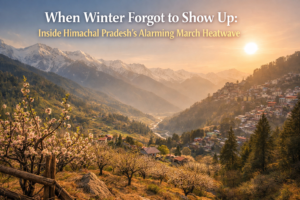
When Winter Forgot to Show Up: Inside Himachal Pradesh’s Alarming March Heatwave
The first few days of March in the northern Indian state of Himachal Pradesh are usually a time of transition. The biting cold of winter begins to loosen its grip, the snow starts its slow melt in the higher reaches, and the famous hillsides begin to blush with the first colors of spring. But in 2026, the script has been flipped. The mountains are not slowly waking up; they are in the grip of an oppressive, unseasonal heat that has left meteorologists, farmers, and locals searching for answers.
On Monday, March 2, the town of Una in the low-lying foothills became the epicenter of this thermal anomaly, sizzling at a summer-like 31°C. This wasn’t an isolated incident. The India Meteorological Department (IMD) has flagged that maximum temperatures across the state are running “appreciably above normal,” turning what should be a pleasant pre-spring period into a worrying preview of an increasingly hot future.
The Heat is On: A Breakdown of the Anomaly
While 31°C might seem modest compared to the blistering 45°C summers of the plains, context is everything. In early March, the average maximum temperature for Una hovers around a comfortable 24-25°C. Touching 31°C means the town is experiencing weather more typical of late April or early May. This isn’t just a warm day; it’s a climatic dislocation.
The numbers paint a stark picture across the state’s diverse topography. Following Una, Neri recorded a high of 28.7°C, and Mandi, nestled in the mid-hills, reached 28.1°C. But the most telling figures come from the higher altitudes, where the deviation from the norm is most dramatic. Kalpa, a picturesque town in the Kinnaur district that overlooks the snow-capped peaks, recorded a staggering 8.5 degrees Celsius above its normal maximum temperature. Imagine the surprise of residents there, accustomed to a crisp March day around 10-12°C, stepping out into conditions more akin to a pleasant spring afternoon in the plains, with the mercury hitting nearly 20°C.
Similarly, the popular tourist town of Kangra was 6.1 degrees above normal, and the gateway town of Bhuntar saw a 5.4-degree jump. Even the state capital, Shimla, the queen of hills, felt the heat, with the day temperature hitting 19°C—a full 3.8 degrees above what it should be for this time of year. The roof of the state, Keylong in Lahaul-Spiti, is not immune either, with temperatures soaring 5.2 degrees above normal. The data is unequivocal: from the Shivalik foothills to the Trans-Himalayan plateaus, Himachal Pradesh is sweating through an unprecedented spell of warm weather.
Beyond the Mercury: The Human Toll of a Precocious Spring
For the casual visitor, these sunny days might seem like a blessing. Tourists in Dharamshala, enjoying a balmy 24.1°C, might be delighted to shed their heavy jackets. But beneath the pleasant surface, a wave of anxiety is building among those whose lives are intertwined with the land and its seasonal rhythms.
The most immediate and visceral concern is for the region’s famous orchards. Himachal Pradesh is the fruit bowl of North India, renowned for its apples, plums, and pears. The fruit industry, which supports hundreds of thousands of families, is finely calibrated to the rhythm of the seasons. Fruit trees require a specific period of “chilling hours”—a cumulative number of hours below a certain temperature during winter—to break dormancy and produce a healthy, bountiful bloom.
“The trees are confused,” says Ramesh Chauhan, an apple grower from the Kotgarhi region, speaking over the phone with a tremor of concern in his voice. “The winter wasn’t cold enough, and now this sudden heat is forcing the buds to break too early and unevenly. If we get even a slight frost now, or if the pollinators like bees aren’t active because of the erratic weather, the yield could be decimated. This isn’t just about one bad season; it’s about the long-term health of our orchards.”
His fear is echoed by agricultural experts. An unusually warm spell can lead to premature flowering (a phenomenon known as ‘bud burst’), leaving the nascent fruit vulnerable to damage from any subsequent cold snaps. It also disrupts the lifecycle of pollinators and can exacerbate water stress, as the提早 melt of snow reduces the slow, steady release of water that feeds streams and irrigation systems throughout the spring and summer.
The dry weather also raises the specter of forest fires. The layer of pine needles that carpets the forest floors across the state becomes tinder-dry under a hot March sun, weeks before the traditional fire season begins. The risk of a major blaze, like the ones that have choked the region in recent years, is exponentially higher.
The Science of the Sweat: Western Disturbances and a Warming World
What is causing this prolonged heat spell? The immediate culprit, according to the IMD, is the absence of active Western Disturbances. These are extra-tropical storms that originate in the Mediterranean Sea and travel eastwards, bringing crucial winter and pre-monsoon moisture to the Indian subcontinent. They are the primary weather-makers for North-West India, responsible for the snow that replenishes Himalayan glaciers and the rain that waters the Rabi (winter) crops.
This year, the rhythm of these disturbances has been out of sync. The IMD report notes that while a fresh Western Disturbance is likely to affect the region from March 4, followed by another on March 6, they are currently expected to bring only “light rain or snowfall… at isolated places over high hills.” They appear insufficient to break the spell of dry, warm, and stable air that has settled over the region. The prolonged dry spell allows the sun to heat the land surface unimpeded day after day, with no cloud cover to reflect radiation and no moisture to moderate the temperature.
This phenomenon, however, cannot be viewed in isolation. It is a stark manifestation of a larger, more ominous trend: climate change. The Himalayan region is warming at a rate significantly higher than the global average. Studies have repeatedly shown that the Hindu Kush Himalayan (HKH) region, of which Himachal Pradesh is a part, is a climate change hotspot. The Intergovernmental Panel on Climate Change (IPCC) has warned that even a 1.5°C global warming average will lead to a 0.3°C warmer and 5% wetter HKH region, with cascading consequences for water security, biodiversity, and livelihoods.
What we are witnessing in Himachal Pradesh in March 2026 is a case study in this new reality. The baseline “normal” is shifting. An event that would have been considered a rare, once-in-a-century heatwave is becoming more frequent and intense. The 8.5-degree anomaly in Kalpa is not just a weather statistic; it’s a data point in the accelerating graph of Himalayan climate change, where the very concept of a stable “season” is becoming obsolete.
A Glimmer of Relief and a Look Ahead
The IMD’s forecast offers a sliver of hope. They predict that minimum and maximum temperatures are expected to rise gradually by another 2-3°C over the next 4-5 days, pushing the heat further, before a possible shift. The Western Disturbances forecast for March 4 and 6 could provide some much-needed respite for the high hills in the form of light snow, but the mid and lower hills are likely to remain dry until at least March 8.
This means that for towns like Una, Mandi, and even Dharamshala, the warm, summer-like conditions will persist. The reprieve, if it comes, will be temporary and localized. The larger question that looms is what happens next. If the summer monsoon is weak or delayed, the early snowmelt caused by this March heat could lead to acute water shortages later in the year. The rivers, fed by a一次性 melt, might run high and fast early on, only to dwindle to a trickle when they are needed most during the peak summer months.
For the people of Himachal Pradesh, this is a moment of reckoning. It is a reminder that the mountains they call home are on the front lines of a global crisis. The 31°C in Una is more than just a headline; it’s a harbinger. It’s a signal that the traditional knowledge of when to sow, when to harvest, and how to prepare for the seasons is being challenged by a new, unpredictable climate reality.
As the sun beats down on the brown hillsides and the snowline retreats higher up the mountains, a quiet, unsettling question hangs in the crisp, thin air: if this is March, what will May bring? The answer, for now, is blowing in an increasingly warm and erratic wind.
You must be logged in to post a comment.