
When Will We Stop Calling It Unprecedented? A Deep Dive into India’s Relentless Heatwave Crisis
A severe heatwave has gripped central and peninsular India in late March 2026, with Rajnandgaon in Chhattisgarh touching 40.5°C—matching highs in Maharashtra—while Telangana and Andhra Pradesh near 40°C under an “extremely dangerous” UV index of 10, and Kerala recording temperatures three degrees above normal. The intense early-season heat mirrors a record-breaking March heatwave in the southwestern US, which a rapid attribution analysis found was made four times more likely and significantly hotter by climate change. Simultaneously, a new ICIMOD report reveals that glacier melt across the Hindu Kush Himalayas has doubled since 2000, fueling deadly glacial floods, while a separate study links rising ocean temperatures to 50–64% of the intensification of land heatwaves globally. Compounding these warnings, research projects that under 2°C of warming, the number of countries facing critical food insecurity could nearly triple, with low-income nations deteriorating seven times faster than wealthy ones—underscoring the urgent need for climate-resilient systems and adaptation measures.
When Will We Stop Calling It Unprecedented? A Deep Dive into India’s Relentless Heatwave Crisis
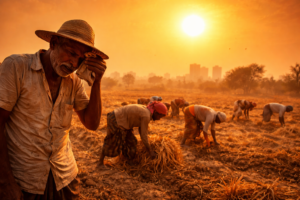
The mercury touched 40.5 degrees Celsius in Rajnandgaon, Chhattisgarh, on March 30, 2026. It was, by all accounts, just another March day in central India. Except it wasn’t. For the thousands of farmers working under the unrelenting sun in the Wainganga basin, for the daily wage labourers in Raipur’s sprawling construction sites, and for the elderly navigating the narrow, heat-trapped lanes of Jagdalpur — this was the day their bodies began to send them signals that something fundamental has shifted in the rhythm of seasons they had known their entire lives.
What makes this moment significant is not merely the number on a thermometer. It is the timing. March in India has historically been a transitional month — the last whisper of spring before summer’s furnace doors swing open in April and May. But the heatwave gripping central and peninsular India today is rewriting that calendar. When Rajnandgaon touches 40.5°C in March — a temperature that would have been remarkable even in peak summer two decades ago — it is not just a weather event. It is a boundary being crossed.
The Geography of Scorched Earth
The heat is not confined to a single state or region. From the red-soil plateaus of Chhattisgarh to the coastal plains of Andhra Pradesh, from Telangana’s parched northern districts to Kerala’s humid backwaters, the pattern is consistent: temperatures are soaring 3 to 5 degrees above what was once considered normal for this time of year.
In Chhattisgarh, Rajnandgaon’s 40.5°C matches temperatures recorded in Washim, Maharashtra — a region far more accustomed to early heat. The Dainik Jagran report that broke this story noted that the district had become an unlikely epicentre of a heat event that meteorologists are struggling to classify as merely “early summer” anymore.
Further south, Hyderabad’s 38°C might sound modest in comparison, but the real story lies in the UV index that has touched 10. Classified as “extremely dangerous,” this reading means that a person exposed to direct sunlight for just 15 to 20 minutes risks second-degree burns. The Hans report highlighting this figure underscores a grim reality: the invisible threat of ultraviolet radiation is now as pressing as the visible one of heatstroke.
Telangana’s northern districts — Adilabad, Nizamabad, and Karimnagar — are bracing for even worse. These are agricultural belts where farmers still toil outdoors by necessity, not choice. When temperatures exceed 40°C in these areas, the calculus of survival changes. Work shifts shorten. Productivity plummets. And for those without access to air conditioning — which is the vast majority — sleep becomes elusive, compounding physical exhaustion with mental strain.
Andhra Pradesh tells a similar story. Vijayawada, a city that sits on the banks of the Krishna River and has historically enjoyed some moderation from its riverine location, is projected to touch 38°C. But it is Rayalaseema — the drought-prone region that has always lived on the edge of water scarcity — where the severity is expected to bite hardest. When a region already defined by aridity experiences temperatures significantly above normal, the compounding effects on groundwater, agriculture, and human health become exponentially worse.
Even Kerala — the state that prides itself on being “God’s Own Country” with its perennial greenery and moderate climate — is not immune. Punalur recorded 38.4°C, Kottayam touched 37.8°C. These are not just numbers; they represent a staggering three-degree departure from the usual values for this time of year, as reported by The Hindu. When a tropical state known for its high humidity — which makes heat far more dangerous because sweat doesn’t evaporate efficiently — experiences such anomalies, the wet-bulb temperature readings approach thresholds that physiologists consider near the limits of human survivability.
The Ocean Connection: Why Warming Seas Are Fueling Land Fires
It would be tempting to view these heatwaves as isolated atmospheric events — unfortunate but temporary quirks in the weather system. But a recent study published by researchers from multiple agencies, reported by Down To Earth, reveals a far more unsettling truth: the heat baking India’s landmass is being fueled, in large part, by the warming of the oceans that surround it.
Between 50 and 64 percent of the intensification of land heatwaves globally can be attributed to rising sea surface temperatures, according to the study. The mechanism is not mysterious. Warmer oceans transfer more heat and moisture into the atmosphere. This altered atmospheric circulation then transports that heat over land, creating the conditions for prolonged, intense heatwaves that persist far longer than they would in a cooler climate system.
For India, this is particularly significant. The Indian Ocean has been warming faster than the global average for decades. The study’s finding that rising temperatures in the Indian Ocean trigger widespread heatwaves across South Asia and West Asia is not a prediction — it is a documented pattern. The ocean is no longer a buffer, absorbing heat and moderating land temperatures. It has become an amplifier.
The researchers made a compelling case that coastal oceanic warming can serve as an early warning indicator for extreme heat events. This is potentially life-saving information, but only if it translates into action. If the Indian Ocean’s surface temperature spikes, the study suggests, governments and communities have a window — albeit a narrow one — to prepare for what is coming.
The Himalayan Crisis: When the Roof of the World Melts
While central and peninsular India swelter, another crisis is unfolding in the north, one that feels distant but is intimately connected to the same forces driving the heatwaves. The Hindu Kush Himalayas — a vast arc of ice and rock stretching 3,500 kilometres across eight countries — are melting at a rate that has doubled since the year 2000.
The International Centre for Integrated Mountain Development’s (ICIMOD) report, which mapped 63,761 glaciers in the region, is the most comprehensive assessment to date of what is happening to the so-called “Third Pole.” The numbers are stark: 78 percent of this glacier area, situated between 4,500 and 6,000 metres above sea level, is highly exposed to elevation-dependent warming — a phenomenon where higher altitudes warm faster than lower ones.
This matters for every reader in India, not just those living in the mountains. These glaciers feed at least ten major Asian river systems — the Ganga, the Brahmaputra, the Indus, the Mekong, the Yangtze — supporting the food, water, energy, and livelihood security of billions of people. When the glaciers retreat at an accelerating rate, the immediate consequence is increased flooding from glacial lake outbursts. The long-term consequence — reduced water availability in the dry season — is even more devastating.
The ICIMOD report’s findings come against a backdrop of visible disasters. The 2021 Chamoli disaster, where a dislodged glacieret triggered a devastating flood that likely killed over 200 people. The October 2023 South Lhonak lake outburst in Sikkim, which killed over 50. The Dharali disaster in Uttarakhand just last year, when Kheer Ganga — fed by a glaciated zone — swept away an entire market. These are not isolated tragedies; they are warning shots.
The Food Insecurity Horizon
The heatwaves, the ocean warming, the glacier melt — these are not just environmental phenomena. They are harbingers of a food system under siege. A new analysis by the International Institute for Environment and Development (IIED) projects that if global temperatures increase by 2°C, the number of countries facing critical food insecurity could almost triple to 24.
For India, a country that has spent decades striving for food self-sufficiency, the implications are profound. The analysis shows that food systems in low-income countries deteriorate seven times as fast as those in wealthy nations under warming scenarios. This is not because of any inherent weakness in these food systems, but because they are more exposed to climate shocks and have fewer resources to buffer against them.
The researchers point to a path forward: strengthening social protection systems that can respond quickly to climate shocks, investing in climate-resilient agriculture, and improving water and soil management. These are not abstract recommendations; they are the difference between a community that survives a heatwave and one that is devastated by it.
The Uncomfortable Question
The World Weather Attribution analysis released last week offered a stark quantification of what many have suspected: the climate crisis, driven primarily by the burning of fossil fuels, has made extreme heatwaves four times more likely to occur over the last decade. Even as recently as 2016, the current heatwave would have been milder — about 0.8°C cooler.
“This is completely off the scale for March,” said Ben Clarke, one of the analysis’s co-authors. Friederike Otto, another co-author, put it even more bluntly: “These findings leave no room for doubt. Climate change is pushing weather into extremes that would have been unthinkable in a preindustrial world.”
Unthinkable. That word captures something important. When Rajnandgaon hits 40.5°C in March, when Phoenix breaks its March heat record by 5°C, when the Hindu Kush glaciers double their melt rate — these are not merely records being broken. They are the boundaries of human experience being redrawn.
And yet, the news cycle moves on. The editorial team that compiled this information will produce another roundup tomorrow, and another the day after. The heat will continue to build, the glaciers will continue to melt, the oceans will continue to warm. The question is not whether these trends will continue — the science is settled that they will. The question is whether the cumulative weight of these “unprecedented” events will finally translate into the scale of action that the moment demands.
Because at some point — and that point may already be here — we have to stop calling it unprecedented. We have to stop treating each heatwave, each melting glacier, each food insecurity projection as a separate story. They are not separate. They are all chapters of the same story: a story of a planet in transition, and of a species that has not yet fully grasped that the world it built its assumptions on no longer exists.
For the farmer in Adilabad, for the construction worker in Vijayawada, for the elderly woman navigating the streets of Kottayam, that transition is not an abstraction. It is the air they breathe, the sweat on their skin, the nights they cannot sleep. And it is only getting hotter.
You must be logged in to post a comment.