
When the World Came Calling, Delhi Turned on the Charm: A City’s Unusual February Warmth Welcomes the AI Summit
On a pivotal day for the India AI Impact Summit 2026, Delhi played the role of an unexpectedly gracious host, offering visiting dignitaries like France’s Emmanuel Macron and tech leaders such as Sam Altman a reprieve from its typical winter with unseasonably warm temperatures peaking at 28°C and a surprisingly “satisfactory” Air Quality Index of 164, thanks to a brief Wednesday shower that cleared the skies and temporarily eased the city’s chronic pollution. This pleasant meteorological interlude provided an optimistic backdrop for the summit’s high-stakes discussions on artificial intelligence and global partnerships, even as the human realities of Indian politics and diplomacy played out in parallel—from Rahul Gandhi’s court appearance in a long-running defamation case to the announcement of an impending US-India trade deal—collectively reminding observers that the city’s borrowed time of clear air and warm breezes was a fleeting gift, not a permanent transformation.
When the World Came Calling, Delhi Turned on the Charm: A City’s Unusual February Warmth Welcomes the AI Summit
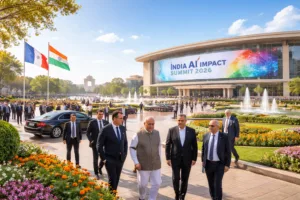
As the world’s most powerful tech moguls and political leaders descended upon New Delhi for the prestigious India AI Impact Summit 2026, they were met with a uniquely Delhi welcome: a blast of unseasonable warmth and a sky so clear it seemed scrubbed clean for the occasion. It was a day where geopolitics, cutting-edge technology, and the simple, visceral experience of a city’s weather converged at Bharat Mandapam.
For the dignitaries stepping out of their climate-controlled cars, the air on Thursday carried a whisper of early summer. The India Meteorological Department (IMD) had predicted it would be this way. While much of northern India still shivers through the tail-end of winter, the capital was playing by its own rules, recording maximum temperatures hovering between a balmy 26°C to 28°C—a full 1.6°C to 3.0°C above what the history books say is normal for a February day.
This wasn’t just a minor statistical anomaly. For Delhiiites, it was a conversation starter, a shared experience that framed the global spectacle happening in their backyard. It felt as if the city itself had dressed up, swapping its usual winter coat for a lighter, more festive spring jacket, eager to impress the likes of French President Emmanuel Macron, OpenAI’s Sam Altman, and a host of other global luminaries.
A Brief Respite from the Unrelenting Climb
The mercury reading on Thursday, however, told a more complex story than just “a warm winter day.” Just 24 hours prior, a sliver of relief had arrived in the form of a brief, almost theatrical, spell of rain. The city recorded a mere 0.3 mm of precipitation, but its effect was immediate and profound.
That short shower was the protagonist in a dramatic weather narrative. Just days earlier, on Monday, Delhi had breached the 30-degree Celsius mark—the earliest the city had reached that temperature in February in half a decade. The capital was on a fast track to summer, a worrying trend that climate scientists have been flagging for years. The 0.3 mm of rain acted as a natural circuit breaker, pulling the temperature back from the brink and offering a fleeting glimpse of the pleasant weather the season is supposed to offer.
This brief cooldown provided the perfect backdrop for the summit’s proceedings. It was warm enough to be pleasant for outdoor gatherings and the much-anticipated “family photo” of world leaders, but not so scorching as to be uncomfortable. It was, in essence, a Goldilocks forecast—a temporary gift from the heavens before the inevitable, relentless climb towards the harsh Delhi summer.
The Air We Breathe: A ‘Satisfactory’ Statement
But the city’s efforts to play the perfect host weren’t limited to the thermometer. For years, Delhi has been synonymous with a different kind of international headline—one about its toxic air. As the world’s media turned its lenses on Bharat Mandapam, the city offered up another surprise: air that was, for once, genuinely breathable.
The Central Pollution Control Board (CPCB) recorded the Air Quality Index (AQI) at a “satisfactory” 164. By Delhi’s standards, this was nothing short of a triumph. It was a number so good that it prompted the Commission for Air Quality Management (CAQM) to immediately revoke the Stage-II restrictions of the Graded Response Action Plan (GRAP), which had been in place since October of the previous year.
The symbolism was potent. Here was Delhi, a city often portrayed as an environmental cautionary tale, presenting a cleansed, clear-skied visage to the world. The improved air quality was attributed to the same favourable meteorological conditions—the light rain and moderate wind speeds—that moderated the temperature. It was a powerful, if temporary, rebranding.
For the visiting dignitaries, the “satisfactory” AQI meant they could move between venues, engage in informal side conversations outdoors, and perhaps even take a deep breath without a second thought. For the people of Delhi, it was a bittersweet validation: a reminder that their city could be different, that the right conditions could momentarily lift the veil that chokes them for much of the year.
Day 4: More Than Just a Summit
Inside the sprawling, modern complex of Bharat Mandapam, the India AI Impact Summit 2026 was entering its fourth and most star-studded day. The agenda was packed, but the human drama unfolding on the sidelines was just as compelling.
Prime Minister Narendra Modi, playing the role of gracious host, was set to welcome the leaders. The day’s choreography—the “family photo,” the bilateral meetings, the keynote addresses—was designed to project an image of India as a confident, connected global power at the heart of the artificial intelligence revolution.
The speaker lineup was a testament to that ambition. Sam Altman, the face of OpenAI, was scheduled to share his vision, standing just a few podiums away from Reliance’s Mukesh Ambani, a titan of Indian industry whose foray into tech is reshaping the nation’s digital landscape. The juxtaposition was electric—the swashbuckling Silicon Valley innovator and the empire-building Indian industrialist, both speaking to the same transformative force.
Yet, the most talked-about absence was perhaps the most telling. Microsoft co-founder and billionaire philanthropist Bill Gates pulled out of his keynote address just hours before he was scheduled to speak. His foundation cited a desire “to ensure the focus remains on the AI Summit’s key priorities.” The official explanation was a diplomatic sleight of hand, but it sparked a flurry of speculation.
Was it truly about the summit’s focus, or was it a symptom of the delicate geopolitical tightrope walked at such international gatherings? The Gates Foundation’s Ankur Vora stepped in to represent the organisation, but Gates’s last-minute withdrawal served as a quiet reminder that even the most carefully orchestrated events are subject to the unpredictable currents of global politics and personal priorities. It was a human moment in a sea of polished presentations.
Echoes of Politics and the Pulse of a Nation
As the AI elite debated algorithms and ethics, the city of Delhi pulsed with its own rhythms, a few of which reverberated just outside the summit’s bubble. The news cycle, ever-fluid, carried two starkly different stories that anchored the day’s events in the broader Indian reality.
In a courtroom in Sultanpur, a few hours’ drive from the capital, Leader of the Opposition Rahul Gandhi appeared before an MP-MLA court in a defamation case dating back to 2018. The charges stemmed from remarks made against Union Home Minister Amit Shah. As Gandhi recorded his statement and was asked to present his evidence by March 9th, his supporters chanted his name outside. The scene was a potent reminder of the enduring political friction that defines India’s democratic landscape—a world away from the consensus-driven, future-gazing discussions at Bharat Mandapam, yet intrinsically linked as the nation’s two opposing political forces chart their paths.
Simultaneously, in the corridors of diplomatic power, US Ambassador Sergio Gor offered a different kind of headline, one that perfectly complemented the summit’s theme of global partnership. He announced that a proposed India-US interim trade deal would be signed “very soon.” The news, coming from the envoy of the world’s largest economy, underscored the tangible outcomes that events like the AI Summit are meant to facilitate. It suggested that while the leaders talked about the ethereal nature of bits and bytes, the groundwork was being laid for deals that move atoms—goods, services, and capital.
The Human Story of a City as a Stage
Ultimately, the story of the AI Impact Summit’s Day 4 wasn’t just about what happened inside Bharat Mandapam. It was about the city that hosted it. Delhi, with its unseasonably warm breeze and unusually clear skies, became a character in the narrative.
For the delegates flying in from cooler European capitals or tech hubs like San Francisco, the warmth was a gentle shock to the system. For the local journalists and support staff, the pleasant weather was a welcome relief, making long hours on the ground bearable. The “satisfactory” air meant that the city’s infamous smog wasn’t the lead story, allowing the substantive conversations on AI to take centre stage.
The summit was a showcase of human ingenuity, a deep dive into the future of intelligence itself. But it was the raw, unfiltered elements of the present—the temperature, the air quality, the political dramas, and the diplomatic manoeuvring—that provided the context. It was a reminder that no matter how advanced our technology becomes, it is always, and will always be, shaped by the human and environmental conditions of the place where it is discussed.
As the sun set on another unusually warm February evening in Delhi, the city had done its job. It had provided a stage worthy of the global gathering. The lingering question, however, remained for its residents: how long would this borrowed time of good air and bearable warmth last? For a few days, Delhi was the perfect host. But the real work of making it a livable home, long after the dignitaries have flown home, is a challenge that no summit, no matter how prestigious, can solve overnight.
You must be logged in to post a comment.