
When the Polling Booth Becomes a Furnace: India’s Extreme Heat Is Melting the Foundations of Democracy
India’s forecast of a severe summer with prolonged heatwaves poses a profound threat not only to public health and infrastructure but to the very fabric of its democracy, as extreme heat increasingly suppresses voter turnout and disproportionately disenfranchises the most vulnerable populations. Drawing on the 2024 general election—where temperatures exceeding 45°C contributed to a significant drop in participation despite mitigative efforts—the article argues that this constitutes a form of “inequitable climate disenfranchisement,” where the poor, elderly, and those in informal settlements are systematically priced out of voting by survival needs. This crisis is compounded by a cruel climatic irony: while air pollution has historically masked some warming, cleaning it up could accelerate temperature rises, further intensifying the threat. To protect democratic integrity, the piece calls for a structural overhaul of electoral logistics, including rescheduling polls to cooler months, building climate-resilient polling stations, and expanding accessible voting options, lest the missing voices of the heat-vulnerable delegitimize the very concept of representative governance.
When the Polling Booth Becomes a Furnace: India’s Extreme Heat Is Melting the Foundations of Democracy
The Indian Meteorological Department’s (IMD) summer forecast arrives with the clinical predictability of a spreadsheet: “above-normal maximum temperatures,” “above-normal heatwave days,” and a seasonal outlook that stretches from March to May. But behind this sterile, statistical language lies a brutal reality that is beginning to reshape the very fabric of Indian society. The forecast isn’t just a warning about crop yields or electricity grids; it is a profound and urgent warning about the health of Indian democracy itself.
As several Indian states prepare for crucial Assembly elections in the coming months, they do so under the shadow of a forecast predicting heatwaves that could last 10 to 14 days longer than the historical average. While we are conditioned to think of climate change as an environmental or economic issue, its most insidious threat may be its capacity to erode the intangible pillars of civic life: participation, representation, and equality.
To understand this, we must look beyond the thermometer and into the heart of the electoral process, where the right to vote is colliding with the right to survive the afternoon sun.
The Great Equalizer That Isn’t: Revisiting the 2024 General Election
Just a year ago, India conducted the largest democratic exercise in human history amidst a cauldron of heat. During the sixth phase of the 2024 general election on May 25, temperatures in large parts of northern and central India breached a staggering 45 degrees Celsius.
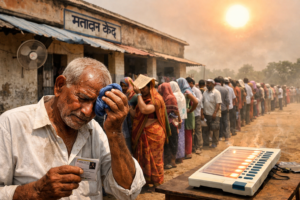
The images from that day are seared into the national memory, but they deserve to be revisited not just as news clips, but as a harbinger of the new normal. They showed polling officials in light cotton shirts, their faces glistening with sweat, fanning themselves with election manuals inside stuffy schoolrooms. They showed elderly voters, draped in cloth to shield themselves, making the slow, arduous trek to polling booths. Candidates and campaign managers, stripped of the energy for raucous rallies, fainted from dehydration.
The tangible impact was immediate and measurable. The Election Commission of India recorded a voter turnout of approximately 66.1% in 2024, a significant drop from the 69.2% seen in the more temperate weather of the 2019 elections. This 1.6% dip represents millions of citizens—millions of voices—silenced not by apathy, but by atmospheric pressure.
This was not a random act of weather; it was a forecasted inevitability. The IMD had already predicted double the number of heatwave days for that summer. Political parties scrambled to adapt, holding rallies in the cool of the dawn or the hush of late evening. The Election Commission mandated shade, water, and fans at polling stations. Yet, despite these mitigative efforts, the heat still won. It didn’t just discourage voting; it actively prevented it.
The Inequity of Sweat: Who Gets Left Behind?
The critical insight from the 2024 election, and the threat it poses for upcoming state polls, is that extreme heat is not a neutral force. It is a discriminatory filter.
In a country with stark economic disparity, the ability to cope with 45-degree heat is a luxury good. Those with access to air-conditioned cars, cool waiting rooms, and flexible schedules can navigate the electoral process with relative ease. But for the vast majority—the daily wage labourer, the street vendor, the farmworker, the resident of a crowded urban informal settlement—stepping out to vote means risking heatstroke, dehydration, and a loss of critical income.
Consider the journey of a voter. It often involves walking or waiting for public transport, standing in a queue that could stretch for an hour in an open courtyard, and then walking back. In extreme heat, this simple act of citizenship becomes a physiological ordeal. The most vulnerable—the elderly, those with chronic illnesses like hypertension or diabetes, and pregnant women—are effectively told that their participation is not worth the risk to their lives.
This phenomenon, which climate scientist Chirag Dhara aptly terms “inequitable climate disenfranchisement,” creates a dangerous feedback loop. The heat suppresses the vote of the very communities who are most reliant on government services and welfare schemes—schemes that provide drinking water, healthcare, and subsidised food. These are the communities that need political representation the most to advocate for their survival. By silencing them, extreme heat skews the electorate toward the more privileged, whose policy priorities may differ vastly from those baking in the sun.
The Cruel Irony of Clean Air
The long-term prognosis, based on peer-reviewed climate assessments, suggests that this problem will not merely persist—it will accelerate. Dhara’s recent study in PLOS Climate highlights that the hottest days in India are now 1.5 to 2 degrees Celsius warmer than they were in the 1950s. Looking ahead, another 1.2 to 1.3 degrees Celsius of warming is projected in just the next two to three decades.
But the study presents a particularly cruel irony for India. A significant reason the country hasn’t warmed even faster is the high burden of atmospheric aerosols—essentially, air pollution. These particles reflect sunlight back into space, creating a “cooling mask” that has hidden about 25% of the warming that would have resulted from greenhouse gases alone.
This places India in an impossible dilemma. Cleaning up the air is a fundamental public health necessity. It is non-negotiable for the well-being of India’s children and the longevity of its citizens. Yet, as India successfully implements stricter emission controls and cleans its skies, this cooling mask will thin. The country could face a “warming acceleration,” where the benefits of cleaner air are immediately offset by a sharper, faster rise in temperatures. The very act of making the air breathable could make the summers unbearable.
The Future of Elections: A Season of Withdrawal
If the 2024 election was a case study in heat-suppressed turnout, the future demands we ask a more disturbing question: What happens when extreme heat is not an exception, but the defining feature of the entire election season?
Current projections suggest the heatwave season could expand to two months. If voting is always held in the scorching months of May and June, we risk normalising a two-tiered democracy. We risk building a system where the poor and vulnerable are systematically filtered out of the electorate, not by legal barriers, but by environmental ones.
This isn’t just about inconvenience; it’s about the legitimacy of the mandate. If a government is elected by a smaller, wealthier, and healthier slice of the population, can it truly claim to represent the will of the people? The policies it enacts will inevitably reflect the priorities of those who voted, potentially neglecting the needs of the millions who were too hot, too sick, or too poor to make it to the booth.
A Blueprint for Resilience: Reimagining Democracy in a Warming World
The recognition of this threat is the first step. The second is action. Following the 2024 election, Chief Election Commissioner Rajiv Kumar admitted a painful truth: the election should have been completed at least a month earlier. This acknowledgment from the highest authority is a starting point for a larger conversation about structural adaptation.
To protect the democratic process from the climate, India must embark on a radical reimagining of its electoral logistics. This goes far beyond providing a glass of water at a polling station.
- The Great Rescheduling:Election timing can no longer be viewed solely through the lens of political convenience or administrative schedules. It must be viewed through a climatic lens. The Election Commission needs the mandate and the data to schedule polls in the cooler months—February to March and October to November—as a standard practice. This requires constitutional foresight and political consensus, but it is the single most effective intervention.
- Infrastructural Overhaul:Polling stations must be redefined as climate-resilient facilities. This means mandating that all booths—whether in government schools, community centres, or temporary tents—have reliable electricity, functioning fans, cool drinking water, and shaded waiting areas. In the long term, it means investing in solar-powered micro-grids to ensure polling stations can run cooling systems even during peak demand hours when the main power grid might falter.
- The Right to Vote Without Risk:Innovative voting mechanisms must be explored. This could include expanding postal ballot facilities to include not just service personnel, but also the elderly and medically vulnerable during declared heatwaves. Mobile polling units that travel to dense residential clusters in urban informal settlements could reduce the travel distance for voters. Early voting periods, spread over several days, could allow people to choose the coolest time to cast their ballot.
- Strengthening the Social Safety Net:The fight for democratic participation is won or lost in the community. If voting happens during a heatwave, the response must be a whole-of-government effort. This means ensuring public water stations are functional, public transport is increased on polling day to reduce wait times, and heat action plans are activated with the same urgency as a security threat.
Conclusion: The Unwritten Ballot
As India heads into another summer of elections, the stakes are higher than the political fortunes of any single candidate or party. The stakes are the integrity of the system itself.
The forecast of an “above-normal” summer is a test. It is a test of whether India’s democracy is resilient enough to evolve in the face of an existential threat. It is a test of whether the country’s institutions can protect its most vulnerable citizens from a disenfranchisement that comes not from tyranny, but from temperature.
Measuring a nation’s progress only in GDP growth rings hollow if its citizens must choose between their health and their fundamental right to vote. The heat is not just melting tarmac and draining water reservoirs; it is melting the very glue that holds the world’s largest democracy together. The question is whether India can cool its elections before the silence of the missing voters becomes the loudest sound in the room.
You must be logged in to post a comment.