
When Green is Not Clean: How the Supreme Court Redefined Conservation in the Aravallis
The Supreme Court’s recent verdict has redefined conservation in the Aravalli region by drawing a clear distinction between natural native forests and invasive green cover, specifically targeting the colonial-era introduction of Prosopis juliflora (Vilayati Kikar). While upholding a railway redevelopment project near Bijwasan, the bench emphasized that preserving such invasive species—which actively degrade biodiversity, deplete groundwater, and suppress native flora—does not constitute true environmental protection. Instead, the ruling shifts the legal and ecological focus toward restoring indigenous ecosystems, signaling that not all “green cover” merits absolute protection and that development projects may proceed when the vegetation in question is ecologically harmful.
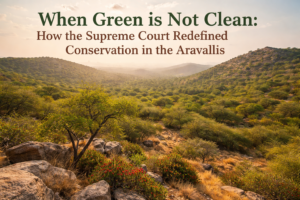
When Green is Not Clean: How the Supreme Court Redefined Conservation in the Aravallis
For decades, the visual definition of an urban forest has been simple: if it’s green and dense, it must be good. In the collective imagination of Delhi-NCR, the Aravalli hills—the ancient spine of the region—have been synonymous with a rugged, untamed wilderness. But what if the lush green canopy we see from our car windows is actually an ecological intruder? What if preserving that view is causing more harm to the environment than building a railway station?
In a landmark verdict that has sent ripples through environmental law and urban development circles, the Supreme Court of India has drawn a razor-sharp distinction between natural forests and invasive green cover. By upholding the redevelopment of railway land near Bijwasan, the apex court has not just cleared a specific infrastructure project; it has fundamentally shifted the philosophical ground on which conservation stands in India.
The verdict, delivered by a bench of Justices Dipankar Datta and Augustine George Masih, dismantles the long-held assumption that all green spaces are inherently natural or worthy of absolute protection. At the heart of this legal and ecological upheaval lies a tree with a deceptive name: Prosopis juliflora, or the Vilayati Kikar.
The Invader in Plain Sight
The story of the Vilayati Kikar is a cautionary tale of colonial quick-fix solutions. During the British era, faced with the need to rapidly create “green cover” around the burgeoning capital of Delhi, foresters introduced this hardy species from Central and South America. It was a utilitarian choice—Prosopis juliflora is virtually indestructible. It grows fast, requires little water, and thrives in arid, degraded soils where native trees struggle to take root.
For decades, this was hailed as a success. Where the landscape was barren, the Vilayati Kikar created a forest. It became the dominant species across the Aravalli ridge and the Delhi region. But as the Supreme Court noted, citing scientific observations, this success came with a dark side.
The court highlighted the biological traits that make this species a textbook example of an invasive terror: high seed production, long seed viability, and expansive canopy growth. What these scientific terms mean on the ground is ecological warfare.
The Vilayati Kikar doesn’t just grow alongside native flora; it actively eradicates it. Its dense canopy shades out native shrubs and grasses that require sunlight. Its roots release chemicals that poison the soil for other plants, a phenomenon known as allelopathy. It lowers the water table at an alarming rate, consuming far more groundwater than native species like Dhau (Anogeissus pendula) or Kair (Capparis decidua).
When the court speaks of preserving “native ecosystems,” it is referring to this intricate, balanced web of life that existed before the Vilayati Kikar arrived. A natural Aravalli forest is not a monoculture; it is a sparse, rocky scrubland with a high diversity of flora and fauna adapted to aridity. The “green desert” created by the Prosopis, while visually appealing from a distance, offers little biodiversity value. It is a monoculture that repels native birds, insects, and animals that once called the Aravallis home.
The Legal Precedent: Redefining ‘Forest’
The immediate context of the judgment was a challenge against a 2024 National Green Tribunal (NGT) order that had dismissed a plea opposing the railway land redevelopment in Bijwasan. The appellant argued that the project would damage the Aravalli ecosystem.
By dismissing the appeal and upholding the project, the Supreme Court did something far more significant than merely approving a construction project. It established a legal doctrine that “invasive green cover” cannot be equated with a “forest” in the legal sense, especially when it stands in the way of public infrastructure.
This is a crucial distinction. The term “forest” in Indian environmental jurisprudence has often carried the weight of absolute protection. Following the landmark T.N. Godavarman Thirumulpad case (1996), the definition of forest was expanded to include any area recorded as forest in government records, regardless of its nature. This led to a situation where a patch of land choked with invasive weeds or monoculture plantations could enjoy the same legal protection as a pristine, ancient forest.
The Supreme Court has now chipped away at that rigidity. The bench’s reasoning suggests that conservation policy must move beyond a simplistic “trees vs. development” binary. If the “green cover” in question is actually an ecological anomaly that is actively degrading the soil, depleting water, and suppressing native regeneration, then its removal—even for a development project—cannot be seen as an environmental crime.
In fact, the court implicitly argued that in some cases, removing these invasive species is the environmental imperative. The verdict underscores that the goal of environmental protection in a fragile ecosystem like the Aravalli should be the restoration of native ecosystems, not the preservation of colonial-era botanical mistakes.
A New Template for Urban Ecology
This judgment arrives at a critical moment for the National Capital Region. The Aravallis are not just a geological formation; they are a vital ecological lifeline. They act as the region’s lungs, its groundwater recharge zone, and its only barrier against the desertification that threatens to engulf the plains from Rajasthan.
For years, every development project near the ridge was met with a predictable legal battle: environmentalists citing the presence of “forest” on satellite maps, and developers arguing for the necessity of urban infrastructure. The court has now offered a middle path—one based on ecological science rather than romanticized notions of nature.
The ruling opens the door for a more nuanced approach to environmental impact assessments (EIAs). Going forward, developers and regulatory bodies like the NGT will need to distinguish between “natural forests” and “invaded landscapes.” A project that clears Vilayati Kikar to make way for a railway station might be viewed differently than one that cuts down a grove of native Neem or Peepal trees.
Furthermore, it places a renewed emphasis on ecological restoration. The judgment implicitly calls for a shift in afforestation policy. For decades, government agencies have focused on “tree plantation” drives, often favoring fast-growing exotic species like Prosopis or Eucalyptus to meet numerical targets. The court’s emphasis on native ecosystems suggests that future compensatory afforestation and greening efforts should prioritize planting indigenous species that support local biodiversity and are more resilient to climate change.
The Human Insight: Beyond the Binary
What makes this verdict resonate beyond the legal and ecological spheres is its refusal to indulge in the reductive binary of “environment vs. development.” It acknowledges the reality of urban living: that cities need infrastructure, that railways and roads are essential for millions of commuters, and that “conservation” cannot mean freezing an urban landscape in a state of arrested decay.
This is not a green light for mindless construction. The bench was clear that the Aravalli ecosystem remains of paramount importance. However, it demands that we ask a harder question: What are we actually trying to protect?
Are we protecting a native ecosystem that sustains leopards, jackals, native birds, and the ancient hydrology of the region? Or are we protecting a dense, thorny thicket of an invasive species that acts as a fire hazard, depletes groundwater, and offers a fraction of the ecological value of the land it conquered?
By upholding the Bijwasan project, the court has signaled that the era of using “green cover” as a blanket shield against all development is over. It demands a higher standard of ecological literacy from citizens, activists, and the judiciary alike.
The true value of this judgment lies in its nuance. It forces environmentalists to move beyond emotional appeals and ground their arguments in concrete ecological science. It forces developers to plan their projects with a sensitivity to the specific ecological character of the land they are using, rather than merely hiring consultants to rubber-stamp compliance.
As the Aravalli range continues to face pressures from urbanization, this verdict provides a vital philosophical compass. It tells us that sometimes, to truly heal the land, we must look beyond the surface of green. We must look at the roots. We must ask whether that green is a native son of the soil, or an alien invader wearing a camouflage of conservation. In doing so, the Supreme Court has not just cleared a project; it has invited us to rethink our very definition of a forest in the 21st century.
You must be logged in to post a comment.