
When Does a Protest Become Terrorism? Britain’s Historic Proscription of Palestine Action
The British government’s unprecedented designation of the protest group Palestine Action as a terrorist organization in July 2025 represents a significant expansion of state power, leading to over 2,400 arrests—including for acts like holding supportive signs—and sparking a historic 73-day prison hunger strike by detainees held without trial. This move, based on the group’s property damage and disruption at sites linked to Israeli arms manufacturing, has ignited a fierce national debate over whether such proscription constitutes a necessary security measure or a dangerous overreach that conflates civil disobedience with terrorism, effectively criminalizing a broad protest movement.
The government defends its action under the Terrorism Act 2000 as a justified response to actions endangering property and safety, while critics, including human rights organizations, argue it dangerously suppresses dissent and aligns the UK with authoritarian regimes. The outcome of a pending judicial review will set a critical precedent for the boundaries of protest, state authority, and the definition of terrorism in a modern democracy.
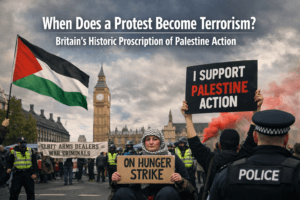
When Does a Protest Become Terrorism? Britain’s Historic Proscription of Palestine Action
The most terrifying words in a democracy may not be “I have orders,” but “I have the law on my side.” The United Kingdom’s decision to ban the protest group Palestine Action and label its supporters as terrorists has brought this tension to the forefront, sparking the country’s most significant coordinated hunger strike in over forty years.
In the early months of 2026, the debate in Britain over the limits of protest reached a fever pitch. The proscription of Palestine Action as a terrorist organization in July 2025—a first for a protest group in the UK—has led to thousands of arrests, ignited a historic prison hunger strike, and forced a national reckoning on where legitimate dissent ends and terrorism begins. At the heart of the controversy lies a fundamental question: in a democracy, can a state pre-emptively outlaw a movement it fears, rather than prosecute the crimes it commits? This analysis explores the unprecedented legal action, the human toll of the hunger strike, and the profound implications for the future of political protest.
The Unprecedented Proscription of a Protest Group
The UK government’s decision to proscribe Palestine Action under the Terrorism Act 2000 was not a typical law enforcement action. For years, the group had engaged in direct action protests, primarily targeting the UK operations of Elbit Systems, Israel’s largest weapons manufacturer. Their tactics included occupations, blockades, and property damage—such as breaking into a Royal Air Force base and spraying military aircraft with red paint in June 2025. While disruptive and unlawful, these actions had not involved violence against people.
The legal basis cited by Security Minister Dan Jarvis was that the group’s actions “satisfied the relevant tests in the Terrorism Act 2000”. This Act defines terrorism, in part, as action involving “serious damage to property” designed to influence the government for a political cause. This “property-damage threshold” had rarely been invoked before, with successive governments wary of conflating vandalism with the kind of violent political terror the law was designed to combat.
The immediate consequence of proscription is severe: membership in or showing support for the group became a criminal offence punishable by up to 14 years in prison. This has led to more than 2,400 arrests, including people simply holding signs that read “I support Palestine Action”. Swedish activist Greta Thunberg was arrested under this provision for displaying a similar placard.
Understanding “Anticipatory Repression”
Legal scholar Paul O’Connell argues that this move represents more than aggressive law enforcement; it signals a shift toward anticipatory repression. This concept describes the pre-emptive engineering of legal frameworks to prevent future political mobilization before it can meaningfully challenge the status quo.
The state already had ample tools to punish Palestine Action’s past conduct through charges like criminal damage, aggravated trespass, and public nuisance. Proscription does something different: it seeks to criminalize the organizational form itself, targeting the network, solidarity, and public expression of allegiance. The goal is to eliminate the capacity for future action, not merely to punish past acts.
The Siege Architecture of Modern Protest Law
The proscription of Palestine Action is the latest layer in what has been termed the siege architecture of British protest law. This metaphor describes a sustained strategy of legal encirclement designed to exhaust the capacity for disruptive resistance through cumulative legislation.
Recent UK Legislation Affecting Protest Rights
| Legislation | Key Provisions | Impact on Protest |
| Police, Crime, Sentencing & Courts Act 2022 | Created a statutory offence of public nuisance with a 10-year max sentence; lowered police threshold for intervention to “more than minor” disruption. | Criminalized and increased penalties for non-violent disruption. |
| Public Order Act 2023 | Created offences of “locking on” and interference with key infrastructure; introduced Serious Disruption Prevention Orders (SDPOs). | Targeted specific protest tactics; allowed courts to impose restrictive orders based on past protest activity. |
| National Security Act 2023 | Expanded “prohibited places” under the Official Secrets Act to include private defense contractors. | Transformed protests at arms factories from trespass into potential national security threats. |
This legislative framework has been endorsed and amplified by the courts. In rulings, courts have upheld severe sentences for non-violent protesters, explicitly stating that deterring the wider movement is a legitimate aim of sentencing. The “chilling effect” on protest is thus not an unintended side-effect but, in the court’s view, a necessary and justified purpose.
Bodies as the Last Weapon: The 2025 Prison Hunger Strike
The human consequence of this legal siege culminated in the Prisoners for Palestine hunger strike, which began on November 2, 2025. At its peak, eight prisoners held on remand refused food, undertaking the largest coordinated hunger strike in UK prisons since the 1981 Irish hunger strike.
Among them was Heba Muraisi, a 31-year-old former florist and lifeguard, who survived for 73 days on only water, salt, and vitamins—matching the duration of the longest-surviving 1981 hunger striker. Muraisi and others like Kamran Ahmed (66 days) were part of the “Filton 24,” accused of breaking into an Elbit research site. They had been held for over a year without trial, far exceeding the standard six-month pre-trial custody limit.
Their demands were both personal and political: immediate bail, a fair trial, an end to censorship of their communications, the de-proscription of Palestine Action, and the shutdown of all Elbit Systems sites in the UK.
The strike ended in mid-January 2026, with activists declaring victory after the UK Ministry of Defence denied Elbit Systems UK a vital £2 billion army training contract. While the government stated there was “no direct evidence” the strike influenced the decision, the prisoners and their supporters viewed it as a direct achievement of their protest.
The Government’s Stance and International Criticism
The government’s response to the hunger strike was one of rigid refusal to negotiate. Justice Secretary David Lammy declined to meet with the prisoners’ representatives, stating it would be “entirely unconstitutional and inappropriate for ministers to intervene in ongoing legal cases”. Prisons Minister Lord Timpson stated the government would not “create perverse incentives” by negotiating with hunger strikers.
This stance has drawn sharp criticism internationally. Yasmine Ahmed, UK Director of Human Rights Watch, argued that labelling protesters as terrorists for holding a sign places the British government “in a bucket with Hungary, Russia, Hong Kong and China,” where counter-terrorism measures are used to suppress dissent. The Council of Europe’s Commissioner for Human Rights and UN special rapporteurs have also expressed grave concerns about the misuse of terrorism powers.
The Deepening Fault Lines in British Society
The proscription and the hunger strike have laid bare the deep divisions within the UK over the conflict in Gaza and the right to protest it. Public opinion is sharply split: a YouGov survey found 33% of Britons supported labeling Palestine Action a terrorist organization, while 27% opposed it.
However, other polls show broader sympathy for the underlying cause. A majority of the British public reportedly favours a ban on arms shipments to Israel, and public sympathy for the Palestinian side reached a recorded high of 37% in mid-2025. This suggests the government’s crackdown targets a form of protest that resonates with a significant portion of the population.
The political landscape reflects this divide. While pro-Israel advocates like Lord Walney (John Woodcock) strongly back the proscription, over 60 MPs from multiple parties signed a motion expressing “extreme concern” over the prisoners’ conditions.
A Precedent for the Future of Dissent
The final act in this unfolding drama now rests with the British judiciary. The High Court is conducting a judicial review of the decision to proscribe Palestine Action, with a ruling expected soon. This judgment will have far-reaching implications, setting a precedent for how democracies define—and defend against—terrorism in an age of sustained, disruptive political protest.
The core tension is between security and liberty, between a state’s duty to protect order and its foundational commitment to enable dissent. By employing the ultimate legal weapon—terrorism designation—against a protest group, the UK government has chosen a path of pre-emptive suppression. As legal experts warn, this path risks transforming the law from a framework for adjudicating rights into an architecture for foreclosing political possibility.
Whether this case becomes a historic aberration or a new blueprint for managing dissent will depend not only on the court’s ruling but on society’s answer to the question it has been forced to ask: When does a protest become an act of terror? The answer will define the contours of British democracy for a generation.
You must be logged in to post a comment.