
When Distant Storms Chill the South: Unpacking Cyclone Bakung’s Surprising Reach
Cyclone Bakung, a powerful tropical cyclone in the southwestern Indian Ocean, is creating an unusual meteorological effect by triggering unseasonal cold winds across South India without making landfall. Originating near Indonesia as Tropical Cyclone Seed 91S and intensifying rapidly to Category 2 strength, Bakung’s circulation is reshaping atmospheric patterns, driving cold northeasterly winds over Karnataka, Andhra Pradesh, and Tamil Nadu.
This has led to a noticeable drop in temperatures, urban air quality deterioration in cities like Bengaluru, and rough seas along the southern coast affecting fishing communities. While forecasts predict the cyclone will weaken and dissipate over the ocean, its indirect impacts underscore the far-reaching influence of distant storms and highlight the complex, interconnected nature of modern weather systems.
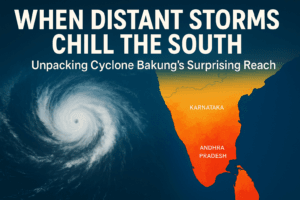
When Distant Storms Chill the South: Unpacking Cyclone Bakung’s Surprising Reach
The development of Tropical Cyclone Bakung over the remote Indian Ocean is creating an unusual meteorological paradox: while the storm swirls hundreds of kilometers from land, its unseen hand is drawing a blanket of unseasonal chill across South India. This event highlights how modern weather systems are interconnected, proving that a cyclone doesn’t need to make landfall to upend daily life. The story of Bakung is not one of destructive landfall but of atmospheric domino effects—a powerful reminder of our planet’s complex and often surprising climate dynamics.
The Making of a Distant Powerhouse
Cyclone Bakung’s journey began as “Tropical Cyclone Seed 91S” in the southwestern Indian Ocean. Indonesia’s Meteorology, Climatology, and Geophysics Agency (BMKG) officially upgraded it to a named tropical cyclone on the evening of Friday, December 12, 2025. At its genesis, the system was located off the coast of Lampung and was already moving southwest, away from Indonesian territory.
Intensification was swift. According to the Pacific Disaster Center (PDC), by Saturday, December 13, sustained winds had reached 45 knots (approximately 83 km/h). Bakung peaked as a compact but potent Category 2 cyclone, with maximum sustained winds clocked at 70 knots (130 km/h) and gusts up to 85 knots (157 km/h). A post from December 14 also recorded its winds at 104 km/h, confirming its significant strength.
The cyclone’s path has been a curious “loop de loop” near the Cocos Islands. As of the latest reports, it was positioned approximately 669 km west-northwest of the Cocos Islands and moving southward at a slow pace of about 6 km/h. Despite its strength, environmental conditions are now conspiring against it. Forecasts from the Joint Typhoon Warning Center (JTWC) indicate that high northeasterly wind shear and dry air entrainment are set to steadily weaken the vortex, with dissipation forecast within three days.
The Atmospheric Domino Effect: Chilling South India
The core paradox of this event is that a cyclone moving away from the subcontinent is directly influencing its weather. The mechanism is a reshuffling of large-scale atmospheric circulation. As Bakung intensified over the ocean, it began to act as a massive pump, interacting with pressure systems and altering established wind patterns.
The primary impact on South India has been the activation of cold northeasterly winds. These winds, blowing at speeds of 10-12 km/h, are sweeping across the states of Karnataka, Andhra Pradesh, and Tamil Nadu. Unlike monsoon winds that bring moisture, these winds are lowering surface temperatures without triggering widespread rainfall, leading to a dry, winter-like chill that is highly unusual for mid-December.
Table 1: Documented Impacts of Cyclone Bakung on South India
| Aspect | Observed Impact | Primary Affected Areas |
| Temperature | Notable dip in minimum temperatures; unusual winter-like chill. | Karnataka, Andhra Pradesh, Tamil Nadu. |
| Wind Pattern | Cold northeasterly winds at 10-12 km/h. | Inland and coastal regions of affected states. |
| Marine Conditions | Higher sea waves and rough waters. | Coastal Andhra Pradesh, Gulf of Mannar. |
| Rainfall | No widespread rainfall expected from this pattern. | – |
Urban Centers in an Unseasonal Chill
The abstract “influence on weather patterns” translates into tangible changes in India’s bustling southern cities. Bengaluru, known for its pleasant climate, has become the poster child for this phenomenon. The city has recorded a sharp dip in temperatures, with minimums expected to hover between 12°C and 14°C for nearly a week. For residents accustomed to milder December weather, this has meant pulling out winter wear much earlier than usual.
The cyclone’s influence has also had an unintended consequence on urban air quality. The same cold winds that bring relief from the heat also lead to reduced wind dispersion. This stagnation allows pollutants to concentrate near the surface. In Bengaluru, reports indicate a deterioration in air quality, with the Air Quality Index (AQI) reaching levels that raise public health concerns. This creates a double-edged sword: cooler weather that encourages outdoor activity, coupled with poorer air that warrants caution, especially for children, the elderly, and those with respiratory conditions.
Coastal areas are experiencing a different set of challenges. Authorities have noted higher sea waves along the coast of Andhra Pradesh. The India Meteorological Department (IMD) has issued warnings for strong winds, reaching up to 55 km/h, over coastal south Tamil Nadu, the Gulf of Mannar, and the Kanyakumari sea region. This has direct implications for the livelihoods and safety of fishing communities.
Official Warnings and Regional Ripple Effects
In response to these developments, meteorological agencies across the region have been vigilant. The India Meteorological Department (IMD) has been the primary source of alerts for Indian states. Their advisories are clear: fishermen should not venture into the rough seas of the south Tamil Nadu coast and the Gulf of Mannar. While heavy rainfall is not anticipated for most of South India, the IMD has forecast moderate rainfall for south Tamil Nadu and its delta districts due to the altered easterly wind patterns.
The story extends beyond India. In Indonesia, BMKG has been closely monitoring Bakung and another system, Invest 93S. Although Bakung is moving away, the agency warned of its indirect impacts, including the potential for moderate to heavy rainfall in parts of Bengkulu, Lampung, and Banten, as well as strong winds and high waves in specific ocean waters. For instance, waves between 1.25 and 2.5 meters were forecast for waters off the Mentawai Islands to Lampung. BMKG has consistently urged the public to access official information via its website and apps to avoid misinformation.
Table 2: Official Advisories and Precautionary Measures
| Agency | Target Region | Key Advisory / Warning |
| India Meteorological Department (IMD) | South India | Warning for strong winds (up to 55 km/h); fishermen advised not to venture into sea. |
| Meteorology, Climatology, and Geophysics Agency (BMKG), Indonesia | Indonesia (esp. Sumatra, Java) | Alert for indirect impacts: heavy rain, strong winds, high waves; public urged to monitor official channels. |
| Pacific Disaster Center (PDC) / JTWC | Indian Ocean (Maritime) | Forecast on track and intensity for shipping and regional planning. |
Beyond the Headlines: Insights from a Distant Cyclone
The saga of Cyclone Bakung offers more than just a weather update; it provides several crucial insights into our contemporary relationship with climate and forecasting:
- The “Action-at-a-Distance” of Weather Systems: Bakung is a textbook example of how a powerful weather system can reorganize atmospheric circulation on a continental scale. It underscores that the “sphere of influence” of a cyclone is often much larger than the storm itself, affecting regions well outside the standard “cone of uncertainty” tracked by forecasters.
- A Test for Modern Forecasting: This event showcases the capabilities and complexities of modern meteorology. Agencies like the JTWC, IMD, and BMKG were able to predict these indirect effects by analyzing complex model data. However, as noted by the PDC, track confidence for Bakung remained low due to a weak steering pattern and poor model agreement, reminding us that predicting the behavior of complex natural systems still involves significant uncertainty.
- Urban Vulnerability to Remote Events: The air quality degradation in Bengaluru reveals a hidden vulnerability. Cities are not just affected by local pollution or direct weather hits; they can be negatively impacted by remote events that alter fundamental atmospheric conditions like wind patterns. This calls for more integrated environmental monitoring that links weather and air quality forecasts.
- A Glimpse into a Changing Climate? While a single event cannot be attributed to climate change, the occurrence of such a strong cyclone in the Indian Ocean in December, and its resultant unseasonal impacts, aligns with broader scientific predictions of more variable and extreme weather patterns. It prompts reflection on how “normal” seasonal weather is being redefined.
In conclusion, Cyclone Bakung, destined to spin itself out over the open ocean without ever touching a coastline, has already left its mark. It has delivered an unseasonal chill to millions, altered daily routines, challenged coastal livelihoods, and provided a stark lesson in global atmospheric connectivity. As the climate continues to evolve, understanding the extended reach of such distant powerhouses will be key to building resilience in an interconnected world.
You must be logged in to post a comment.