
When Diplomacy Is Under Siege: The Unsettling Attack on London’s Palestinian Embassy and the Rules That Bind Nations
When Diplomacy Is Under Siege: The Unsettling Attack on London’s Palestinian Embassy and the Rules That Bind Nations
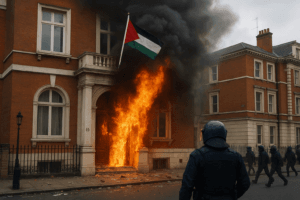
The façade of an embassy is more than stone and glass; it is the physical embodiment of a nation’s sovereignty on foreign soil. When masked individuals descended upon the Palestinian embassy in Hammersmith last Saturday, waving Israeli and Union Jack flags and defacing its doors with provocative stickers, they did more than stage a protest. They challenged a centuries-old global compact: the inviolability of diplomatic space. This incident, far from a mere localized act of vandalism, pierces the heart of international law and tests the United Kingdom’s commitment to its diplomatic duties amidst one of the world’s most polarized conflicts.
The Incident: A Breach More Than Physical
The details, as reported, are stark. A group, faces covered, posed triumphantly at the embassy entrance. Their calling cards were stickers bearing messages like “I love the IDF” and “Anti-Zionism is racism,” one even superimposing the Star of David onto the British flag with the phrase, “We are not Jews trembling at the knees.” For Ambassador Husam Zomlot and his staff, this was a chilling echo of past threats. Just two years prior, when the location was a “mission” rather than a full embassy, staff endured four attacks in weeks, including vandalism and death threats.
The timing is critically significant. The building had only formally elevated its status to an embassy following the UK’s recognition of the Palestinian state in September, a move meant to solidify diplomatic relations. Yet, as Ambassador Zomlot pointedly noted, this enhanced political profile has not been matched by enhanced physical protection. The embassy remains without the permanent security or close protection afforded to other missions deemed at higher risk, such as the Israeli embassy a few miles away.
The Vienna Convention: A “Special Duty” Ignored?
Here lies the crux of the legal and ethical dilemma. The 1961 Vienna Convention on Diplomatic Relations is the bedrock of international diplomacy. Article 22 is unambiguous: the host state is under a “special duty to take all appropriate steps to protect the premises of the mission against any intrusion or damage and to prevent any disturbance of the peace of the mission or impairment of its dignity.”
The Palestinian embassy’s accusation of a “flagrant breach” of this law is a serious charge against the UK state. The core question is: what constitute “all appropriate steps”? The Metropolitan Police’s statement that security is “based on an assessment of risk and are constantly reviewed” suggests a reactive, intelligence-led model. However, the public advertisement of a further protest—promising “direct action” and “a taste of their own medicine”—indicates a clear and present threat that seems to demand proactive, visible deterrence.
The discrepancy in protection levels between embassies in London is telling. It creates a perception, whether intended or not, of a hierarchy of diplomatic worth. In an atmosphere of heightened tension following the war in Gaza, leaving any embassy exposed can be seen as a failure of the host state’s fundamental duty to provide a neutral and secure ground for international dialogue.
The Protesters’ Message and the Muddled Battlefield
The protesters’ symbolism is a deliberate political cocktail. The fusion of the Israeli and British flags is not random; it seeks to frame their action as a defense of shared values, positioning the Palestinian diplomatic presence itself as an affront. By targeting the embassy—the symbol of the Palestinian Authority—with slogans demanding an end to Hamas and Palestinian Islamic Jihad, they conflate radically different entities, a tactic that only deepens misunderstanding and fuels hostility.
This action effectively transnationalizes the conflict, bringing its confrontational dynamics onto London’s streets and attempting to force the UK government, through pressure on a diplomatic compound, into a partisan stance. It turns the embassy into a pawn in a wider symbolic war, which is precisely what diplomatic law is designed to prevent.
The Human Cost: Diplomacy in a Climate of Fear
Beyond the legal principles, the human impact is profound. Diplomats are civilians serving their country abroad. The “impairment of its dignity” cited in the Vienna Convention speaks to the climate required for diplomatic work. Can staff focus on building relations, aiding citizens, and engaging in dialogue when they fear masked groups at their door? The prior death threats reveal this is not hyperbole. Ambassador Zomlot’s defiance—“your actions will not deter us”—is commendable, but no diplomat should have to exhibit bravery simply to go to work.
The call for “comprehensive protection” is not a request for special privilege; it is an appeal for the UK to uphold the standard it promises to all diplomatic missions. As noted, other nations like France provide permanent security to Palestinian missions, recognizing the uniquely charged context they operate within.
A Test for UK Foreign Policy and the “Rules-Based Order”
This incident presents a subtle but significant test for the UK’s foreign policy stance. The government has attempted a delicate balancing act: recognizing Palestinian statehood while maintaining its critical relationship with Israel. However, diplomacy is conducted both in grand statements and in practical protections. Failing to robustly secure a recognized state’s embassy undermines the very meaning of that recognition.
It calls into question the consistency of the UK’s commitment to the “rules-based international order” it frequently champions. The rules are clear in the Vienna Convention. Upholding them, especially when politically inconvenient, is what separates principle from pragmatism. The government’s response to this incident and its provision of future security will be a concrete indicator of where that balance lies.
Conclusion: The Embassy as a Canary in the Coal Mine
The masked men at the Hammersmith embassy targeted more than a building. They tested the resilience of international law and the UK’s willingness to enforce it equally. In a world where geopolitical conflicts increasingly spill into domestic spaces, the protection of diplomatic premises is a canary in the coal mine for the health of civil international discourse.
Providing adequate security is not an endorsement of the Palestinian Authority’s politics any more than protecting the Israeli embassy is an endorsement of every Israeli government policy. It is a reaffirmation of a foundational rule: that nations, regardless of size or conflict, can engage with one another on safe, neutral ground. For the sake of its own diplomatic credibility and the safety of all who serve within its borders, the UK must ensure that ground in London is not allowed to erode. The world is watching, not just what happens in Gaza, but what happens in Hammersmith.
You must be logged in to post a comment.