
When Celebration Becomes Massacre: Gaza School Attack Exposes Ceasefire’s Fragile Reality
On December 20, 2025, an Israeli tank shell struck a wedding at the Gaza Martyrs School, a shelter for displaced families in Gaza City, killing at least six people including a five-month-old baby and blocking rescue teams for over two hours—an attack that epitomizes the severe and systematic violations of a ceasefire that has failed to bring safety. Since the truce began on October 10, 2025, Israeli forces have killed over 400 Palestinians in hundreds of reported violations, maintaining control of more than half of Gaza and regularly obstructing humanitarian aid and emergency responders, which deepens the population’s trauma and erodes any fragile hope. This violence persists amid stalled U.S.-led talks on a second-phase agreement for Gaza’s future, as the international community faces mounting legal and moral pressure over its response to what UN experts describe as a continuing crisis, leaving Gaza’s civilians trapped in a “ceasefire” that remains a deadly and unstable limbo.
When Celebration Becomes Massacre: Gaza School Attack Exposes Ceasefire’s Fragile Reality
The Attack: A Wedding Celebration Shattered by Shelling
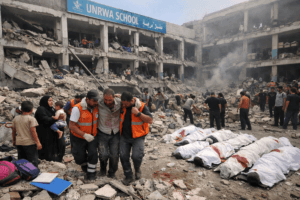
In the Tuffah neighborhood of Gaza City, a place where displaced families had sought refuge from two years of war, a moment of joy turned into a scene of horror on the evening of December 20, 2025. The Gaza Martyrs School, like many others in the strip, was functioning as a shelter for civilians who had lost their homes. That evening, families had gathered for a wedding celebration, a rare attempt at normalcy amid the rubble. Without warning, according to multiple witnesses and officials, the school’s second floor was struck by tank shells fired by the Israeli military.
The immediate aftermath was catastrophic. Gaza’s Civil Defense confirmed that at least six Palestinians were killed, including a five-month-old baby named Ahmed al-Nader. Several others were wounded. Mahmoud Basal, the Civil Defense spokesman, reported that most of the dead were children, and that additional shells fired after the initial strike worsened the situation and hampered rescue efforts. For over two hours, Israeli forces blocked ambulance and civil defense teams from reaching the site, delaying the evacuation of the wounded and the recovery of the dead. Rescue teams were only able to access the area after the United Nations Office for the Coordination of Humanitarian Affairs (OCHA) intervened with Israeli authorities.
The Israeli Defense Forces (IDF) issued a statement saying that during operational activity, “a number of suspicious individuals were identified in command structures west of the Yellow line,” and troops fired to “eliminate the threat.” The statement added that the IDF was aware of claims regarding casualties and that details were “under review”.
A Ceasefire in Name Only: Mounting Violations and Broken Trust
This attack did not occur in a vacuum. It was the latest and one of the most poignant violations of a ceasefire that has proven to be devastatingly fragile. The agreement, which took effect on October 10, 2025, was hailed as a “desperately needed breakthrough” by the UN Secretary-General. Its first phase called for an end to hostilities, the withdrawal of Israeli troops to a demarcated “yellow line,” and a significant increase in humanitarian aid into Gaza.
However, the reality on the ground has told a different story. According to Gaza’s health ministry, at least 401 Palestinians have been killed by Israeli fire since the ceasefire began. Hamas authorities state that the truce has been breached at least 738 times since October. The attack on the Gaza Martyrs School, a facility sheltering displaced civilians, is a stark embodiment of these violations.
The following table summarizes the stated goals of the ceasefire against the reported reality, highlighting the critical gaps:
| Ceasefire Phase & Goal | Stated Objective | Reported Reality (as of Dec 2025) | Source |
| Phase 1: Cessation of Hostilities | End to fighting between Hamas and Israel. | Continued Israeli strikes; 401 Palestinians reported killed since Oct 10. | |
| Phase 1: Withdrawal & Demarcation | Israeli troops withdraw to a defined “Yellow Line.” | IDF remains in control of ~53-58% of Gaza territory; regular operations beyond the line. | |
| Phase 1: Humanitarian Access | Major increase in aid to address famine conditions. | Access remains difficult; UN reports “inadequate” supply of essentials per ICJ ruling. | |
| Phase 2: Path to Peace | Negotiate permanent peace, disarmament, int’l force, Israeli withdrawal. | Talks stalled on “thornier issues”; no agreement on bridging core gaps. |
The “yellow line,” a physical and cartographic boundary meant to separate forces, has become a symbol of the ceasefire’s limitations. Israeli forces maintain control over more than half of the Gaza Strip from behind this line and continue to conduct operations. A senior Hamas official, Husam Badran, has explicitly stated that “the next phase cannot begin as long as the [Israeli] occupation continues its violations of the agreement and evades its commitments”.
The Human Cost: Voices from the Rubble
Beyond the grim statistics lies an immeasurable depth of human suffering. The attack on a wedding—a universal symbol of hope and new beginnings—has resonated as a particularly cruel act. Nafiz al-Nader, a witness to the school attack, told Agence France-Presse, “This is not a truce, it is a bloodbath”.
His words echo the profound trauma of a population pushed beyond its limits. When the ceasefire was first announced in October 2025, reactions from Gazans, captured by the Norwegian Refugee Council (NRC), were not of pure elation but of exhausted, cautious disbelief.
- Reham Khalaf, an NRC staffer, expressed mixed feelings: “I’m happy of course that finally the fire is going to stop… but at the same time sad for the two years that went like that from our lives… The country is destroyed. Gone.” She spoke of the need to “rebuild ourselves from the inside” first.
- Haneen Ajjour, another aid worker, described a numbing fear of hope itself: “I don’t want to believe it, because I don’t want to be upset again, since the sadness when things fall apart again is even worse”.
- Mohammed El Aklouk recounted waking his family with the news. His young son’s first question was, “does that mean we will eat meat and the chicken again, my Dad?”—a heartbreaking indicator of the deprivation endured.
These personal accounts underscore that the ceasefire, however fragile, had offered a psychological lifeline. Each violation, especially one as brutal as an attack on a civilian shelter during a celebration, shatters that fragile sense of potential safety, deepening the collective wound.
A Pattern of Endangerment: Targeting the Protectors
The two-hour delay in allowing rescue teams to reach the Gaza Martyrs School is part of a documented and deadly pattern. Attacks on first responders and humanitarian workers have been a consistent feature of the conflict, described as “routine” by UNRWA chief Philippe Lazzarini.
In a grave incident from March 2025, Israeli forces killed eight Palestinian medics, six civil defence first responders, and a UN staff member who were on a mission to collect the injured in Rafah. Clearly marked ambulances and a UN vehicle were hit, and access to the site was blocked for days. Jonathan Whittall of OCHA stated, “They were killed in their uniforms. Driving their clearly marked vehicles. Wearing their gloves. On their way to save lives. This should never have happened”.
The International Committee of the Red Cross (ICRC) emphasized that the rules of International Humanitarian Law “could not be clearer”—civilians and humanitarians must be protected. The systematic hindrance of rescue operations not only costs lives in the immediate aftermath of attacks but also erodes the entire humanitarian infrastructure essential for survival in Gaza.
International Crossroads: Diplomacy Stalls as Violence Continues
The school attack coincided with a critical diplomatic moment. Senior U.S. officials were due to begin talks in Miami on advancing the contentious second phase of the Gaza agreement. This phase envisions a technocratic government for Gaza, the disarmament of Hamas, the deployment of an international stabilization force, and a full Israeli withdrawal.
The challenges are monumental. U.S. Secretary of State Marco Rubio noted that potential contributing countries to an international force need clarity on its mandate and funding before committing. Meanwhile, Hamas official Bassem Naim stated, “Our people expect these talks to result in an agreement to put an end to ongoing Israeli lawlessness”.
The international legal landscape adds further pressure. In an October 2025 Advisory Opinion, the International Court of Justice (ICJ) reaffirmed Israel’s obligations as the occupying power to ensure the essential needs of Gaza’s population are met and to facilitate humanitarian relief. Furthermore, a report by UN Special Rapporteur Francesca Albanese, titled “Gaza Genocide: A Collective Crime,” accused third states of breaching their duty to prevent genocide by continuing to supply Israel with arms and political cover.
Conclusion: The Long Shadow of a Broken Truce
The shelling of the Gaza Martyrs School is more than a tragic isolated event. It is a powerful metaphor for the current state of the Israeli-Palestinian conflict: a place meant for growth and community (a school), hosting an event symbolizing hope (a wedding), brutally destroyed, with the most vulnerable (a baby) among the first to perish. The prevented rescue is a metaphor for a peace process that is being systematically blocked and undermined.
As the death toll since October 7, 2023, surpasses 70,900 Palestinians, and with Gaza almost entirely in ruins, the path forward remains shrouded in violence and distrust. The ceasefire, a “glimmer of hope” just months ago, is now described as “increasingly shaky”. Without immediate, credible accountability for violations, without the protected space for humanitarian work, and without a good-faith diplomatic push to address core issues, the temporary truce will remain just that—a brief pause in a longer, unending tragedy. The people of Gaza, as one aid worker pleaded, simply need “our life to return, even just a part of it”. The attack on a wedding celebration shows just how far away that simple wish remains.
You must be logged in to post a comment.