
When Art Becomes Accusation: The Berlinale’s Night of Reckoning
When Art Becomes Accusation: The Berlinale’s Night of Reckoning
The annual Berlin International Film Festival, affectionately known as the Berlinale, has always prided itself on being more than just a marketplace for movies. It’s a festival with a political soul, a tradition born from its 1951 inception in the shadow of a divided city. For decades, its red carpet has been a runway for cinematic art, but its stages have often served as platforms for moral and political discourse. However, the evening of February 21, 2026, may be remembered as the night that discourse exploded into a full-blown cultural and political firestorm.
The setting was the formal awards ceremony, a glittering affair meant to celebrate the best of world cinema. But by the time the final Golden Bear was handed out, the gala had transformed into a raw, emotional tribunal on the war in Gaza. The fallout was immediate and severe, exposing a deep and painful rift between the world of art and the fortified political doctrines of its host nation, Germany.
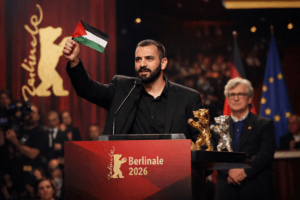
The night’s most searing moment came from Abdallah Al-Khatib, the Syrian-Palestinian co-director of Chronicles From the Siege, which won the Best Feature Film Debut Award in the festival’s new Perspectives section. His film is not a traditional documentary. It’s an episodic, almost surrealist drama that pieces together life under unrelenting military assault. The city is unnamed, but its identity is unmistakable: it is Gaza, reduced to rubble yet teeming with unbreakable human spirit.
Standing at the podium, the weight of his film’s subject matter pressing down on him, Al-Khatib delivered a speech that was less an acceptance and more a testament. He spoke not as a filmmaker, but as a witness. He called out the German government directly, labeling them “partners in the genocide in Gaza by Israel.” His voice, trembling with a mixture of fear and defiance, acknowledged his own precarious position as a refugee in Germany. He had been warned, he said, about the country’s “red lines” regarding criticism of Israel. “But I don’t care,” he declared, his voice rising. “I care about my people, about Palestine.” As he left the stage, he raised a small Palestinian flag—a simple, potent symbol that would be replayed thousands of times in the ensuing media storm.
Just moments earlier, another filmmaker had struck a similar chord. Lebanese director Marie-Rose Osta, accepting the Golden Bear for Best Short Film for Someday a Child, painted a stark picture of innocence under fire. “In reality, children in Gaza, in all of Palestine and in my Lebanon do not have superpowers to protect them from Israeli bombs,” she said, her words a poetic indictment of global inaction. “No child should need superpowers to survive a genocide empowered by veto powers and the collapse of international law.”
The words hung in the air of the auditorium, a stark contrast to the usual celebratory atmosphere. For many in the room, the speeches were a necessary dose of reality, a reminder that art cannot be divorced from the world it depicts. For others, particularly those representing the German state, they were an unacceptable breach of protocol and a delegitimization of Israel.
The political response was swift and brutal, unfolding in real-time on social media and in the tabloids the next morning. German Environment Minister Carsten Schneider didn’t wait for the speeches to end. He walked out of the gala, a silent but powerful gesture of protest that his office later confirmed, calling the statements “unacceptable.”
Berlin’s conservative mayor, Kai Wegner, seized the moment, accusing the filmmakers of hijacking the event. In a blistering interview with the German tabloid Bild, he claimed the ceremony was “misused for political destruction,” robbing other artists of their moment of glory. He went further, asserting that those expressing pro-Palestinian views were not concerned with human rights or peace, but were driven by a singular, destructive force: “hatred of Israel.” Alexander Hoffmann, a parliamentarian for the conservative Christian Social Union (CSU), took to X (formerly Twitter) to decry the “disgusting scenes,” which he characterized as filled with “accusations of genocide, antisemitic outbursts and threats against Germany.”
To understand the visceral nature of this backlash, one must understand the unique, deeply complex landscape of German political discourse, particularly regarding Israel. It is a landscape shaped by the indelible shadow of the Holocaust. The concept of Staatsräson, or “reason of state,” dictates that ensuring Israel’s security is a fundamental part of Germany’s national identity, a historic responsibility born from the crimes of the Nazi era. This principle, for decades a guiding light of German foreign policy, has created a political and media environment where criticism of the Israeli government is often automatically conflated with antisemitism, creating a chilling effect on open debate.
The events of October 7, 2023, when Hamas terrorists killed over 1,200 Israelis and took hundreds hostage, only intensified this dynamic. Germany, like many nations, affirmed Israel’s right to self-defense. But as Israel’s military campaign in Gaza has unfolded, resulting in the deaths of over 70,000 people according to a recent study in The Lancet, and reducing vast swathes of the territory to uninhabitable rubble, the space for nuanced conversation in Germany has become increasingly fraught. To call the military action a “genocide,” as Al-Khatib did, is to cross a line that much of the German political establishment considers sacred.
This is not the first time the Berlinale has found itself at the epicenter of this cultural earthquake. In 2024, the documentary No Other Land, which chronicles the violent displacement of Palestinian communities in the West Bank by Israeli settlers, won the festival’s audience award. Its Israeli co-director, Yuval Abraham, used his speech to decry the “apartheid” system he sees in his country, sparking outrage from German politicians who accused him of antisemitism. The pattern is clear: when artists bring the reality of the conflict, particularly the Palestinian experience of it, to a German stage, they are met not with dialogue, but with political condemnation.
The festival’s jury president this year was the legendary German director Wim Wenders (Paris, Texas, Wings of Desire), a filmmaker whose work is synonymous with humanism and empathy. Wenders found himself caught in the crossfire. Earlier in the week, he had suggested, somewhat naively, that filmmakers should “stay out of politics.” The comment ignited a firestorm of criticism online, with many accusing him of willful ignorance of cinema’s inherently political nature.
In his closing remarks at the awards ceremony, Wenders attempted to bridge the widening chasm. He spoke of an “artificial discrepancy” between the “empathetic” language of cinema and the “effective” but often reductive language of social media and activism. He acknowledged the activists’ cause—”the dignity and protection of human life”—as one shared by filmmakers. “Most of us filmmakers applaud you,” he said, addressing the activists directly. “You do necessary and courageous work. But does it need to be in competition with us? Do our languages need to clash?”
Wenders’ question is the central one now facing the Berlinale and the broader cultural world. Does the language of art inevitably clash with the language of politics? Or is the clash itself a sign of a healthy, if deeply uncomfortable, public square?
The Berlinale, in its official response to The Hollywood Reporter, attempted to stake out a middle ground, reaffirming its commitment to free speech, artistic freedom, and human dignity. “Everything that was said on Saturday,” the statement read, “was within the bounds of free speech laws in Germany.” It was a cautious defense, a reminder that in a democracy, even speech that offends the government is protected. But it also highlighted the festival’s precarious position: a cultural institution caught between its international artistic community and its national political overseers, many of whom provide its funding.
The aftermath of this year’s ceremony leaves a lingering question: What is the role of a cultural festival in an age of intractable political conflict? For the filmmakers, the answer is clear. For them, the Berlinale stage was not a privilege to be enjoyed in apolitical silence, but a rare global platform to bear witness to a catastrophe they feel the world is ignoring. To ask them to separate their art from their identity, or their film’s subject from their speech, was to ask them to be complicit in the silencing of their own people.
For the German politicians, the red lines are equally clear, rooted in a historical trauma that makes any questioning of Israel’s actions feel like an existential threat. They see themselves as guardians of a sacred duty, defending a Jewish state from a new wave of delegitimization.
In the middle sits the audience, the viewers, and the artists themselves. The 2026 Berlinale proved that when the language of cinema meets the language of geopolitics, there is no easy translation. There is only the raw, unfiltered, and often painful exchange of human experience. Abdallah Al-Khatib’s final words, “Palestine remembers,” were not just a political slogan. They were a promise from an artist that as long as he has a voice and a platform, the story of his people will be told, even—and perhaps especially—in the heart of a country that would prefer not to hear it. The festival may be over, but the reckoning it has forced upon German culture is just beginning.
You must be logged in to post a comment.