
When a Jury Said No: The Acquittal That Exposes Britain’s Protest Crackdown
A UK jury’s acquittal of six Palestine Action activists for storming an Israeli arms factory, despite video evidence of property destruction and an activist fracturing a police officer’s spine with a sledgehammer, has created a profound legal and political rupture, exposing deep societal divisions over the Gaza war and the limits of protest. The mixed verdicts—including not guilty findings for aggravated burglary but hung juries on charges like grievous bodily harm—signaled that some jurors were sympathetic to the defense’s argument that they were acting to disrupt a “genocide,” directly challenging the government’s framing of the group as terrorists. This outcome not only complicates potential retrials but also undermines the state’s broader crackdown, which includes designating Palestine Action as a terrorist organization and passing stricter protest laws, by revealing a gap between official policy and public conscience over Britain’s role in arming Israel and the legitimacy of civil disobedience.
When a Jury Said No: The Acquittal That Exposes Britain’s Protest Crackdown
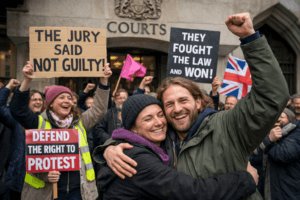
When the six activists hugged in the dock as supporters cheered, it wasn’t just a legal victory—it was a direct challenge to a government that had labeled their protest terrorism. The jury’s decision revealed a chasm between official counter-terrorism policy and public conscience over Britain’s role in Gaza.
When six Palestine Action activists walked free from Woolwich Crown Court, acquitted of aggravated burglary for a meticulously planned raid on an Israeli arms factory, they delivered something far more significant than a personal legal victory. Their case has become a defining test of democratic boundaries in a Britain increasingly divided over Gaza, protest rights, and the government’s expanding counter-terrorism powers. The verdict—arrived at after 36 grueling hours of jury deliberation—represents not merely the outcome of a criminal trial but a profound collision between state authority and public conscience over Britain’s international alliances and domestic freedoms.
The Night That Started It All
In the early hours of August 6, 2024, a white former prison van rammed through the perimeter fence of Elbit Systems UK’s Bristol facility. Inside were six activists wearing red boiler suits and armed with sledgehammers—Charlotte Head, 29; Samuel Corner, 23; Leona Kamio, 30; Fatema Rajwani, 21; Zoe Rogers, 22; and Jordan Devlin, 31 . Their target was explicit: Elbit Systems, Israel’s largest arms manufacturer, whose UK subsidiary produces technology including drones used extensively in Gaza.
The prosecution described a scene of calculated disruption. The activists used the van “as a battering ram” to enter the factory, then set about destroying property—spraying red paint from fire extinguishers, smashing computer equipment and boxes of technical products with crowbars and hammers, and even damaging a disabled toilet . According to court testimony, Head, a charity worker who drove the van, would later describe the events as “the craziest 20 minutes of my life” .
Most controversially, body-worn camera footage shown in court allegedly captured Corner striking Police Sergeant Kate Evans on the back with a sledgehammer while she knelt to arrest another suspect, fracturing her lumbar spine . This act formed the basis for the grievous bodily harm charge that would eventually result in a hung jury.
The Legal Battle and Its Surprising Outcome
The trial at Woolwich Crown Court produced a complex set of verdicts that defied easy categorization:
| Charge | Defendants | Verdict |
| Aggravated Burglary | All six defendants | Not Guilty |
| Violent Disorder | Rajwani, Rogers, Devlin | Not Guilty |
| Violent Disorder | Head, Corner, Kamio | Hung Jury |
| Criminal Damage | All six defendants | Hung Jury |
| GBH with Intent | Samuel Corner | Hung Jury |
Remarkably, despite five of the six admitting in court that they had damaged Elbit’s property—including drones and computers—the jury refused to convict anyone of criminal damage . Prosecutors indicated they would consider seeking a retrial on the charges where the jury couldn’t reach verdicts .
The defense strategy proved pivotal. Barrister Rajiv Menon KC compared the activists to the suffragettes, who were similarly denounced in their time as “a threat to the social order” and “unladylike, feral, aggressive, violent” . The defendants maintained that their sledgehammers were “solely for destroying property” and “in no circumstances intended to injure security staff” . Corner’s lawyers argued he struck the police officer because he “genuinely thought” another activist was being seriously injured .
The Terrorism Proscription Battle
This trial occurred against the backdrop of a much larger legal battle. In July 2025, nearly a year after the Bristol raid, Britain’s government proscribed Palestine Action as a terrorist organization—the first time in British history a direct action group has received this designation . The ban made membership or expressions of support for the group punishable by up to 14 years in prison .
The timing was significant: the proscription came after Palestine Action members broke into RAF Brize Norton in June 2025 and sprayed red paint on Voyager planes allegedly used to supply Israel’s military . The government cited the Bristol incident among its justifications, though Judge Jeremy Johnson told jurors the ban was irrelevant to their criminal trial .
Palestine Action co-founder Huda Ammori launched a legal challenge, with the Court of Appeal finding reasonable grounds to argue the proscription interfered with rights to freedom of speech and protest . The High Court challenge, heard in November-December 2025, presented four key arguments:
- The ban unlawfully interfered with rights to freedom of expression and assembly under the European Convention on Human Rights .
- The decision ignored relevant considerations, including that Palestine Action sought to prevent what it reasonably considered complicity in genocide .
- The Secretary of State failed to follow published policy .
- The decision violated natural justice by not giving Ammori opportunity to make representations beforehand .
UN Special Rapporteur Ben Saul and four other UN experts submitted statements expressing concern about “the unjustified labelling of a political protest movement as ‘terrorist'” . By November 2025, over 2,000 people had been arrested for holding signs reading “I oppose genocide, I support Palestine Action” .
A Wider Crackdown on Protest
The Palestine Action case represents just one front in what constitutional scholar Paul O’Connell terms Britain’s “siege architecture of protest law”—a cumulative construction of offences, powers, and narratives progressively closing space for disruptive protest .
Recent legislation has dramatically expanded state powers:
- The Police, Crime, Sentencing and Courts Act 2022 created a statutory offence of public nuisance with ten-year maximum sentences for non-violent disruption .
- The Public Order Act 2023 introduced “locking on” offences and Serious Disruption Prevention Orders allowing preemptive restrictions on individuals’ protest activities .
- The National Security Act 2023 expanded “prohibited places” to include private defence contractors, potentially reframing protests at arms factories as threats to national security .
Constitutional lawyers argue this represents “anticipatory repression”—pre-emptive legal frameworks designed to prevent future political challenges before they can meaningfully threaten existing structures . As O’Connell notes, Palestine Action’s activities were already being successfully prosecuted under ordinary criminal law; proscription seeks “to eliminate the future capacity for such conduct by criminalising the organisational form itself” .
The International Context and Public Conscience
Beneath the legal technicalities lies a profound moral and political conflict. Palestine Action explicitly frames its actions as challenging “Britain’s complicity in Israeli war crimes in Gaza” . The group accuses the UK of providing vital F-35 jet components and operating surveillance flights over Gaza .
This context permeated the trial. Prosecutor Deanna Heer acknowledged the defendants “genuinely believed the attack on Elbit” would help the Palestinian cause in Gaza . The defense maintained they acted to “prevent violence” by destroying weapons they believed would be used against Palestinians .
The verdict reveals a potential gap between official counter-terrorism policy and public perception. As Labour MP Kim Johnson noted: “A jury has refused to criminalise people who took action to stop a genocide” . This sentiment echoes concerns raised in Parliament, where MPs warned that arresting people merely holding signs risks diluting the seriousness of terrorism charges rather than strengthening them .
The Aftermath and Implications
The activists’ acquittal triggered sharply divergent reactions. Human rights groups hailed a “huge victory” and “powerful affirmation of jury independence” . The Board of Deputies of British Jews expressed concern about “troubling verdicts” and called for retrials . Gideon Falter of Campaign Against Antisemitism asked rhetorically: “How far does this impunity go?” .
Beyond immediate reactions, the case raises fundamental questions about democracy in crisis moments:
Jury Equity and Conscience: Shortly before verdicts, the judge directed jurors to ignore posters near the court about “jury equity”—the principle that juries can return verdicts according to conscience . This traditional safeguard in British law now clashes with increasingly expansive state powers over protest.
The Definition of Terrorism: Legal experts, including former senior judges and intelligence officials, warn Britain’s terrorism definition has become “too broad” when it encompasses property damage without serious risk to life . The case tests where society draws the line between violent extremism and principled civil disobedience.
Democratic Accountability: At its core, the Palestine Action case represents a collision between state authority and citizens challenging government policies through direct action. As activist Clare Rogers stated: her daughter “could not stand by as witnessed what was happening in Gaza so direct action against the weapons suppliers themselves was the only way” .
The six activists spent approximately 18 months in prison before trial, exceeding Britain’s usual six-month pre-trial detention limit . Their prosecution has drawn international scrutiny as a test case for how the British government handles pro-Palestine demonstrations under Prime Minister Keir Starmer .
A Democratic Reckoning
The Woolwich Crown Court verdict represents more than a legal outcome—it’s a symptom of deeper democratic tensions in a Britain grappling with its international role amidst the Gaza conflict. When a jury refuses to convict activists who admit destroying property but claim higher moral purpose, it signals a potential disconnect between official policy and public conscience.
The government faces a dilemma: how to maintain security and order while preserving space for legitimate dissent, especially when that dissent challenges state alliances and policies. As Parliament heard during debates on the proscription, “People must be able to protest what is happening in Gaza, and the focus should be on what is happening in Palestine, not Parliament Square” .
The Palestine Action verdict—with its acquittals, hung juries, and ongoing legal battles—doesn’t resolve these tensions but magnifies them. It highlights how terrorism laws crafted for different threats are being stretched to address political protest. It reveals how international conflicts increasingly play out in domestic legal systems. And it demonstrates that, despite expanding state powers, the conscience of twelve ordinary citizens in a jury room remains a unpredictable democratic safeguard.
As Britain awaits potential retrials and the High Court’s ruling on Palestine Action‘s proscription, this case continues to pose uncomfortable questions about protest, terrorism, and democracy in an age of globalized conflict and polarized conscience. The final chapter has not been written, but the verdict already delivered a clear message: when citizens believe their government is complicit in atrocities abroad, they will find ways to dissent—and sometimes, their fellow citizens will refuse to condemn them for it.
You must be logged in to post a comment.