
‘We’ve forgotten what gas feels like’: Gaza’s Ramadan rituals consumed by smoke and fire
A severe cooking gas shortage in Gaza, persisting despite a recent ceasefire, has forced displaced families to resort to burning wood and toxic plastic for their daily meals, with devastating health consequences. Mothers like Islam Dardouna, an asthmatic, now cook over open fires while relying on inhalers to breathe, as the constant smoke exacerbates respiratory illnesses and covers their lives in soot. The crisis has intensified during Ramadan, making it nearly impossible to prepare proper meals, with UN data showing that less than three percent of the needed cooking gas is entering the territory, leaving over 97 percent of families to rely on hazardous alternatives that are slowly poisoning them.
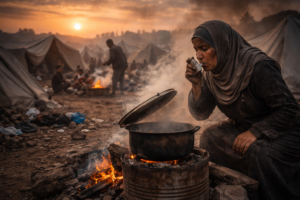
‘We’ve forgotten what gas feels like’: Gaza’s Ramadan rituals consumed by smoke and fire
As cooking gas remains virtually unavailable across the Gaza Strip, displaced families mark the holy month by burning wood and plastic—and watching their health deteriorate with every meal they manage to prepare.
The call to sunset prayer echoes across the sprawling tent camp in Sheikh Ajleen, western Gaza City, but Islam Dardouna cannot rise to answer it. She is hunched over a battered metal canister, her face streaked with grey soot, one hand gripping a pot handle while the other brings an asthma inhaler to her lips.
For a long moment, she does not lift the lid. She cannot. The smoke rising from the scraps of paper and splintered wood beneath the makeshift stove has triggered another breathing crisis, and she must wait for the medicine to take effect before she can check on the iftar meal inside.
“I can no longer tolerate the fire at all,” the 34-year-old mother of three finally manages, her voice strained and whisper-thin. “We heat water on it, we cook on it, everything depends on it. It has completely destroyed my health.”
What should be a moment of anticipation—the breaking of the daily fast during Ramadan—has become yet another ordeal for Dardouna and countless women across Gaza. The cooking gas that once made meal preparation routine has all but vanished from the territory, replaced by open fires that demand constant attention, inflict respiratory damage, and turn every mealtime into a battle for survival.
A family’s displacement, a nation’s crisis
Dardouna and her husband Muath, 37, have not known stability since October 2023, when Israel’s military campaign forced them from their home in Jabalia, northern Gaza. What followed was a grim odyssey of repeated displacement—from shelter to shelter, neighbourhood to neighbourhood, until they finally joined thousands of other families in this makeshift camp.
Their home is gone, destroyed like so many others. But the loss of structure, Dardouna says, has been accompanied by the erosion of everything that made domestic life functional. Chief among those losses: cooking gas.
“There is no cooking gas and no gas cylinders. We lost all of that during displacement,” she says, gesturing toward the fire that now serves as her kitchen. “Our entire life now is a struggle, searching for wood and things we never imagined we would need one day.”
The wood itself has become a precious commodity. Each morning, Muath ventures out to scavenge whatever burnable materials he can find—broken pallets, discarded construction timber, the branches of trees that somehow survived the bombings. When wood cannot be found, the family burns whatever is available: cardboard, fabric scraps, and increasingly, plastic.
The search consumes hours that could otherwise be spent resting, working, or caring for their children. And the results are never guaranteed.
The invisible enemy: smoke
Dardouna’s respiratory problems did not begin with this war. She traces them back to 2008, during another Israeli offensive, when a phosphorus bomb struck her home and filled her lungs with chemical smoke. For years afterward, her condition remained manageable—a touch of asthma, occasional allergies, nothing that prevented her from living normally.
The current war has rewritten that reality.
“I developed airway obstruction,” she explains quietly. “Recently, masses were found in my lungs.”
In January, her condition deteriorated so severely that she spent six days hospitalised, struggling for every breath while oxygen deprivation threatened her life. Doctors prescribed an oxygen cylinder for home use—a lifeline that remains out of reach.
“Unfortunately, I cannot afford it,” Dardouna says, her eyes dropping to the ground.
The smoke that fills her makeshift kitchen comes from materials never intended for cooking fires. When wood runs short—which is most days—the family burns plastic bottles, nylon sheeting, and other synthetic waste. The toxic fumes these materials release contain dioxins, furans, and heavy metals that attack respiratory systems already compromised by malnutrition, stress, and the generalised misery of displacement.
For Dardouna, each cooking session becomes a calculated risk: feed her children or protect her lungs. There is no choice, really. The children must eat.
Ramadan without suhoor
The holy month has intensified every hardship. Ramadan demands two meals each day: suhoor before dawn, and iftar after sunset. For families cooking over open fires, this means lighting fires twice daily—a task that ranges from difficult to impossible depending on weather conditions.
“Today, for example, it’s raining and windy,” Muath says, gesturing toward the damp sky. “I couldn’t light the fire at all this morning.”
His children began their fast without food. They will break it this evening with whatever can be prepared on a fire that must now be coaxed into life despite the dampness.
“Even when we break our fast, we wish we could drink a cup of tea or coffee afterwards,” Muath continues. “But we can’t. Lighting the fire again is another struggle.”
Before the war, Muath worked as a psychosocial support worker for children traumatised by conflict. Now he watches his own children absorb trauma with every skipped meal, every cancelled comfort, every day that begins without suhoor and ends with smoke.
“Every detail of our lives is literally suffering,” he says. “Fetching water is suffering. Cooking is suffering. Even going to the bathroom is suffering. We are truly exhausted.”
He looks down at his hands, blackened with soot that no amount of washing can fully remove. The stains have become permanent, embedded in the lines of his palms and the creases of his knuckles.
“Our lives are covered in soot,” he observes. “That’s what we’ve become.”
The gas cylinder that felt like Eid
For a brief moment a few months ago, the Dardouna family experienced something resembling normalcy. A gas cylinder—one of the few that have entered Gaza since the October ceasefire—made its way to their tent.
“It felt like Eid day,” Muath remembers, a faint smile crossing his exhausted face. For the first time in months, they could cook without smoke, without searching for wood, without watching their mother gasp for air.
The joy was short-lived. They had the cylinder, but they had lost their gas stove somewhere during their multiple displacements. The cylinder sat unused, a cruel reminder of how completely war had stripped them.
“We don’t even have the stove to use it,” Muath says. “And many families are like us.”
The cylinder eventually went to neighbours who still had a functioning burner. The Dardouna family returned to wood and plastic.
“We are living on the edge of nothing,” Muath says. “Displacement and war stripped us of everything. We are willing to live with the simplest rights in tents. But there is no heating, no gas, no lighting. It feels like we are living in open graves on Earth.”
A camp full of smoke
A few tents away, 26-year-old Amani Aed al-Bashleqi watches her husband stir a pot over another open fire. The flames leap and dance, casting shadows across faces streaked with exhaustion.
She has noticed something strange about food cooked this way. It tastes different—not because the smoke changes the flavour, but because of what the process demands.
“Exhaustion and suffering have become part of every bite,” she explains. “We start cooking early so we can finish by iftar, and after breaking the fast, my husband and I are completely exhausted and covered in soot.”
Al-Bashleqi’s greatest concern is her seven-month-old baby. Infant formula requires boiled water, but boiling water requires fire, and fire is never guaranteed.
“Sometimes I boil water and keep it in a borrowed thermos, but I don’t always have one,” she says. “And sometimes when he wakes up at night, I mix the milk with water without boiling it, even though I know that’s not healthy. But what can I do?”
The question hangs in the air, unanswered and unanswerable. What can any of them do?
Around her, the camp’s women share the same afflictions: chronic headaches, persistent coughs, burning eyes, and the deep chest congestion that comes from inhaling smoke day after day.
“The fire suffocates you,” al-Bashleqi says. “All the women in the camp suffer health problems from cooking on fire. But we have no choice.”
The plastic economy
Iman Junaid, 34, has found a solution to the wood shortage, though she knows its cost. Behind her tent, bags full of plastic bottles are stacked against a makeshift wall. Her family collects them from anywhere they can find them—roadsides, rubble heaps, the shoreline—and burns them to fuel their cooking fire.
“With the price of wood rising, we now wish we could even find wood,” she says while pushing an empty plastic oil bottle beneath the flames. “Gas has become almost impossible … we’ve forgotten it.”
Her husband Jihad, 36, stirs the pot as black smoke rises from the burning plastic. The smell is acrid, chemical, unmistakably toxic. Behind them, more bags wait their turn to become fuel.
Junaid knows the health dangers. She has six children, including a one-year-old daughter.
“My little daughter’s chest always hurts because she inhales the smoke,” Junaid admits. “Our life is collecting and burning plastic and nylon.”
The family heard promises that gas would enter Gaza after the ceasefire. International mediators assured the population that essential goods would flow freely, that the worst of the shortages were over.
“Nothing happened,” Junaid says flatly. “Nothing.”
The numbers behind the suffering
The Gaza General Petroleum Authority issued a warning on Wednesday that puts the family’s experiences in grim statistical context. According to their statement, the territory faces a shortfall of approximately 70 percent of its actual gas needs compared to the quantities that entered after the ceasefire announcement.
The United Nations Office for the Coordination of Humanitarian Affairs offers even starker numbers: the limited cooking gas entering Gaza covers less than three percent of what the population requires.
As a result, UN data indicates that roughly 54.5 percent of households now rely on firewood for cooking. Another 43 percent burn waste or plastic. Only about 1.5 percent of Gaza’s families can still cook with gas.
The authority described the situation as a “complete suspension of gas supplies” that places Gaza “before a looming disaster that threatens food and health security”—particularly during Ramadan, when families must prepare two meals daily under conditions that make even one meal a struggle.
They called the blockade a “clear violation of the ceasefire understandings” and urged international mediators to intervene. But for families huddled around smoky fires, international appeals feel distant. What matters is the fire in front of them, the food they must somehow prepare, and the children watching with hungry eyes.
Beyond gas: the question of normal life
Islam Dardouna has thought deeply about what she needs. The answer, she has concluded, is larger than cooking gas.
“What we need is for life to become possible again,” she says slowly, choosing each word with care. “Let gas enter. Let goods enter at reasonable prices. Let there be basic necessities for a normal life.”
Normal life. The phrase seems almost fantastical in the context of a tent camp, surrounded by displacement and loss. But Dardouna can still imagine it: a life where cooking does not threaten her breathing, where her children begin their fasts with food in their stomachs, where the soot on her hands comes from honest work rather than survival scavenging.
Until then, she will continue her daily routine. She will gather wood or plastic, coax flames from damp materials, prepare food while smoke fills her lungs, and reach for her inhaler before she can serve her family. She will watch her children eat while she struggles to breathe, and she will tell herself that this, too, is what mothers do.
“Imagine my son simply wants a cup of tea,” Muath had said earlier, frustration cracking his voice. “Even a little wind can stop me from making it.”
A cup of tea. A boiled egg for the baby. A warm meal after a day of fasting. These are the simplest of human comforts, the most basic of parental duties. In Gaza, they have become nearly impossible to provide.
As the sun sets over the camp and families gather around their smoky fires, the call to prayer rises again. Islam Dardouna hears it, but she does not rise. She is still waiting for her inhaler to work, still waiting to lift the lid, still waiting for the day when cooking no longer feels like a battle.
Behind her, the fire crackles and spits, sending another plume of smoke toward the darkening sky.
You must be logged in to post a comment.