
West Bank Displacement Crisis: How Settler Violence and Demolitions Are Forcing Palestinians From Their Homes
The UN reports that over 900 Palestinians have been displaced in the occupied West Bank since the start of 2026, driven primarily by a surge in Israeli settler violence and home demolitions. This crisis represents a systematic transformation of the territory, marked by a blurring of lines between state forces and settler militias, which has led to widespread intimidation, restricted movement, and a severe humanitarian fallout. The accelerating displacement and concurrent settlement expansion are fragmenting Palestinian land, worsening living conditions, and critically undermining the viability of a future two-state solution, all while violations of international humanitarian law persist with minimal accountability.
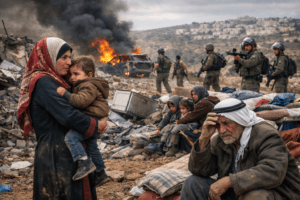
West Bank Displacement Crisis: How Settler Violence and Demolitions Are Forcing Palestinians From Their Homes
The United Nations has issued a stark warning about an accelerating humanitarian crisis in the occupied West Bank, where more than 900 Palestinians have been forcibly displaced from their homes and communities in the first five weeks of 2026 alone. According to UN spokesperson Stéphane Dujarric, this mass displacement is primarily driven by escalating violence from Israeli settlers and restrictive access measures imposed by Israeli authorities, followed by home demolitions.
These alarming figures, covering the period up to February 4, 2026, reveal a rapid deterioration of security and living conditions for Palestinian civilians. In just the two weeks from January 20 to February 2, the UN Office for the Coordination of Humanitarian Affairs (OCHA) documented more than 50 separate attacks by Israeli settlers that resulted in Palestinian casualties, property damage, or both. The UN is now conducting preliminary damage and needs assessments to coordinate an effective humanitarian response.
This crisis unfolds against the backdrop of continued tensions in Gaza and represents a profound shift in the dynamics of the Israeli-Palestinian conflict, with long-term implications for regional stability and the viability of a future two-state solution.
The Dual Drivers: Settler Violence and Systematic Restrictions
The displacement of Palestinians in the West Bank follows a distinct and troubling pattern, with two interconnected forces pushing people from their lands.
Escalating Settler Attacks
Settler violence has emerged as the most immediate and visible driver of displacement. The UN has documented a concerning pattern of attacks that extend beyond isolated incidents to become a coordinated campaign of intimidation. These attacks often target vulnerable communities, particularly Bedouin and herding families who depend on access to land and pastures for their livelihoods.
Recent reports indicate that over 100 Palestinian Bedouin and herding households from five different communities were displaced in a single two-week period in January, with the majority coming from Ras Ein al ‘Auja in the Jericho governorate. These attacks create an environment of fear that makes continued residence untenable for many families.
Restriction of Movement and Access
Parallel to the violence, Israeli authorities have implemented severe movement restrictions that effectively strangle Palestinian communities. A particularly stark example began on January 19, when approximately 25,000 residents of Hebron’s H2 area were placed under curfew and severe movement restrictions as part of a large-scale Israeli military operation.
These restrictions have disrupted access to food, healthcare, and education, with approximately 7,200 students at 18 schools forced to shift to e-learning. Humanitarian access has been severely constrained, with emergency services struggling to reach those in need. On January 20, the Palestine Red Crescent Society managed to evacuate seven kidney dialysis patients and deliver essential injections to two chronic patients within the closed area, but more than 460 chronic patients remain with limited access to care.
The Structural Shift: Blurring Lines Between State and Settler Violence
A significant development documented by both the UN and independent investigations is the institutional blending of state military forces and settler militias, creating what one UN report describes as a “growing phenomenon of ‘settler-soldiers'”. This structural shift represents a fundamental change in the occupation’s dynamics.
The “Hagmar” Units: State-Sanctioned Militias
Since October 2023, Israel has activated “hagmar” or regional defense units across the West Bank. These units consist of settlers who are given weapons and military authority but operate with minimal oversight. Israeli reservists who have served alongside these units describe them as “armed militias doing what they want”.
An investigation by The Guardian reveals that these settler-soldiers often operate in civilian clothing while carrying military-issue weapons, creating confusion about whether they are acting as state agents or private citizens. This ambiguity complicates accountability and enforcement of international law.
Escalation and Impunity
The consequences of this structural shift are measurable and severe. Since October 2023, settler attacks have completely displaced 29 Palestinian communities—more than one per month on average. This represents a dramatic acceleration compared to the period before October 2023, when only four communities were displaced over nearly two years.
Accountability remains minimal. According to the Israeli rights group Yesh Din, since October 2023, Israeli soldiers have been indicted in connection with only three violent offences and three property offences in the occupied West Bank. The last attack leading to a homicide indictment occurred in 2019.
Table: Displacement of Palestinian Communities in West Bank
| Time Period | Communities Completely Displaced | Average Rate of Displacement |
| 2022 – Sept 2023 | 4 communities | 1 every 5 months |
| Oct 2023 – Present | 29 communities | More than 1 per month |
| January 2026 (5 weeks) | 900+ individuals displaced | Data on full communities pending |
Broader Context: Gaza’s Shadow and Regional Implications
The West Bank displacement crisis cannot be understood in isolation from the broader regional context, particularly the ongoing humanitarian emergency in Gaza and political developments affecting Palestinian territories.
The Gaza Connection
While the West Bank faces escalating violence, Gaza continues to grapple with the aftermath of conflict and severe restrictions. More than 18,500 patients in Gaza still require specialized medical treatment unavailable locally. The UN has repeatedly called for the reopening of medical referral routes to the West Bank, including East Jerusalem, to ease pressure on Gaza’s overstretched health system.
The partial reopening of the Rafah crossing in early February 2026 offers limited relief, allowing some medical evacuations to Egypt. However, the process remains constrained, with only five patients and their companions crossing on the first day of reopening—far below the reported capacity of 50 patients daily.
Settlement Expansion and Territorial Fragmentation
Beyond immediate violence, structural changes are reshaping the West Bank’s geography. The Israeli government has advanced plans for the E1 settlement area, which includes tenders for 3,401 settlement housing units published in December 2025. These expansion plans would further isolate East Jerusalem from the rest of the West Bank and severely undermine territorial contiguity between northern and southern Palestinian areas.
According to the Israeli organization Peace Now, a record 9,629 settlement housing units were tendered in 2025—more than the previous six years combined. This acceleration of settlement construction directly threatens the viability of a future Palestinian state and increases the risk of forced displacement for approximately 18 Bedouin communities comprising over 4,000 people living in affected areas.
Humanitarian Fallout: Beyond the Numbers
The human cost of this displacement crisis extends far beyond the raw statistics of people forced from their homes. The cascading effects touch every aspect of life for Palestinian communities.
Health and Wellbeing
Approximately 232,000 women and girls in the West Bank, including 14,800 pregnant women, are estimated to have limited access to reproductive health services due to ongoing military operations, record levels of settler violence, and movement restrictions. The UN Population Fund and partners have been working to deliver critical services through mobile clinics, but access remains severely constrained, particularly in Jenin, Tulkarm, and Tubas governorates.
Education Disruption
The curfew in Hebron’s H2 area has forced approximately 7,200 students at 18 schools to shift to e-learning modalities. This disruption compounds an already fragile educational system that has suffered repeated closures and restrictions throughout the occupation.
Agricultural Livelihoods Under Threat
A recent Food and Agriculture Organization survey indicates that more than 72,000 farming and herding families—nearly two-thirds of all agricultural families in the West Bank—require urgent emergency agricultural assistance. When settlers destroy olive groves, steal livestock, or prevent access to pastures and water sources, they undermine not just immediate food security but generational livelihoods.
International Law and Accountability
The UN has been unequivocal in its assessment of these developments under international law. Secretary-General António Guterres has strongly condemned actions against United Nations premises in occupied East Jerusalem, including the unlawful entry into a UNRWA health centre and demolition of buildings in UNRWA’s Sheikh Jarrah compound.
Guterres emphasized that these measures “violate the inviolability of United Nations premises” and obstruct implementation of the General Assembly’s mandate for UNRWA’s continued operations. He noted that, as confirmed by the International Court of Justice, “any executive, administrative, judicial or legislative action against United Nations property and assets is prohibited”.
The UN spokesperson has reiterated that “all parties must fulfil their obligations under international humanitarian law to protect civilians and civilian infrastructure”. However, the systematic nature of the displacement and the blending of state and settler violence raise profound questions about implementation and enforcement of these legal standards.
Looking Forward: Pathways and Obstacles
As the international community grapples with this escalating crisis, several key factors will determine whether the displacement accelerates or is brought under control.
The Need for Protective Measures
Immediate steps recommended by humanitarian organizations include:
- Enhanced international monitoring and presence in vulnerable communities
- Clear differentiation and accountability for state security forces versus settler militias
- Unimpeded humanitarian access to affected populations
- Documentation and preservation of evidence for potential legal proceedings
Political Implications
The acceleration of displacement and settlement expansion fundamentally alters facts on the ground, with significant implications for any future political process. The territorial fragmentation caused by settlement expansion and movement restrictions increasingly renders a contiguous Palestinian state geographically impossible without massive relocation of settlers—a politically fraught proposition.
Regional Stability Considerations
The West Bank has historically been viewed as relatively stable compared to Gaza, but the current escalation of violence risks igniting broader unrest. With over 3.4 million Palestinians in the West Bank (compared to approximately 2.1 million in Gaza), widespread instability would have profound regional consequences.
Conclusion
The displacement of over 900 Palestinians in the first weeks of 2026 represents more than a humanitarian crisis—it marks a systematic transformation of the West Bank’s demographic and geographic reality. What distinguishes this phase from previous periods of tension is the institutional blending of state power and settler activism, creating a mechanism for displacement that operates with increasing efficiency and diminishing accountability.
As UN teams conduct their preliminary damage assessments and humanitarian organizations struggle to respond, the fundamental question remains whether the international community can develop effective mechanisms to protect vulnerable communities and preserve the possibility of a just political resolution. The accelerating pace of displacement suggests that without urgent intervention, the window for such resolution may be closing rapidly.
The voices of those displaced—the Bedouin herders separated from their pastures, the Hebron families confined under curfew, the patients unable to reach hospitals—form a collective testimony to a crisis that demands more than humanitarian bandages. It requires a fundamental reassessment of how the international system protects civilians under prolonged occupation and what measures can effectively restrain the powerful dynamics now reshaping the Palestinian landscape.
You must be logged in to post a comment.