
West Bank at a Crossroads: How Settlement Expansion Redefines the Future of Israel and Palestine
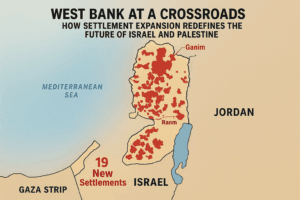
West Bank at a Crossroads: How Settlement Expansion Redefines the Future of Israel and Palestine
Beyond the Headlines: Understanding What “19 New Settlements” Really Means
In late December 2025, Israel’s security cabinet approved a plan to formalize 19 settler outposts across the occupied West Bank, marking one of the most significant settlement expansions in recent decades. This decision includes the revival of two northern outposts, Ganim and Kadim, which were dismantled in 2005. While framed by officials as a bureaucratic “legalization,” the move carries profound implications for Palestinian communities, regional stability, and the rapidly vanishing prospect of a two-state solution.
Far from an isolated event, this approval represents the latest acceleration in a methodical expansion strategy. According to documents reported by Israeli media, far-right Finance Minister Bezalel Smotrich has earmarked $843 million over five years for settlement growth, with explicit goals that include establishing 17 new settlements and funding mobile “absorption clusters” to rapidly move settlers into strategic areas.
A Clash of Perspectives
| Israeli Government Position | International Law & Palestinian Perspective |
| Strengthening security and Israeli presence in historic Judea and Samaria | Illegal annexation of occupied territory |
| “De facto sovereignty” to prevent a Palestinian state | Violation of UN resolutions and International Court of Justice rulings |
| Response to international recognition of Palestine | Demographic engineering and land theft |
| Development needs and “continuity of life” | Systematic fragmentation of a future Palestinian state |
The Human Landscape: Dispossession on Multiple Fronts
Behind the political statements and legal debates lies a stark reality for Palestinian communities. The expansion operates through multiple interconnected mechanisms, each contributing to Palestinian displacement and loss of livelihood.
The “Crimson Thread” Barrier: Severing Communities from Their Land
Parallel to settlement approvals, Israel has begun construction on what it calls the “Crimson Thread” barrier—a 300-mile security installation that will eventually run from the Golan Heights to the Red Sea. This barrier carves through some of the West Bank’s most fertile agricultural land, particularly in the Jordan Valley area known as Palestine’s breadbasket.
In the village of Atouf, farmers received eviction notices giving them seven days to vacate properties their families have worked for generations. Ismael Bsharat, a local farmer, faces the severing of water pipes that irrigate his 1.2 hectares of land. “What can I do? I can’t farm without water,” he says. Abdullah Bsharat, the village council leader, predicts up to 40 families will be cut off from their village and water supply.
Systematic Violence and Impunity
Settlement expansion occurs alongside escalating violence. According to UN data from late 2025, Israeli forces or settlers have killed 227 Palestinians in the West Bank since January 1, with nearly half of these fatalities occurring in the Jenin and Nablus governorates. The same period saw 1,680 settler attacks across more than 270 communities—an average of five incidents daily.
The olive harvest season, a crucial economic and cultural tradition, has become particularly dangerous. Between October and November 2025 alone, the UN documented 178 olive-harvest-related settler attacks. In Turmus Ayya, 53-year-old grandmother Afaf Abu Alia was bludgeoned so severely she suffered bleeding on the brain while trying to harvest her olives. In another incident, 20-year-old Sayfollah Musallet, an American citizen visiting family, was beaten to death by settlers in an olive grove.
The Legal Facade: When “Authorization” Enables Dispossession
The transformation of outposts into authorized settlements follows a consistent pattern. Many outposts begin as small, unauthorized clusters of caravans established by settlers in strategically important locations. Over time, through political pressure and bureaucratic maneuvering, they gain increasing recognition and services. The recent authorization of eight outposts—including Adei Ad, a known source of violent attacks on Palestinian communities—demonstrates how previously illegal constructions become normalized facts on the ground.
An IDF whistleblower revealed to Israeli media that the military under Central Command chief Maj. Gen. Avi Bluth has actively facilitated the establishment of new “farming outposts,” allocating resources and providing security. This represents a significant policy shift from tacit tolerance to active collaboration in creating facts on the ground.
Geopolitical Repercussions: International Reactions and Regional Stability
The settlement approvals have drawn widespread international condemnation, highlighting Israel’s growing diplomatic isolation on this issue.
European Opposition and Sanctions
The E4 group (France, Germany, Italy, and the United Kingdom) issued a strong statement condemning both settlement expansion and escalating settler violence. They noted that more than 3,000 housing units had been approved in the three weeks preceding their November 2025 statement, bringing the yearly total to an unprecedented 28,000 new units.
The UK has taken concrete measures, implementing sanctions against far-right ministers Itamar Ben-Gvir and Bezalel Smotrich for “repeated incitement of violence against Palestinian civilians”. These sanctions, coordinated with Australia, Canada, New Zealand, and Norway, represent a significant diplomatic escalation.
Regional Responses
Arab and Muslim-majority countries have been unanimous in their condemnation:
- Saudi Arabia called the settlements a “serious threat to the possibility of a two-state solution”
- Jordan warned they “encourage the perpetuation of cycles of violence and conflict in the region”
- Turkey stated they “target the territorial integrity of the State of Palestine”
- Qatar expressed “unequivocal rejection” of policies aimed at preventing a Palestinian state
The American Position
Perhaps most notably, Ynet reported that the decision was “coordinated with the US in advance”. This aligns with a pattern of the Trump administration focusing criticism primarily on violence while offering less resistance to settlement growth than previous administrations. When asked about settlement developments in August 2025, a State Department spokesperson deflected, saying Washington was focused on ending the Gaza war and ensuring Hamas would never govern again.
The Strategic Objective: Fragmenting a Future Palestine
Viewed together, these developments reveal a comprehensive strategy to reshape the West Bank’s geography beyond the point of return for a viable Palestinian state.
The E1 Settlement: A Case Study in Fragmentation
The recent push builds upon earlier, equally consequential decisions. In August 2025, Israel revived plans for the E1 settlement between East Jerusalem and Maale Adumim. Finance Minister Smotrich openly stated this would “bury the idea of a Palestinian state”. Experts agree that E1 would sever the West Bank’s northern and southern halves while isolating East Jerusalem from its Palestinian hinterland.
The Displacement Pattern
| Mechanism of Displacement | Impact on Palestinian Communities |
| Settlement expansion & land confiscation | Loss of agricultural land, homes, and livelihoods |
| Security barriers & restricted access | Separation from farmland, water sources, and communities |
| Settler violence & intimidation | Forced abandonment of homes and farmland |
| Home demolitions & building restrictions | Direct displacement and prevention of natural growth |
The humanitarian impact is staggering. According to UN monitoring, Israeli forces demolished 11 Palestinian-owned structures in just one week in late November 2025 for lacking Israeli-issued permits, which are notoriously difficult for Palestinians to obtain. In the northern West Bank, military operations have displaced thousands, with at least 11 families (55 people) remaining displaced since early November after their homes were converted into military posts.
Looking Ahead: Implications for Peace and Regional Security
The acceleration of settlement expansion creates several potentially irreversible realities:
- Territorial Integrity Undermined: The fragmentation of the West Bank into disconnected Palestinian enclaves makes a territorially contiguous state increasingly implausible.
- Economic Viability Compromised: The loss of agricultural land, particularly in the fertile Jordan Valley, undermines the economic foundation of a future state.
- Two-State Solution Becomes Theoretical: As former Israeli peace negotiators and Palestinian leaders have warned, there is a point of no return beyond which separation becomes impossible.
- Radicalization Risks: The UN human rights office has warned that pressure on Palestinian civil society—including raids on agricultural organizations—is reaching alarming levels, potentially eliminating moderate alternatives to armed resistance.
The international community faces a dilemma: continue issuing statements of condemnation while facts on the ground steadily eliminate the possibility of the two-state solution they officially endorse, or develop new approaches to address a reality that increasingly resembles permanent occupation with unequal rights for two populations under one controlling authority.
As Palestinian official Mu’ayyad Sha’ban observed, these developments represent another step toward “erasing Palestinian geography.” The coming months will reveal whether the international response evolves beyond condemnation to meaningful prevention of what many are now calling de facto annexation—a change that would fundamentally alter the conflict and its potential resolutions.
You must be logged in to post a comment.