
Weaving the Unbroken Thread: Meet the Custodians Protecting India’s Cultural Soul
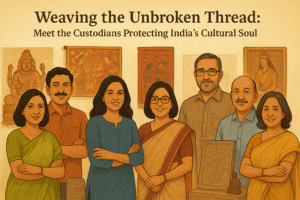
Weaving the Unbroken Thread: Meet the Custodians Protecting India’s Cultural Soul
In a world hurtling towards the future, the quiet work of looking backward is often a radical act. It’s a profession not of excavation, but of connection—linking the hands of the past with the imagination of the present to inform the identity of the future. These are the memory keepers: a dedicated cadre of curators, archivists, and conservationists who are not merely preserving artifacts but are actively redefining what it means to safeguard a culture. In India, a nation with a cultural tapestry of immense richness and complexity, their work is particularly vital. They are the guardians of the unbroken thread.
Moving beyond the stereotypical image of austere, silent halls, a new generation of cultural custodians is at work. They understand that preservation isn’t about sealing history in a vacuum; it’s about making it breathe, speak, and even argue with the present. They are transforming museums from temples of reverence into vibrant town squares of encounter, ensuring that culture remains a living, evolving conversation, not a forgotten monologue.
Here are the stories of six such individuals who are preserving India’s artistic legacy for posterity.
Puja Vaish: The Architect of Participatory Memory
As the director of the Jehangir Nicholson Art Foundation at Mumbai’s CSMVS museum, Puja Vaish is on a mission to dismantle the “Do Not Touch” ethos that has long defined cultural institutions. For her, a museum is not a mausoleum for art, but a space for dynamic encounter.
Her curatorial philosophy came alive in the centenary show Ancestors, where she collaborated with multidisciplinary artist Sahej Rahal. In a bold move, she decided to remove all explanatory labels from the artworks. Instead, visitors were invited to become co-authors of the exhibition’s narrative by writing their own labels in response to the art. “It was a way to get people to think about how history is written—and what often gets left out or erased,” Vaish explains. This act of participatory storytelling transformed passive viewers into active participants, challenging the very authority of the historical record and suggesting that memory is a collective project.
Her work extends beyond interactive gimmicks. In piecing together a retrospective on the late abstractionist Nasreen Mohamedi, Vaish combed through family collections, uncovering rarely seen artworks and stitching together fragments of a life through handwritten letters and oral histories. This meticulous, almost archaeological approach demonstrates that preservation is as much about safeguarding intangible stories as it is about conserving physical objects.
Mayank Mansingh Kaul: The Poet of Cloth
For Mayank Mansingh Kaul, a single childhood encounter with an exhibition of jewelled textiles was a formative, almost spiritual experience. Today, his curatorial practice is a pilgrimage into the soul of cloth. He sees textiles not as inert objects behind glass, but as living entities—bearing the memory of their makers, the pulse of their histories, and the potential for endless reinvention.
In exhibitions like Red Lilies, Water Birds in Hampi, Kaul’s philosophy becomes an environment. He drapes fabrics over bamboo scaffolds, allowing them to cascade down ancient stone walls and respond to the shifting sunlight. The exhibition becomes a meditation on material and time, where “cloth seemed to remember and stone seemed to breathe.” This approach is inherently risky—allowing precious textiles to interact with the elements—but it is essential to his belief that preservation is about letting things live, not just exist.
Kaul’s work is deeply political, reminding us that cloth is a second skin, marked by caste, class, and community. By making textiles tactile and experiential, he creates a site of democratic awakening, where touch can provoke profound thought. His upcoming project in Paris will further his lifelong inquiry: how can we not just look at textiles, but learn to live through them?
Deepika Sorabjee: The System Builder
While some custodians work in the public eye, Deepika Sorabjee’s profound impact is felt in the foundational structures of India’s art world. As the head of the Tata Trusts’ Art Conservation Initiative (ACI), her mission is to professionalize the entire conservation sector. “In India, the arts ecosystem has suffered due to a lack of strong institutions and structured methodologies,” she notes.
Her approach is systemic, not spotlight-seeking. A trained medical doctor with a passion for the arts, Sorabjee has methodically built conservation labs across the country—in Bengaluru, Uttarakhand, Kolkata, Mumbai, and Jodhpur. This network doesn’t just decentralize conservation; it democratizes it. Under her guidance, a daily-wage carpenter can train to become a wood conservator, ensuring that skills are nurtured within communities, not just imported from elite institutions.
Her work extends to film preservation with the Film Heritage Foundation and even to authoring India’s first specifications for built heritage conservation. Whether funding a lab or restoring celluloid, Sorabjee’s focus is intentional and enduring: building resilient systems, not chasing temporary spotlights.
Deepthi Sasidharan: The Decolonizer of Memory
Deepthi Sasidharan, through her firm Eka Cultural Resources and Research, acts as a bridge between private collections and the public. She steps into the vast, often chaotic holdings of erstwhile royalty, corporate giants, and private collectors to decipher, organize, and coax out their hidden stories.
Her portfolio is remarkably diverse, ranging from the Museum of Indian Paper Money to a museum dedicated to a Manipuri dancer. This versatility highlights a key insight: cultural memory is embedded everywhere, not just in traditional art forms. A key part of her self-imposed brief is to free the museum space from its colonial hangover. “Formal museums being a British legacy, we are yet to make a museum the Indian way,” she states. She calls for more imagination, more daring, and an “army of museum professionals” to create institutions that truly reflect India’s own ways of collecting, remembering, and displaying.
Ally Matthan: The Keeper of Woven Knowledge
For Ally Matthan, the founding of The Registry of Sarees (TRS) was born from a moment of profound personal connection. Wearing a blouse made from her grandmother’s telia rumal in the heartland of ikat weaving, she was approached by a local weaver who recognized the motifs as his family’s work. The encounter, filled with emotion, revealed the deep, personal legacy embedded in every thread.
TRS is more than a collection; it is a “registry of skills, weaves, motifs.” Matthan is spearheading a monumental shift towards archiving the informal, inherited knowledge of Indian weavers. Through magnificent compendiums and exhibitions that recreate literary epics like the Meghdootam in textile form, she pushes for new definitions of artistry. Her goal is to break the “stuffy concept of a museum,” making it agile and contemporary, ultimately to elevate Indian craft to a position of global leadership. “Because that’s what we were,” she asserts, linking past excellence to future potential.
Mortimer Chatterjee: The Guardian of Institutional Legacy
For over two decades, Mortimer Chatterjee has served as a discreet guardian to some of India’s most significant corporate and institutional art collections. His work with The Taj Mahal Palace, the Tata Institute of Fundamental Research (TIFR), and others is a masterclass in protecting cultural continuity.
His most daunting task came in the wake of the 26/11 terror attacks, when he and his wife, Tara Lal, undertook the arduous conservation of the Taj’s damaged heritage wing and its collection of nearly 4,000 artworks. Saving these works by masters like Husain and Gaitonde was not just an act of restoration; it was an act of cultural defiance.
By curating exhibitions and authoring books on these collections, Chatterjee ensures that these institutional treasures are not locked away but are brought to public glory. His work demonstrates that preservation is incomplete without access, ensuring that the art that shaped a nation’s post-independent identity is safeguarded for the generations to come.
Together, these six custodians represent a powerful and evolving force. They are not simply storing the past; they are actively weaving it into the fabric of the present, ensuring that India’s cultural memory remains a vibrant, living, and unbroken thread.
You must be logged in to post a comment.