
Weather Extremes Grip India: Southern Deluge Meets Northern Chill as Climate Patterns Collide
India is currently experiencing starkly contrasting weather extremes, with the lingering remnants of Cyclone Ditwah fueling continued heavy rainfall, wind hazards, and rough seas across Tamil Nadu, Puducherry, and adjacent southern regions, disrupting life and livelihoods, while simultaneously, northwestern and central parts of the country brace for a sharp temperature drop, anticipating cold waves and dense fog that threaten health, agriculture, and transportation, collectively highlighting the nation’s complex climatic challenges and the critical need for region-specific preparedness amid such divergent yet concurrent meteorological events.
Weather Extremes Grip India: Southern Deluge Meets Northern Chill as Climate Patterns Collide
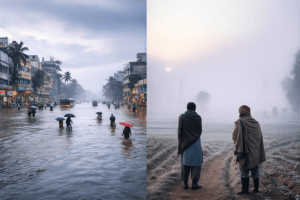
As dawn broke over Chennai on Wednesday, residents once again navigated streets transformed into shallow rivers, a familiar yet disruptive scene marking the lingering influence of Cyclone Ditwah. Nearly 900 kilometers to the north, in Punjab’s rural heartland, farmers wrapped in shawls surveyed their fields under a stark, pale sky, bracing for a sharp plunge in temperature. This stark contrast paints a vivid picture of the complex atmospheric drama currently unfolding across the Indian subcontinent, where the remnants of a tropical cyclone and advancing cold waves are scripting two very different weather narratives simultaneously.
The India Meteorological Department’s (IMD) latest bulletins underscore a nation grappling with climatic opposites. While the southern peninsula, particularly Tamil Nadu and Puducherry, contends with waterlogged woes, northern and northwestern regions are bundling up against an impending cold snap. This isn’t merely a forecast of rain and chill; it’s a case study in how disparate weather systems coexist, each with profound implications for millions of lives, regional economies, and daily resilience.
The Southern Saga: Ditwah’s Long Farewell
Cyclone Ditwah, having spent its initial fury, is demonstrating that a cyclone’s legacy is often written in its aftermath. Now degraded into a well-marked low-pressure area hovering over the north Tamil Nadu coast, its slow, southwestward crawl is a meteorological masterclass in lingering impact. Unlike systems that dissipate rapidly over land, Ditwah’s proximity to the coast allows it to continue tapping moisture from the Bay of Bengal, acting as a relentless rain pump.
The immediate consequence is the continuation of heavy to very heavy rainfall in isolated parts of Tamil Nadu, Puducherry, and Kerala. Cities like Chennai, with its ongoing challenges of urban drainage and rapid development on floodplains, are particularly vulnerable. Each heavy spell tests civic infrastructure, disrupts transportation, and poses risks to public health, from waterborne diseases to accidents in waterlogged conditions. For the farming communities in the interior districts of Rayalaseema and south coastal Andhra Pradesh, these rains are a double-edged sword. While they recharge groundwater and benefit certain winter crops, unrelenting intensity can damage standing crops and oversaturate soils, leading to losses.
The IMD’s wind warnings—predicting squally conditions of 35-45 kmph along the coasts—extend the hazard beyond rainfall. For the fishing community, these advisories are critical economic directives. Days of “very rough to rough” sea conditions mean halted voyages, directly impacting livelihoods and local seafood supply chains. This aspect highlights how weather alerts transcend mere information; they are vital tools for risk management for those whose lives are intimately tied to the elements.
The Northern Narrative: The Creeping Cold
In stark contrast, northwest India is preparing for a different kind of siege. A silent influx of cold, dry winds from the snow-clad Himalayas and beyond is set to initiate a steady decline in the mercury. The IMD forecasts a significant 3-4°C drop in minimum temperatures over the plains of Punjab, Haryana, Delhi, and Rajasthan in the coming days, with isolated cold wave conditions likely.
A “cold wave” is not just a subjective feeling of chill; it is a technical threshold defined by the IMD based on region-specific temperature dips below normal. Its impacts are insidious and widespread. For public health, it elevates risks of respiratory ailments, hypothermia among the unhoused population, and cardiovascular stress. Agriculturally, the “rabi” (winter) crop season is in a sensitive phase. Wheat, mustard, and gram can suffer from frost damage if cold waves are severe or prolonged, potentially affecting yield. Farmers often resort to light irrigation or “frost smudging” (creating smoke screens) to protect their crops—age-old practices that gain urgent relevance with each IMD warning.
Furthermore, the predicted dense morning fog, often a companion to these cold conditions, cripples transportation. Flight schedules, highway travel, and train operations face massive disruptions, creating a cascade of delays and economic losses. Thus, the cold wave preparedness involves not just pulling out winter wear but also systemic coordination between transport authorities, health departments, and disaster management units.
Connecting the Dots: The Synoptic Scale View
To the casual observer, these events may seem unrelated—a southern storm and a northern chill. However, from a synoptic (large-scale weather system) perspective, they can be interconnected pieces of the continental weather puzzle. Often, intense western disturbances (storm systems from the Mediterranean) that bring snowfall to the Himalayas strengthen the flow of cold northerly winds into the plains. Simultaneously, weather patterns over the Indian Ocean and Bay of Bengal, like cyclones, are influenced by broader phenomena such as the Madden-Julian Oscillation (MJO) or sea surface temperatures.
While Cyclone Ditwah’s specific formation may not directly cause the northern cold wave, both are manifestations of the active winter season transition. The jet stream’s positioning, high-pressure systems over Central Asia, and the availability of moisture in the southern seas all interact in a complex dance. The IMD’s role is to decode this dance, providing region-specific forecasts that allow for localized responses.
Beyond the Forecast: Human Resilience and Adaptive Challenges
The true story lies in the human response to these forecasts. In Tamil Nadu, the memory of past floods has ingrained a certain wary preparedness. Communities in low-lying areas move essentials to higher ground, local administrators pre-position drainage pumps, and schools announce closures proactively. The real insight is in how this repeated exposure shapes urban policy and citizen behavior, pushing for better water management and resilient infrastructure, albeit at a pace often challenged by rapid urbanization.
In the North, winter preparedness is a cultural and logistical ritual. Night shelters (“rain basera”) see increased allocations, hospitals stock up on medicines for respiratory illnesses, and farmers monitor weather apps as closely as their fields. The cold wave tests social safety nets and highlights the vulnerability of marginalized communities facing the elements.
The Bigger Picture: Climate Variability and the Future
While attributing single events to climate change is complex, the increasing frequency and intensity of weather extremities—whether it’s heavier rainfall from cyclones or unpredictable cold spells—align with broader climate projections for the region. Warmer ocean surfaces can fuel more potent cyclonic systems, while changing global atmospheric patterns can alter the persistence and severity of winter conditions. This makes the work of agencies like the IMD not just about forecasting the next week, but about providing data that informs long-term climate adaptation strategies.
A Nation in Two Seasons
For now, India witnesses a nation functioning in two distinct seasons. The key takeaway for readers is the critical importance of location-specific preparedness. Heeding IMD’s color-coded alerts—orange for the southern rains, yellow for the northern cold—is the first step. For southern residents, it means avoiding waterlogged roads, securing property, and staying updated on fisherfolk warnings. For northern citizens, it involves protecting health, ensuring vulnerable family members and neighbors are safe, and exercising extreme caution during fog.
The simultaneous occurrence of Cyclone Ditwah’s aftermath and the advancing cold wave is a powerful reminder of India’s vast and varied climatic identity. It underscores the monumental task the IMD undertakes in monitoring and communicating these threats. As citizens, moving from passive consumption of weather news to active, informed preparedness is the most valuable insight we can derive. In a world of changing climate patterns, understanding the “why” behind the rain and the chill empowers us to build personal and community resilience against the forces of nature, no matter which corner of the country we call home.
You must be logged in to post a comment.