
‘We Resist With Our Faith’: Inside the West Bank Village Where Settler Violence Is Testing a Christian Community’s Will to Stay
Settler violence in the West Bank’s last all-Christian village, Taybeh, has escalated sharply since 2023, culminating in the March 2026 armed takeover of a Palestinian-owned quarry by Israeli extremists who now block the owner from accessing his sole livelihood. The village is increasingly encircled by settler outposts, residents face threats, theft, and movement restrictions, and dozens have already emigrated. Amid the fear, the local parish priest describes the community’s perseverance as a form of “resistance” rooted in faith and historic presence, even as human rights groups document hundreds of settler attacks across the West Bank with what activists say is military and police complicity.
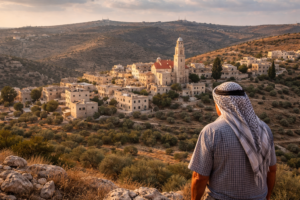
‘We Resist With Our Faith’: Inside the West Bank Village Where Settler Violence Is Testing a Christian Community’s Will to Stay
For two decades, Roland Bassir would begin his mornings the same way: a short drive to the western edge of this hilltop village, a turn down the dirt path, and the familiar roar of machinery at the quarry he built with his brother. It was hard work, but it was theirs—a livelihood carved from limestone, a future chiseled out one stone at a time.
Today, Bassir stands on a ridge overlooking the property, too afraid to descend. Below, an Israeli flag flutters from a structure he once owned. A large tent marks the presence of settlers who, he says, have claimed his quarry as their own. He holds a cigarette between trembling fingers, his gaze fixed on the valley floor where decades of labor now sit beyond his reach.
“I can’t sleep at night,” Bassir told OSV News on a recent afternoon, the March sun casting long shadows across a landscape that has become unrecognizable to him. “I can’t understand how people can just come and take over my 20 years of work. It is unjust. It is indescribable.”
His story is no longer an isolated one in Taybeh, a village of roughly 1,200 residents that holds a distinction both cherished and increasingly precarious: it is considered the last all-Christian community in the West Bank.
A Pattern of Escalation
The March 19 takeover of Bassir’s quarry did not come without warning. Days earlier, settlers posted a video announcing their intention to seize the site. When they arrived, approximately 30 extremists entered the property, hoisted an Israeli flag, and held prayer services. For Bassir, the symbolism was devastating.
“Since Oct. 7, 2023, I have had problems with the settlers,” he said, referring to the Hamas attack that triggered the ongoing war in Gaza. “They took lands above the quarry. Last week they brought a backhoe and opened up a dirt road and went into the quarry and are not allowing us in. They put guards around the quarry.”
What makes the situation particularly alarming for residents is the speed with which their landscape has been transformed. Taybeh, once buffered by distance and relative quiet from the nearby settlements of Rimonim and Kochav HaShahar, now finds itself encircled. Six settler outposts have sprouted around the village since 2025—three to the west, three to the east.
Father Bashar Fawadleh, parish priest of Christ the Redeemer Catholic Church in Taybeh, has watched this encroachment with growing alarm. In July 2025, armed settlers set fire to the grounds surrounding the fifth-century Byzantine ruins of St. George Church, spray-painted threatening graffiti, and destroyed olive groves nearby.
“We feel that we are losing everything,” Father Fawadleh said. “We are losing our land, we are losing our fruits, we are losing our income. But who can stop them? This is creating fear in people’s hearts.”
The Human Toll
For Madees Khoury, whose family runs the Taybeh Brewing Company—the first beer brewery in the Palestinian territories—the fear has become intimate. She and her sister Nadine, who returned from Boston five years ago with her husband and three children, now hesitate to walk alone through their own village streets.
“You can’t imagine how frightening it is to live like this in your own village,” Nadine said.
The brewery, once a destination for visitors from around the world, has seen its business wither. With the yellow gate that now blocks the main road out of Taybeh—erected overnight and operated by soldiers who open and close it unpredictably—even getting products to clients in Jerusalem and Bethlehem has become a logistical nightmare.
“One minute it may be open and the next closed for several hours,” Madees Khoury said of the gate, which appeared at the outbreak of the U.S. and Israel-Iran war.
But beyond the economic hardship, it is the psychological weight that residents describe as unbearable. A Taybeh resident who spoke on condition of anonymity for fear of retribution recounted a recent incident in which settlers broke into a horse stall, stole a horse and its colt, and then, despite evidence of ownership presented to Israeli police, were permitted to keep the animals while the owner was told he should help the settlers locate their own missing horse.
“The settlers were permitted to keep the horse,” the resident said, shaking his head. “The owner was told he should help them look for their horse if the one they stole was not theirs.”
A Community’s Calculus
Since 2023, 16 families and 10 individuals have left Taybeh—approximately 80 people from a community of 1,200. For a village that has long prided itself on its Christian identity and its continuity in a land where Christian populations have steadily dwindled, each departure carries symbolic weight.
According to Embrace the Middle East Foundation, approximately 45,000 Christians remain among the West Bank’s 3.2 million Palestinian population. Meanwhile, the United Nations Office of the High Commissioner for Human Rights reported that over 500,000 settlers lived in the West Bank in 2025.
The imbalance is not lost on Father Fawadleh, who traces the deterioration to the entry of far-right political parties into the Israeli government.
“Our problems are not with the settlers inside these settlements” like Rimonim and Kochav HaShahar, he clarified. Before the current government, residents would go freely to work in those communities. “Our problems are with the fanatic mentality from the settlers created by Smotrich and Ben-Gvir, who want to create the ‘Kingdom of Israel.'”
National Security Minister Itamar Ben-Gvir and Finance Minister Bezalel Smotrich, leaders of far-right factions, have long advocated for expanded settlement construction and have been accused by human rights groups of encouraging settler violence.
Beyond Taybeh: A Regional Pattern
The violence in Taybeh reflects a broader escalation across the West Bank. According to a February 2026 report from Peace Now, more than 1,800 settler attacks resulting in injuries or property damage were documented in 2025. Eight hundred thirty-eight Palestinians were injured in settler attacks, and nine Palestinians were killed by settlers. These attacks led to the displacement of 22 Palestinian communities and the eviction of thousands of Palestinians from tens of thousands of dunams of land.
In the Jordan Valley, 11 of 13 Palestinian families living on patriarchate-owned land in the community of Hamamat Al-Maleh have fled due to settler violence. Zaki Sahlieh, an attorney for the Latin Patriarchate and head of endowments, told OSV News that the patriarchate has protested the violence to Israeli authorities.
In a written statement, Sahlieh said the patriarchate “expresses its deep concern regarding the recent escalation of violence affecting Palestinian communities in the Jordan Valley.”
“Such acts are unjustifiable and pose a serious threat to stability and peaceful coexistence,” the statement continued. “We call for restraint, respect for the rule of law, and the protection of all civilians and their property.”
The Israeli human rights group B’tselem has documented a “wave and severity of settler violence” since the start of the Israel-Hamas war in 2023. Since the outbreak of the U.S. and Israel-Iran war on Feb. 28, 2026, Palestinian residents and activists report an intensification of violence, including arson, expulsion of shepherds from pastureland, destruction of crops, theft of livestock, and blocking of access roads.
Human rights groups maintain that these attacks occur with the collusion of Israeli police and military forces, who often do little to intervene.
The Church’s Role
Speaking via video link from Jerusalem at a March 15 webinar organized by the International Oasis Foundation, Cardinal Pierbattista Pizzaballa, the Latin patriarch of Jerusalem, described a West Bank where “the situation is deteriorating constantly.”
“Almost every day there are attacks by settlers on Palestinian villages,” Pizzaballa said. “There are now almost a thousand checkpoints; Palestinians still struggle to move about, and permits have largely been canceled.”
For Father Fawadleh, the church’s role has shifted from purely pastoral to something more elemental: providing a reason to stay.
“I can encourage my parishioners, but I cannot give them safety,” he said. “I’m here to give them safety and security in faith, in hope.”
It is a form of resistance that he is careful to define.
“So we still are hoping and we still hope in the third day, in the new resurrection and the new life for ourselves,” he said. “And we are here as a resistance in this land because we are rooted in this land. And when I say resistance, that means we resist with our faith.”
A Future Uncertain
For Bassir, whose quarry remains inaccessible, faith is tested daily. He tells his children that God is with them, that they are peaceful people seeking peace. But the fears are visceral.
“I am depressed, I can’t sleep at night,” he said. “I feel miserable. I am afraid for the future, that it will get worse.”
Nadine, the Khoury sister who returned from Boston to raise her children in Taybeh, says she wants to stay despite the difficulties. But she worries about what the future holds for her three children in a village where armed settlers can appear without warning.
“I can’t imagine leaving again,” she said. “But I think about it more now than I ever did before.”
Father Fawadleh acknowledges the pull of emigration—the steady drain that has reduced Christian populations across the Middle East. But he also points to something more than demography: a question of presence, of testimony, of what it means to remain in a land where your community has lived for centuries.
“This is the new panorama the settlers have created,” he said. “Inside Taybeh, we are fearful all the time and we don’t know exactly what’s happening from one minute to the next.”
Still, he adds, “we are rooted in this land.”
For now, Bassir continues to watch from the ridge, unable to work, unable to retrieve what he built, unwilling to let go entirely. The flag flies below. The tent remains. And a man who spent 20 years building a livelihood stands on a hill, wondering what comes next.
“God is with us,” he said, repeating the words he tells his children. But his eyes remain fixed on the quarry he can no longer enter, and his hands do not stop shaking.
You must be logged in to post a comment.