
‘We Now Pray Quietly’: How India’s Anti-Conversion Laws Are Reshaping Christian Lives
This article examines the human impact of India’s anti-conversion laws, particularly in Uttar Pradesh, where Christians face arrest and prosecution based on unverified complaints from neighbors or local activists. Beyond the legal proceedings, families experience devastating consequences: income loss, children dropping out of school due to shame and taunting, social ostracism that outlasts bail, and lasting psychological trauma for children exposed to parental arrest. Women bear particular burdens, facing stigma that destroys livelihoods even after release. The broad language of these laws, which criminalize conversions through “force, fraud, or inducement,” has created an environment where ordinary religious expression becomes risky, forcing many Christians to practice their faith privately and in fear, fundamentally altering community life while they navigate prolonged legal battles that strain already fragile finances.
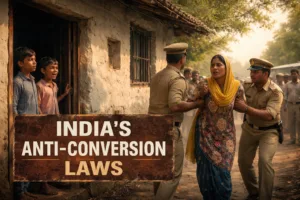
‘We Now Pray Quietly’: How India’s Anti-Conversion Laws Are Reshaping Christian Lives
Behind the statistics of arrests and court cases are families torn apart, children traumatized, and communities learning to practice their faith in the shadows
The morning light had barely touched the walls of Sushma’s home when the knocking began. Her children, ages seven and ten, watched from the doorway as their mother was led to a waiting police vehicle. They had been told she would answer some questions and return by evening. That was six weeks earlier.
“I kept thinking about my children crying at night,” Sushma, 32, recalls from her home in Uttar Pradesh, where she now speaks under a pseudonym, fearing further scrutiny. “I had never even been inside a police station before. I didn’t know what to expect, how long I would be there, or if I would see my children again.”
What landed Sushma in custody was not an accusation of violence, theft, or fraud. Her alleged crime, according to a complaint filed by neighbors, was hosting a small prayer meeting in her home—an act prosecutors characterized as an attempt at unlawful religious conversion under Uttar Pradesh’s stringent anti-conversion law.
The case against her would eventually weaken, and she would be released on bail. But the damage, her family says, had already been done. Her husband’s income as a daily wage laborer collapsed during the weeks he spent arranging her legal defense. Their children stopped attending school, afraid of questions from classmates and ashamed of the whispers that followed their family. Relatives who once visited weekly began keeping their distance.
“Before any court decided anything, our lives were already changed,” a family member says quietly, glancing toward the room where Sushma now rarely ventures beyond her doorstep. “We are still waiting for the case to conclude. But our neighbors have already concluded for themselves.”
The Human Toll Behind the Headlines
Sushma’s experience represents a growing reality for Christian communities across several Indian states, particularly in the north, where anti-conversion laws enacted over the past decade have increasingly been used to detain and prosecute minority faith practitioners. While these laws are officially designed to prevent conversions achieved through force, fraud, or allurement, human rights advocates and legal experts argue that their broad language has created an environment where ordinary religious expression can become grounds for arrest.
In Uttar Pradesh, home to more than 200 million people and one of India’s most stringent religious conversion statutes, recent convictions have sent ripples of anxiety through Christian communities. A widely discussed case saw a Christian couple sentenced to five years imprisonment for alleged conversion activity—a verdict that legal analysts say demonstrates how these laws are being applied to routine religious gatherings rather than the coercive conversions they purport to target.
The legislation criminalizes conversions obtained through “force, fraud, or inducement,” but critics contend that these terms remain poorly defined, allowing police to register cases based largely on suspicion or complaints from third parties with no direct involvement in the alleged conversion.
“What we’re seeing is the criminalization of faith itself,” says a Delhi-based human rights lawyer who has represented multiple clients in anti-conversion cases but requested anonymity due to the sensitivity of ongoing litigation. “The laws were drafted with a legitimate purpose—protecting vulnerable communities from exploitation. But in practice, they’ve become tools that can be activated by anyone with a grievance against a Christian neighbor, employee, or acquaintance.”
The numbers tell part of the story. According to tracking by civil liberties organizations, arrests of Christians under these statutes have increased substantially since 2020, though official government data remains limited. More telling, perhaps, is the nature of the complaints that trigger these arrests. In case after case documented by support groups, the allegations originate not from individuals claiming they were coerced into converting, but from local activists, vigilante groups, or neighbors who report suspicion of conversion activity.
“Once a case is registered, the accused enters a different world,” the lawyer explains. “The judicial process moves slowly—cases can take years to reach trial. Meanwhile, the person is out on bail, but their reputation in the community is destroyed. Their ability to work may be compromised. Their children face stigma at school. The legal case is just one front in a much broader battle for normal life.”
Women Bearing the Heaviest Burden
For women, the consequences of arrest under anti-conversion laws often extend well beyond the legal proceedings themselves. Several families interviewed for this article described how female relatives who were detained faced social stigma that persisted even after their release on bail, affecting their ability to work, maintain community relationships, and ensure their children’s wellbeing.
One woman from a town in Madhya Pradesh, who asked to be identified only by her first name, Priya, said her neighbors stopped speaking to her entirely after her arrest last year. A domestic worker whose income supported her two children, she lost her regular clients when word spread through the community.
“They didn’t ask about the case or whether I was guilty,” Priya says. “They just stopped calling. One woman I had worked for over five years told me she couldn’t have someone coming to her home who had been in trouble with police. She didn’t care what the trouble was about.”
Priya was eventually released on bail, but her case remains pending. Without her previous income, she now takes whatever informal work she can find, often traveling to neighborhoods where she is not known. Her children, she says, have become quiet and withdrawn.
“My daughter asked me why the other children called her names at school. I didn’t know what to tell her. How do you explain to a nine-year-old that her mother is accused of something she didn’t do, but that the accusation itself is enough to change everything?”
Another woman, whose husband was also detained in a separate case, described how her children begged to stay home from school after classmates taunted them about their parents’ arrest. For several weeks, she kept them home, unable to bear their distress and unsure how to protect them.
“We are fighting a case in court,” she says. “But we are also fighting people’s assumptions. The court will eventually decide the legal matter. The assumptions may never go away.”
The Children in the Shadows
Child welfare advocates say that children of parents arrested under anti-conversion laws face particular vulnerabilities that are often overlooked in discussions of the statutes’ impact. Sudden separation from parents, exposure to police actions in the home, and community hostility can create lasting psychological effects, especially among younger children.
In cases documented by support organizations, minors have been left in the care of distant relatives when both parents were detained simultaneously, disrupting education, nutrition, and daily routines. Even when one parent remains free, the demands of arranging legal defense, traveling for court hearings, and managing the family’s altered circumstances often mean less attention to children’s emotional needs.
“The trauma is compounded by the fact that these are not cases where the parent has done something that the child can understand as wrong,” explains a counselor who has worked with families affected by anti-conversion cases but requested anonymity to protect client confidentiality. “The child knows their parent was taken away, but they don’t understand why. They hear from other children that their parent is bad, but their own experience tells them something different. That contradiction is very difficult for young minds to process.”
Some families report that children have developed anxiety around authority figures, fearing that anyone in uniform might take their parents away. Others describe sleep disturbances, withdrawal from activities they once enjoyed, and reluctance to form new friendships.
“The effects may not be visible in a courtroom or a news article,” the counselor says. “But they will shape these children’s lives for years to come. They are learning that faith—their family’s faith—can make them targets. That is a heavy lesson for anyone, let alone a child.”
When Prayer Becomes a Risk
Across neighborhoods where Christians once gathered openly for prayer meetings, fellowship events, and festivals, a quiet transformation is underway. Pastor Samuel, who leads a small congregation in a town in Uttar Pradesh, says his community has fundamentally changed how it practices its faith.
“We used to invite people to our services,” he says, speaking on condition that his full identity not be used. “If someone showed interest in Christianity, we would welcome them, answer their questions, share our experiences. That was part of our understanding of faith—that it was something to be shared.”
Now, Pastor Samuel’s congregation meets in smaller groups, carefully limiting who is invited and avoiding anything that might be interpreted as outreach. New faces are viewed with caution rather than welcome. Conversations about faith happen in whispers, if they happen at all.
“We now pray quietly and avoid inviting new people,” he says. “Faith should not feel like a risk, but today many believers are afraid even to meet. Not because they are doing anything wrong, but because they don’t know how their gathering might be interpreted by someone who doesn’t understand.”
This shift from open practice to private devotion represents a profound change for communities that have long understood their faith as inherently communal and expressive. Festivals that once featured public processions are now celebrated within home compounds. Prayer meetings that drew dozens now draw handfuls. The vibrancy of shared worship has been replaced, in many places, by the caution of hidden practice.
“We are not hiding because we are ashamed,” one church leader explains. “We are hiding because we are afraid. There is a difference. But the result is the same—our faith becomes something we do behind closed doors, something we protect by making it invisible.”
The Legal Landscape: Protection or Persecution?
India’s constitutional framework guarantees freedom of religion, including the right to practice and propagate faith, while permitting states to regulate conversions to prevent coercion. This tension between religious liberty and consumer protection—ensuring that conversions result from genuine conviction rather than exploitation—has created a patchwork of state-level laws with widely varying interpretations.
Supporters of anti-conversion statutes argue that they serve as necessary safeguards for vulnerable communities, particularly tribal populations and lower-caste individuals who may be susceptible to allurement. They insist that authorities act only when credible allegations exist and that the laws target exploitation, not genuine religious practice.
“The intention is to protect, not to persecute,” says a legal scholar who has advised state governments on religious freedom legislation but asked not to be named due to the political sensitivity of the issue. “When a law is misapplied, that is a failure of implementation, not necessarily a flaw in the law itself. The question is whether we can address those failures while maintaining protections for those who need them.”
Critics, however, argue that the laws are inherently flawed precisely because their language is too broad to prevent misapplication. Terms like “force,” “fraud,” and “inducement” are defined loosely enough, they contend, to encompass ordinary expressions of faith, hospitality extended to seekers, or even the provision of social services by Christian organizations.
“What constitutes inducement?” asks the human rights lawyer. “If a Christian shares a meal with someone interested in their faith, is that inducement? If a church runs a school that provides quality education to poor children, is that inducement? The laws don’t provide clear answers, which means police and prosecutors have enormous discretion to decide what counts.”
This uncertainty creates a chilling effect that extends well beyond actual arrests. Christians across affected states report modifying their behavior not because they believe they are violating the law, but because they cannot be certain what might be interpreted as violation.
“I don’t know where the line is,” says a Christian shopkeeper in a mixed-faith neighborhood. “So I stay far away from it. I don’t talk about my faith with customers. I don’t invite anyone to my church. I don’t do anything that might make someone wonder what I believe. I just live my life quietly and hope that’s enough.”
Community Responses: Between Resistance and Retreat
Christian communities have responded to the changing environment in varied ways. Some have chosen public advocacy, organizing awareness campaigns and legal challenges to the statutes they believe target them unfairly. Church bodies have issued statements, filed interventions in court cases, and sought meetings with government officials to express their concerns.
Others have chosen a different path—retreat into private practice, minimizing visibility to reduce vulnerability. In some neighborhoods, Christmas celebrations that once featured lights and music visible from the street have moved indoors. Easter processions that wound through communities have been replaced by services held entirely within church walls.
“We celebrate the same faith, the same holidays, the same God,” says Pastor Samuel. “But we celebrate differently now. More quietly. More privately. It is still our faith, but it feels different. It feels smaller.”
Some congregations have found middle ground, maintaining their practices while taking precautions their predecessors never considered. Prayer meetings are scheduled at varying times to avoid establishing patterns. New attendees are welcomed only after multiple conversations establishing their genuine interest. Churches maintain relationships with local police stations, hoping that familiarity will prevent misunderstanding.
“We try to be good neighbors,” one pastor explains. “We help when there is need in the community. We contribute to local festivals. We want people to see us as part of the community, not apart from it. Sometimes that works. Sometimes it doesn’t. But we keep trying.”
The Long Road Ahead
For families like Sushma’s, the immediate crisis has passed—she is home with her children, her husband has returned to work, and the children have resumed their education. But the long-term consequences of her arrest continue to shape their lives.
The case against her remains pending, requiring periodic court appearances that take her away from work and family. Legal fees have consumed savings that were meant for her children’s future. The stigma of her arrest lingers in her neighborhood, affecting everything from her children’s friendships to her ability to buy groceries on credit from the local shop.
“I thought that if I was released, everything would go back to normal,” she says. “But normal was something we had before the police came. That normal is gone. We are building something new now, but it is not the same.”
Her children, she says, have begun asking questions about what happened—questions she struggles to answer honestly without frightening them or undermining their sense of safety.
“My son asked me if the police could come again. I told him no, that everything was fine now. But I don’t actually know if that’s true. I don’t know what might trigger another complaint, another arrest, another separation. I pray it doesn’t happen, but I can’t promise him it won’t.”
Across India, thousands of Christian families share that uncertainty. They continue to practice their faith, attend their churches, and raise their children in their traditions. But they do so with a heightened awareness that their religious identity carries risks their parents and grandparents never imagined.
“We are Christians,” Sushma says simply. “That is what we are. That is what we have always been. I don’t know how to be anything else. I just hope that being who we are doesn’t mean losing everything we have.”
You must be logged in to post a comment.