
‘We knew it was illegitimate’: the retirees caught in the UK’s controversial terror law crackdown
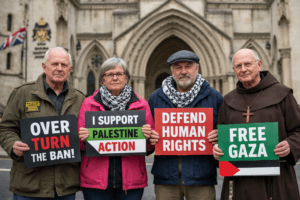
A landmark high court ruling declaring the UK government’s proscription of Palestine Action unlawful has brought a sense of vindication to the nearly 3,000 people—including many retirees, a former army colonel, and a Catholic priest—who were arrested under the ban for expressing solidarity with the group, but their relief is tempered by the government’s plan to appeal, leaving hundreds with outstanding charges in legal limbo while they express frustration that the crackdown has wasted public money and distracted from the ongoing suffering in Gaza, which they see as the true motivation for their protests.
‘We knew it was illegitimate’: the retirees caught in the UK’s controversial terror law crackdown
High court ruling brings vindication but not closure for hundreds facing uncertain legal futures after Palestine Action ban overturned
The champagne corks had barely settled after Friday’s landmark high court ruling when the reality began to sink in for Trisha Fine. The phone was ringing constantly – friends offering congratulations, assuming her 14-month legal nightmare was finally over.
“Quite a lot of friends have got in touch to say: ‘Yay, aren’t you lucky it’s all over?’” Fine says, her voice carrying the weary edge of someone who has learned not to trust good news. “It bloody isn’t. It seems like our jolly government has got all the cards in their hands.”
Fine, arrested in Cardiff last year while expressing solidarity with Palestine Action, speaks for nearly 3,000 people across Britain whose lives have been upended by one of the most controversial uses of counter-terrorism legislation in recent memory. This week’s high court decision declaring the government’s ban on Palestine Action unlawful should have been the end. Instead, with the Home Office confirming plans to appeal, it has become yet another chapter of uncertainty.
The judgment that shook Whitehall
In a scathing written judgment, Dame Victoria Sharp, president of the king’s bench division, delivered what legal experts describe as an extraordinary rebuke to the Home Office. Alongside two fellow senior judges, she ruled the proscription of Palestine Action unlawful on two fundamental grounds: it breached human rights laws, and it violated the home secretary’s own policy requiring consideration of whether a group poses a genuine threat to the UK.
For the retirees now scattered across the country – former military attaches, Catholic priests, grandparents, and Holocaust descendants – the ruling represents something rare in their long engagement with the British legal system: vindication.
Chris Romberg, a former army colonel and ex-military attache, has spent months waiting to enter a plea after his arrest last August. Standing outside court this week, he allowed himself a moment of quiet satisfaction.
“I’m pleased and satisfied that this proscription, which we knew was illegitimate, has now been shown to be unlawful as well,” he says.
The numbers tell their own story. Since July last year, according to civil liberties organisation Defend Our Juries, police have arrested at least 2,787 people across the UK. The alleged offence? Holding signs displaying statements such as “I oppose genocide, I support Palestine Action”. The arrests swept up pensioners at silent vigils, faith leaders at peaceful protests, and dozens of ordinary citizens who believed they were exercising fundamental democratic rights.
A life interrupted: 27 hours in custody
Fine’s experience offers a window into what happens when counter-terrorism powers intersect with the lives of ordinary citizens. Arrested in Cardiff, she spent more than 27 hours in police custody – time during which officers failed to inform her husband of her whereabouts.
“I was denied antibiotics I needed for a serious gum infection while in custody,” she recalls. The medical neglect was compounded by a subsequent travel ban that made it difficult to accompany her husband, then recovering from cancer treatment, on trips away.
“I want to get my life back,” she says quietly. “I’ve had enough.”
When asked whether she would do it again, Fine hesitates in a way that none of the other arrestees do. “I’m not sure that I would,” she admits – a confession that speaks volumes about the personal toll of state power exercised, as the courts have now ruled, unlawfully.
For others, the answer comes more swiftly. Father John McGowan, a Catholic priest arrested at a silent vigil in Parliament Square last August, doesn’t miss a beat.
“I’d do it all over again, no question,” he says. “And if I have to go to prison, I would do so. I could justify it to my conscience. It isn’t an easy thing to do, to break the law, to get arrested, but I’d be willing to do it over again. It’s just an inconvenience to me, compared to what people are going through in Gaza.”
The moral witness
McGowan, who lived in Jerusalem for five years, brings a perspective shaped by direct experience of the region. His anger at the government runs deep, not merely for the personal inconvenience of arrest and potential prosecution, but for what he sees as a fundamental moral failure.
“I’m angry at the government, and even angrier now that they should want to appeal,” he says. “They do not seem to understand the anger of probably the majority of British people at them for supporting Israel. If they want to know the reason why they’re unpopular, this is one of them. Their unconditional support for Israel.”
For McGowan, the government has placed itself “on the wrong side of history”. The decision to proscribe Palestine Action, he suggests, revealed something deeper about the political class.
“It just struck me how out of touch the government is with the people in this country.”
Romberg, who is also a member of Holocaust Survivors and Descendants against the Gaza Genocide, offers an even starker assessment. He attributes the Palestine Action ban to “the type of political class we have now, which doesn’t seem to believe in anything”.
“We have a government that seems to have given up on its values, on its liberties, on rights, happy to turn on its own people, and even to lie, and it hasn’t worked for them,” he says. “It may go to the supreme court, but whatever happens, this has been a big blow for the government because their credibility, I think, is completely shot.”
The secret evidence that wasn’t
Throughout the legal battle, the government had hinted at secret evidence that would justify the proscription – material too sensitive to share in open court but sufficiently damning to prove Palestine Action’s terrorist credentials. In the end, it failed to convince the judges.
Romberg notes this with particular satisfaction. “Lots of talk about secret evidence that would definitely prove that [Palestine Action] should be banned as a terrorist organisation hasn’t convinced the judges,” he says.
The failure of the secret evidence argument raises uncomfortable questions about the basis on which nearly 3,000 people were arrested. If the government cannot convince three of the UK’s most senior judges that the proscription was lawful, what justified the mass arrests, the nights in custody, the travel bans, the ongoing criminal proceedings?
Richard Whitmore-Jones, arrested six times and currently facing multiple charges, has done the maths on what this has cost the public purse. A former professional who found himself caught up in the protests, he describes the entire episode as “a disgraceful waste of money”.
“It’s clearly just a disgraceful waste of money to keep arresting people for this and putting them in prison and holding people on remand for excessive periods,” he says. “It’s just unconstitutional and disgraceful.”
Whitmore-Jones, who has so far pleaded not guilty to the first of his charges, received a summons to another plea hearing through the post on Friday – arriving while he was outside the Royal Courts of Justice, celebrating the high court’s decision.
“I still have a number of bad-boy appointments at magistrates courts,” he jokes, though the humour barely masks the underlying strain of living with ongoing legal uncertainty.
The limbo persists
For all those with outstanding charges or open police investigations, Friday’s ruling changed nothing – at least not yet. While the Metropolitan police have confirmed they will cease arresting people for expressing support for Palestine Action pending the appeal process, officers will continue gathering evidence at protests.
The government’s decision to appeal means the legal sword still hangs over hundreds of defendants. Dame Victoria Sharp indicated she would hear from both sides before issuing an order to remove the proscription while the appeal proceeds – a procedural step that leaves defendants in an agonising limbo.
Whitmore-Jones captures the emotional whiplash of the past few days. “Obviously yesterday was such a good day, we were all ecstatic that the proscription ban was overturned, but I think today I’m feeling a little bit more circumspect about what might happen in future with the appeal.”
The wider context: Gaza and the failure to look
Throughout conversations with those caught up in the arrests, one theme emerges with striking consistency: frustration that while Britain debates the legality of protest, the situation in Gaza continues to deteriorate.
“I’m concerned that all this fiddling around with the law doesn’t prevent civilians being killed in Palestine,” Whitmore-Jones says.
The statistics he cites are stark. “At least one child is being murdered every day in Gaza. I think yesterday there were 30 or 40 people killed. People are dying from cold, lack of medicine, and they’re being killed by munitions. And our country is supporting it. I’m just horrified.”
For Whitmore-Jones, the connection between the protests and the suffering they seek to highlight remains paramount. He describes a conversation with his grandchildren that crystallised his motivation.
“I came out with this rather trashy quote that bad things happen when good people stand around and allow it to happen,” he says. “And that’s exactly the situation that we’re in.”
Father McGowan makes a similar point. The inconvenience of arrest, the prospect of prison, the stress of legal proceedings – all of it pales beside what Palestinians are experiencing.
“It’s just an inconvenience to me, compared to what people are going through in Gaza,” he says.
A question of values
The Palestine Action proscription and its aftermath raise fundamental questions about the nature of British democracy and the limits of state power. A government that prides itself on upholding the rule of law has now been found by the country’s most senior judges to have acted unlawfully in banning an organisation. Nearly 3,000 people have been arrested under that unlawful ban. Hundreds face ongoing criminal proceedings.
The government’s decision to appeal means these questions will remain unresolved for months to come. But for those who have lived through the past 14 months, the damage has already been done.
Romberg speaks of a government that has “turned on its own people” and “even lied” in pursuit of its objectives. He believes the credibility of the political class is “completely shot” – a damning verdict from a former military attache, a man who spent his career serving the state that now seeks to prosecute him.
As the legal battle moves towards the Supreme Court, the retirees who became unlikely defendants wait in the wings. They have won a significant victory, but not yet their freedom. They have been vindicated by the courts, but not yet cleared of the charges brought against them under an unlawful ban.
Trisha Fine wants her life back. Chris Romberg hopes the government’s credibility is indeed “completely shot”. Richard Whitmore-Jones continues to receive summonses through the post. Father John McGowan stands ready to go to prison if necessary.
And in Gaza, the killing continues – the reason, they all insist, that they took to the streets in the first place, holding signs that led to their arrest, their interrogation, their uncertain future.
“I’d do it all over again, no question,” McGowan repeats. “In a heartbeat.”
You must be logged in to post a comment.