
‘We Are Living in the Open-Air Prison’s Cage’: The Forgotten Front of the West Bank
‘We Are Living in the Open-Air Prison’s Cage’: The Forgotten Front of the West Bank
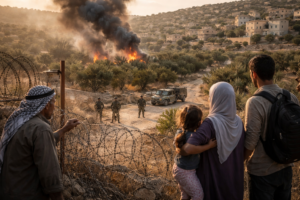
RAMALLAH, West Bank — For the Palestinian farmers of Abu Falah, the olive harvest has always been a race against time. But in the first week of March 2026, the race was not against the changing of the seasons, but against the barrel of a settler’s gun. The village, a patchwork of stone houses and terraced hillsides northeast of Ramallah, became the epicenter of a brutal, sharp escalation in violence that has swept across the West Bank under the deafening cover of a regional war.
While the world’s gaze remains fixed on the dramatic military confrontation between Israel, its allies, and Iran, a quieter, more intimate form of violence is reshaping the landscape of the occupied territories. It is a violence of torched fields, of sudden gunfire at a village edge, of military checkpoints that don’t just delay life, but suffocate it. As the major powers trade blows in the headlines, the daily reality for Palestinians in the West Bank has devolved into a relentless campaign of pressure, displacement, and erasure.
Muhannad Jaduo’s report for WAFA from March 8th paints a statistical picture of this escalation: an estimated 25% increase in settler attacks, eight Palestinians killed in a single week, hundreds arrested, and thousands of ancient olive trees reduced to ash. But behind the cold numbers are the stories of communities being systematically unraveled. This is not merely a spillover of the regional conflict; it is a deliberate exploitation of it—a calculated move to reshape the West Bank while the world is looking the other way.
The Settlers’ War: A Week of Blood in the Hills
The first week of March was not a week of open battle, but of targeted strikes. In Abu Falah, the Hamayel family bore the brunt of the new reality. Thaer Farouq Hamayel, just 24 years old, and Farea Jawdat Hamayel, 57, were not soldiers on a front line. They were community members, likely tending to land their families had cultivated for generations, when they were shot and killed by settler gunfire. Their deaths were not isolated incidents but part of a coordinated pattern.
Just days later, in the village of Qaryout, south of Nablus, the Ma’ammar family experienced a horror no family should endure. Two brothers, Mohammad Taha Abdul Majid Ma’ammar, 52, and Faheem Abdul Majid Ma’ammar, 47, were killed together. In the tightly-knit fabric of Palestinian village life, where family is the primary source of identity and support, the loss of two men from the same household is a catastrophe that echoes for generations. It leaves widows, orphans, and a community grappling with a gaping wound.
Further south, in the Hebron hills, the violence was just as pervasive. Amir Mohammad Shnaran, 27, from Yatta, fell to settler gunfire, while Mohammad Jihad Masalmeh and Tamer Ismail Qaisi were killed by Israeli army gunfire. The distinction between settler and soldier often blurs in these moments; the army frequently provides cover for settler attacks, and settlers often operate with military-grade weaponry and impunity. This synergy was chillingly illustrated by the death of Mohammad Hussein Murra, 55, also from Abu Falah. He didn’t die from a bullet, but from inhaling tear gas fired by occupation forces who were present specifically to provide protection during a settler attack on his village. He was suffocated by the very force meant to “keep the peace.”
This is the new face of the “price tag” strategy, but on a grand scale. It is an organized, ideologically-driven effort to make life so unbearable, so dangerous, that Palestinians will leave. In the northern Jordan Valley, this goal is being realized in real-time. In the village of Aqaba, east of Tubas, six families reached their breaking point. After a particularly vicious settler attack that left 12 villagers shot by the Israeli army while trying to defend their homes, these families made the agonizing decision to dismantle their own homes and tents. They packed up their lives, not because they wanted to, but because staying meant risking death. This is not war; it is ethnic cleansing by attrition, a slow-motion expulsion carried out under the radar.
The Strangulation of Daily Life: Eid Under Siege
Beyond the gunfire and the direct physical violence, a more pervasive weapon is being deployed: the closure. The Israeli authorities have imposed what local residents describe as unprecedented military restrictions across the West Bank. Main roads, the arteries of Palestinian economic and social life, have been sealed with iron gates and earth mounds. Checkpoints, once a daily nuisance, have become impenetrable barriers.
For the millions of Palestinians observing the holy month of Ramadan, this year is defined not by spiritual reflection and communal celebration, but by isolation and economic desperation. As Eid al-Fitr, the festival that marks the end of the fasting month, approaches, the West Bank’s economy is in a state of paralysis.
In normal times, the weeks leading up to Eid are a flurry of activity. Markets overflow with shoppers buying new clothes, sweets, and gifts. Families travel across the West Bank to visit relatives, share meals, and pray together. In 2026, the markets of Ramallah, Nablus, and Hebron are eerily quiet. Employees cannot reach their workplaces. Goods cannot be transported. The simple joy of buying a new dress for a child or visiting a grandmother in a neighboring village has been rendered impossible by military fiat.
Nowhere is this cultural and religious suffocation more acute than in occupied East Jerusalem. The Old City, a magnetic center for worshippers and tourists during Ramadan, has been sealed off, accessible only to its residents. Al-Aqsa Mosque, the third holiest site in Islam, has been effectively closed. For the first time in recent memory, the faithful have been barred from Friday prayers and the special nightly Tarawih prayers. The sound of the call to prayer echoes through empty alleyways, answered only by the footsteps of Israeli patrols.
For the estimated 1,400 merchants in the Old City who depend on the Ramadan rush to sustain their families for the entire year, this is an economic death blow. Their shops, stocked with goods and hope, sit idle. The spiritual vacuum is matched by a profound economic despair. Meanwhile, Israeli excavations continue unabated beneath the Al-Aqsa compound, a move that fuels existential fears among Palestinians and the wider Muslim world that the physical and historical foundations of their holy site are being deliberately undermined. As UN experts have warned, Jerusalem is facing irreparable harm as Israel accelerates measures to alter its demographic composition and religious character, using the regional chaos as a smokescreen.
The Night Raids and the Forgotten Prisoners
The violence is not confined to daylight hours or village perimeters. As night falls across the West Bank, the now-familiar rhythm of military occupation intensifies. In cities like Bethlehem, Salfit, and Jenin, families are jolted from their sleep by the pounding on their doors. The Israeli army has conducted widespread detention campaigns, sweeping through neighborhoods, arresting over 225 people in a single week. Homes are invaded, belongings are smashed, and residents are subjected to field interrogations before being bundled into military vehicles.
Some homes aren’t just raided; they are seized. In several instances, the army has taken over private residences, evicting the families or confining them to a single room while turning the rest of the house into a military outpost. Snipers are positioned in bedrooms, their muzzles protruding from windows that once framed a child’s view of the world. The intimate space of the home, the last sanctuary of Palestinian life, has been militarized.
For those already in Israeli custody, the situation has grown even more desperate. Court sessions for Palestinian prisoners have been postponed for the second consecutive week. Appeals for “administrative detainees”—prisoners held indefinitely without charge or trial—have been delayed indefinitely. West Bank lawyers, barred from entering Israel due to the closures, cannot even visit their clients. The prisoners are left in a legal limbo, erased from the judicial process and forgotten by a world consumed with other conflicts. They are the hidden casualties of the war, their voices silenced by concrete walls and diplomatic silence.
The Gaza Paradox: Ceasefire is Not Peace
The report from Gaza adds a layer of tragic paradox to the regional situation. An announced ceasefire has been in place since October, yet the killing has not stopped. Since that agreement, the Ministry of Health reports 641 fatalities and over 1,700 injuries, with 755 bodies recovered from the rubble. The total toll since October 7, 2023, has now climbed to a staggering 72,126.
The blockade remains, tighter than ever. Humanitarian aid is restricted. Medical evacuations, a lifeline for the critically ill, have been suspended. The World Health Organization warns of a looming health catastrophe as medicine stocks dwindle and patients face life-threatening delays. The UN has had to postpone staff rotations, crippling its ability to coordinate the very aid that is supposed to flow.
For Gazans, the “ceasefire” is a word devoid of meaning. It is merely a less intense phase of the same siege, a slow suffocation that continues to claim lives long after the major bombing campaigns have subsided. The regional war has provided the perfect cover to tighten the screws on Gaza, ensuring that even in a state of supposed calm, the territory remains uninhabitable.
Conclusion: The World’s Blind Spot
As the geopolitical chess game plays out between Washington, Tehran, and Tel Aviv, the people on the ground in the West Bank are being systematically erased from the board. The escalating settler violence, the military closures, the home seizures, and the economic strangulation are not random byproducts of war. They are a coordinated policy, a land grab executed under the cover of conflict.
The world’s attention is a finite resource, and it is currently being consumed elsewhere. This is precisely the point. The architects of this escalation understand that a distracted world is a permissive world. While we watch the missiles fly, the olive trees of Idhna are being uprooted. While we analyze diplomatic cables, the families of Aqaba are dismantling their tents. While we debate the ethics of drone strikes, a child in Ma’azi Jaba’ nurses wounds from a settler attack.
The West Bank is not a separate issue from the regional war; it is the other front, the one where the conflict’s most enduring and intimate consequences are being written. It is a slow-motion catastrophe unfolding in plain sight, a tragedy not of sudden explosions, but of the quiet, relentless extinguishing of a people’s presence on their own land. And unless the world turns its gaze back to this forgotten front, the map of Palestine will continue to be redrawn, one torched field, one closed road, one stolen life at a time.
You must be logged in to post a comment.