
Walking the Via Dolorosa in 2026: A Conversation on Suffering, Faith, and the Long Road to Peace
Father Francesco Patton, the former Custos of the Holy Land, was personally asked by Pope Leo XIV to write the Good Friday Via Crucis meditations at the Colosseum—an assignment tied to the eighth centenary of St. Francis of Assisi’s death. Drawing on the Gospel of John, Franciscan spirituality, and his nine years of witnessing war and suffering in the Middle East, Patton shaped the reflections around real people he encountered: grieving mothers (the “watermark” of Mary and Veronica), selfless aid workers (modern Cyrenians), and victims of religiously justified violence. He emphasized that the meditations are not meant to judge individuals but to inspire personal change and reveal Christ’s closeness to every suffering person. Patton also warned of the global return of “zealots” who exploit religion to fuel conflict, called for desacralizing political power, and expressed hope for eventual peace in the Holy Land through cultural change, grassroots movements, and education. At the end of his custodial mandate, Patton chose to remain in the region as a simple friar on Mount Nebo, seeking a life of prayer and humble service.
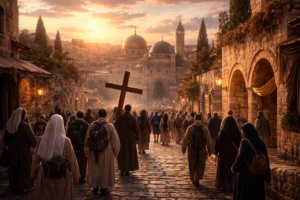
Walking the Via Dolorosa in 2026: A Conversation on Suffering, Faith, and the Long Road to Peace
In a few days, when Pope Leo XIV kneels beneath the shadow of the Colosseum on Good Friday evening, the words he prays will not have been written in the quiet of a Vatican library. They were written in Gaza, in the West Bank, in Syrian refugee camps, and on a mountain in Jordan where an aging prophet once gazed upon a land he would never enter.
Father Francesco Patton, who served as the Custos of the Holy Land for nearly a decade until June 2025, has spent the past several months doing something few spiritual leaders ever experience: translating the raw, unvarnished suffering of real people into a liturgical meditation that the entire world will hear.
“It intimidated me,” Patton admits of the assignment from Pope Leo XIV. “But at the same time, it honored me.”
The choice of Patton is no accident. The year 2026 marks the eighth centenary of the death of St. Francis of Assisi, and the Pope wanted the Good Friday meditations to reflect the Franciscan charism of walking alongside the suffering—not from a distance, but with dirty sandals and a breaking heart.
The Watermark of Women
Patton is careful with his words, as any man who has spent nine years navigating the religious and political minefields of the Holy Land must be. But when he speaks about the women who inspired his writing, something shifts in his tone.
“Where I speak about the suffering of mothers and women, women appear in watermark who have also been written about in L’Osservatore Romano and who today embody the figure of Mary, Veronica, and the women of Jerusalem,” he says.
He does not name them. He does not need to. Anyone who has followed the news from Gaza over the past two years knows their faces: mothers clutching empty rice sacks, grandmothers digging through concrete dust with bare hands, young women walking miles for a single bottle of water that might be contaminated.
These are not abstract figures of biblical piety. These are the women Patton met in hospital corridors and church basements, women who have buried children and then returned to stand in line for bread. In his meditations, their voices become the voice of the Via Dolorosa itself.
Beyond Judgment: The Religious Core
One of the most striking aspects of Patton’s approach is what he refuses to do. He will not name names. He will not point fingers. He will not transform the Colosseum into a political tribunal.
“The concrete situations named in the reflections do not want to trigger judgment on individual persons,” he insists. “They invite reflection, asking questions and—if necessary—even to change.”
This is a deliberate theological choice. The Way of the Cross, as Patton understands it, is not a courtroom. It is a procession. It moves. It walks. And in the walking, something happens that cannot happen in the stillness of accusation: hearts begin to soften.
“The message is essentially religious,” Patton says. “It wants to express the closeness of Jesus Christ, as the incarnate Son of God, to every human person.”
For non-believers who will watch the Colosseum ceremony—and there are always many—Patton hopes for something simpler: “That they discover that Jesus cares about each of us, and that in Him one can find hope and a reason for life even if it has been lost.”
The Cyrenean Has Many Faces
One of the most powerful images in the traditional Stations of the Cross is Simon of Cyrene, the passerby forced to carry Jesus’s cross. In Patton’s meditation, Simon has many faces.
“Behind the reflection on the distorted conception of power and abuse of power there are international news events that are before everyone’s eyes,” he says. But then he adds something unexpected: “The Cyrenean has the face of many volunteers and humanitarian and communication workers whom I have met over these years and who risked their lives to care for someone or to make the truth known, without even being Christians.”
This is a remarkable admission: that non-believers can carry the cross as faithfully as any saint. Patton has watched aid workers from secular organizations pull bodies from rubble. He has watched journalists risk sniper fire to document atrocities. He has watched ordinary people—Muslims, Jews, atheists—perform acts of extraordinary compassion.
In his meditation, they are not converted. They are not baptized. They are simply honored. And in that honoring, something subversive happens: the cross becomes not a Christian possession but a human reality.
The Little Flock
When asked about Christians in the Holy Land—whose numbers have dwindled precipitously over the past two decades—Patton does not despair. Instead, he reaches back two millennia.
“Christians living today in the Holy Land are very similar to the first generation of Christians,” he says. “They have the same virtues and the same limits, and probably the same DNA.”
The first Christians were statistically insignificant. They had no political power, no army, no economic leverage. What they had was a story—a story about a crucified man who rose from the dead and invited everyone, absolutely everyone, to the table.
“Being Christians in the Holy Land is a vocation and a mission,” Patton says. “We are called to show the merciful face of God who welcomes every person without distinction of gender, nationality, or religion.”
This is not sentimentalism. In a region where every identity marker can get you killed, welcoming every person without distinction is a radical, dangerous act. It is, in its own way, a crucifixion.
The Return of the Zealots
Perhaps the most provocative section of the interview concerns what Patton calls the return of the “zealots”—the first-century Jewish revolutionaries who believed violence in God’s name was not only permissible but sacred.
“Today, ‘zealots’ are everywhere,” Patton says. “We find them in the Muslim world through a galaxy of armed fundamentalist movements. We find them in the Jewish world, well represented by settlers and those who politically support them. We also find them among Christians, who unfortunately invoke strange blessings going in the opposite direction to that indicated by Pope Leo XIV and 2,000 years ago by Jesus in Gethsemane.”
The reference to “strange blessings” is pointed. In recent years, some Christian groups have embraced a form of messianic politics that blesses military expansion and ethnic exclusivity. For Patton, this is a betrayal of the Gospel.
“What is happening in Israel is not an anomaly but a global trend,” he warns. The solution, he believes, lies in desacralizing political power while guaranteeing religious freedom for all. “It is necessary to remove the ground from under both religious fundamentalism and the political exploitation of religion.”
He points to the Document on Human Fraternity signed in Abu Dhabi by Pope Francis and the Grand Imam of Al-Azhar as a potential foundation for what he calls a “UN of religions”—a global body where religious leaders cooperate to delegitimize any exploitation of faith to justify violence.
Will There Ever Be Peace?
The question hangs in the air, heavy and familiar. The Israeli-Palestinian conflict has lasted eighty years. Ninety-five percent of today’s combatants have never known peace. What possible reason is there for hope?
Patton does not offer easy answers. He does not predict a breakthrough or announce a miracle. What he offers is something stranger and perhaps more valuable: patience.
“Sooner or later there will be peace, inevitably,” he says. “But the path will still be long. It will require a generational change, a change of political class, and above all a cultural change.”
He sees signs of hope in civil society: the movement started by Israeli Maoz Inon and Palestinian Aziz Abu Sarah; the “Mothers Who Walk Barefoot for Peace”; the “Women of Faith for Peace.” These are small groups, statistically insignificant—much like the first Christians.
“Our own schools are an example of education towards coexistence and fraternity,” Patton says. He calls for compulsory programs of education for respect and welcoming of the other, following the model of Rondine, the citadel of peace in Arezzo, Italy. “This is not only true for Israel and Palestine but also for European countries.”
Mount Nebo: The View from the Edge
Perhaps the most personal moment in the interview comes when Patton discusses his decision to remain in the Holy Land after his custodial mandate ended. He could have returned to Italy, to comfort, to familiarity. Instead, he chose Mount Nebo—the mountain in Jordan from which Moses saw the Promised Land but could not enter.
“After so many years spent in positions of authority and governance, I felt the need to return to living as a simple Minor Friar,” he says. “Living in a small, somewhat peripheral fraternity allows me to recover a more regular rhythm of prayer, resume studying, serve pilgrims, and perform humble services.”
There is something deeply Franciscan about this choice. Francis of Assisi famously relinquished authority, choosing poverty and obscurity over institutional power. Patton, in his own way, is doing the same.
Mount Nebo has particular resonance for him. It was a Byzantine monastery and sanctuary for centuries, then swallowed by history and left in ruins, then reborn a hundred years ago thanks to the friars of the Custody of the Holy Land. Today, it is frequented by Christians and Muslims alike.
“It is a meeting place for everyone and with everyone,” Patton says. “All can breathe that climate of faith and peace it transmits, and all can obtain ‘healing of body and soul,’ as a pilgrim of the 5th century said.”
What the Colosseum Will Hear
On Good Friday evening, when Pope Leo XIV kneels before the ancient arena where Christians were once martyred, the words he prays will carry the weight of Patton’s nine years in the Holy Land. They will carry the tears of women in Gaza, the exhaustion of aid workers in Syria, the quiet courage of Christians who refuse to leave their ancestral lands.
But they will also carry something else: the conviction that the cross is not a symbol of defeat but of transformation. That suffering is real but not final. That death has an enemy, and that enemy has already lost.
“My desire,” Patton says, “is that by encountering Jesus Christ and walking behind Him toward Calvary, every person may perceive His closeness and His love; perceive that Jesus Christ gave His life for each of us and wants to bring each of us ‘back to the Father’ together with Him, to find life in its fullness.”
It is a message that would have been familiar to the first Christians, huddled in their small, statistically insignificant communities. It is a message that will be familiar to the last Christians, whenever and wherever they gather. And on one Friday night in April, surrounded by the ghosts of the Colosseum and the prayers of a watching world, it will be proclaimed again.
The Via Dolorosa is still being walked. The cross is still being carried. And somewhere on a mountain in Jordan, a simple friar who once held the keys to the holiest places on earth is washing dishes, studying Scripture, and waiting for the resurrection.
You must be logged in to post a comment.