
Walking a Tightrope: Anita Anand’s Diplomatic Balancing Act in Mumbai Reveals Canada’s India Conundrum
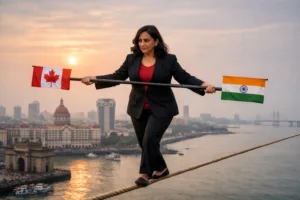
Walking a Tightrope: Anita Anand’s Diplomatic Balancing Act in Mumbai Reveals Canada’s India Conundrum
The Mumbai air hung thick with humidity and unspoken tensions as Foreign Affairs Minister Anita Anand faced the press corps on Saturday, her words carefully calibrated to bridge an impossible divide. Behind her, the bustling commercial capital of India symbolized the economic promise that Canada’s new government desperately seeks. Before her, journalists armed with questions about national security, murder investigations, and whether Canada’s intelligence community had just performed an inexplicable about-face on foreign interference.
“No country has a pass when it comes to Canadian public safety and security,” Anand declared, her statement landing like a diplomatic grenade wrapped in diplomatic velvet.
The scene captured perfectly the paradox of Canada-India relations in early 2026: a government trying to warm ties with New Delhi while simultaneously refusing to say whether it believes Indian agents still threaten Canadian citizens on Canadian soil.
The Briefing That Shook Ottawa’s Security Establishment
To understand why Anand’s Mumbai press conference mattered—why it reverberated from the manicured lawns of Rockcliffe Park to the Sikh gurdwaras of Brampton—you have to go back to what happened in Ottawa just three days earlier.
A senior Canadian government official, speaking on condition of anonymity, told reporters something extraordinary: India was no longer involved in foreign interference or transnational repression in Canada. The official went further, suggesting that if the government believed otherwise, Prime Minister Mark Carney’s trade mission to India would not be proceeding.
The timing was surreal. Only sixteen months had passed since Canada expelled six Indian diplomats, including High Commissioner Sanjay Verma, after the RCMP named them “persons of interest” in an investigation into what police described as a campaign of violence, extortion, and intimidation targeting the Sikh diaspora. The RCMP had gathered evidence suggesting agents of Narendra Modi’s government were running operations on Canadian territory.
Now, a senior official was effectively declaring the matter resolved.
National security experts reacted with something between disbelief and alarm. Jody Thomas, who served as Prime Minister Justin Trudeau’s national security adviser, put it delicately: she found it “hard to believe” that things had resolved themselves to the point described. Stephanie Carvin, a former national security analyst now teaching at Carleton University, was blunter. India has meddled in Canada since the 1980s, she noted. “It did not stop this week because of a few official exchanges.”
More troubling to Carvin was what she saw as the politicization of intelligence—a warning that the recent Public Inquiry on Foreign Interference had specifically cautioned against. When senior officials downplay threats, she argued, they risk either ignorance or opportunism, “neither of which is good.”
The Sikh Community’s Unanswered Questions
For Sikh Canadians, the official’s statement wasn’t just puzzling—it was disconnected from lived reality.
Liberal MP Sukh Dhaliwal, representing Surrey—one of Canada’s largest Sikh communities—condemned the remarks outright. “This view is disconnected from the reality confronting members of the Sikh community across Canada and contradicts assessments by national-security and law-enforcement agencies.”
What reality? The one where community leaders receive threatening phone calls. Where temples monitor unfamiliar visitors. Where families in British Columbia follow the trials of murder cases allegedly linked to extortion rackets reaching back to the subcontinent. Where the name “Bishnoi gang”—which Canada recently listed as a terrorist entity—has become shorthand for a network of transnational crime and intimidation.
Anand pointed to that listing as evidence of Canada’s vigilance. “That is the reason why we’ve listed the Bishnoi gang as a terrorist entity,” she said. “That is the reason why we ordered senior Indian diplomats and government officials to leave our country.”
But listing a gang and expelling diplomats is retrospective action. It doesn’t answer the forward-looking question: Is it still happening?
On that, Anand would not be drawn. She declined repeatedly to say whether she agreed with the anonymous official’s assessment. Instead, she pivoted to process—the registry of foreign agents Canada is establishing, the guardrails being built.
For community members who have watched the RCMP lay charges in recent months related to alleged India-linked plots, process feels insufficient.
The Carney Calculus: Economics Versus Security
To understand why Mark Carney’s government is navigating these waters, follow the money.
The United States under Donald Trump has become increasingly protectionist. Trade wars threaten. Supply chains are being weaponized. For Canada, overdependence on the American market—long criticized but tolerated—has suddenly become an existential vulnerability.
India represents an alternative. Not an easy alternative, not a seamless alternative, but a demographic and economic force that can’t be ignored. With 1.4 billion people and one of the world’s fastest-growing major economies, India is a market Canada can’t afford to permanently alienate.
Carney signaled ambition in Mumbai, suggesting a comprehensive trade deal could be completed by year’s end. Canadian universities announced partnerships with Indian counterparts. Saskatchewan Premier Scott Moe expressed optimism about uranium deals.
The economic logic is compelling. The security logic, however, remains unresolved.
This is the tightrope Carney walks: how do you negotiate trade with a government your police force recently accused of running violent operations on your soil? How do you sign MOUs with universities in a country whose diplomats you expelled for allegedly directing threats against your citizens?
The anonymous official’s statement—that India is no longer interfering—would conveniently resolve this contradiction. If it were true.
The Russia Complication
Then there’s the elephant in every room where Canada and India meet: Russia.
India maintains what it calls “strategic autonomy”—a foreign policy doctrine that means refusing to choose sides between global powers. In practice, this translates to warm relations with everyone, including those Canada considers adversaries.
Prime Minister Modi hosted Vladimir Putin in December 2025, praising their “deep and unbreakable relationship.” Russia remains India’s primary arms supplier. Energy ties flourish. At the United Nations, India routinely abstains from votes condemning Russian aggression in Ukraine.
Canada, by contrast, has spent over $25 billion supporting Ukraine’s defense since 2022. The contrast couldn’t be starker.
When a reporter asked Anand how Canada-India relations could advance given New Delhi’s embrace of Moscow, her answer revealed the pragmatic philosophy driving this government: “We actually have to be able to advocate. Diplomacy is not about hiding under a rock and saying, ‘I am not going to deal with you because of the actions of your government.’ Diplomacy, in my view, is very much about sitting at the table, having conversations that are difficult, but conversations that represent Canadian interests.”
Translation: We can’t afford the luxury of only dealing with countries we agree with.
The Hardeep Singh Nijjar Shadow
No discussion of Canada-India relations can escape the shadow of Hardeep Singh Nijjar, the British Columbia Sikh activist whose murder in June 2023 shattered whatever normalcy existed between Ottawa and New Delhi.
Nijjar, 45, was shot multiple times in his pickup truck outside the Guru Nanak Sikh Gurdwara in Surrey. He had been designated a terrorist by India—a designation Canada rejected—and had organized an unofficial referendum on Sikh independence among diaspora members.
When Justin Trudeau stood in the House of Commons in September 2023 and announced “credible allegations” linking Indian government agents to Nijjar’s killing, the diplomatic rupture was immediate and severe. India denied involvement, expelled Canadian diplomats in retaliation, and suspended visa services for Canadians.
The freeze lasted through 2024 and most of 2025. Diplomatic expulsions continued. Rhetoric hardened. The relationship hit its lowest point since the 1985 Air India bombing—a terrorist attack originating in Canada that killed 329 people, most of them Canadian citizens, and which was linked to Sikh extremists seeking revenge for India’s 1984 attack on the Golden Temple.
For decades after Air India, Canada-India relations operated under a shadow of mutual suspicion. The Nijjar case brought those suspicions roaring back, but with roles reversed: now it was Canada accusing India of state-sponsored violence on Canadian soil.
Sixteen months after the last diplomatic expulsions, Carney’s government is attempting a reset. But resets require trust, and trust requires accountability. The Nijjar investigation continues. No one has been arrested. The RCMP’s allegations against Indian diplomats remain unproven in court but also unretracted by the government.
What Intelligence Actually Shows
The central mystery in this diplomatic drama is empirical: What does Canadian intelligence actually believe about ongoing Indian interference?
The anonymous official’s statement suggested a definitive conclusion: it’s over. But former officials and experts express skepticism, partly because foreign interference doesn’t typically end with announcements. It’s not the kind of activity that lends itself to clean conclusions.
India’s intelligence apparatus has deep historical roots in Canada, stretching back to operations targeting Sikh separatists in the 1980s. Those operations didn’t stop because of diplomatic protests then, and experts question whether they would stop now simply because Canada wants better trade relations.
Moreover, the incentives for India haven’t changed. The Sikh separatist movement, while marginal in India, remains active in the diaspora. Canadian politicians still court Sikh votes. Gurdwaras still host discussions that New Delhi considers hostile. From India’s perspective, the underlying irritants persist.
If Indian interference has truly ceased, what changed? Was there a secret agreement? A policy shift in New Delhi? A deal trading non-interference for diplomatic normalization?
The Canadian government hasn’t explained, and Anand’s refusal to endorse the anonymous official’s statement suggests either internal disagreement or a recognition that the claim requires more evidence than the government can currently provide.
The Human Dimension
Lost in the diplomatic maneuvering and intelligence assessments are the human beings caught in the middle.
Canadian Sikhs who have spent months—years—watching over their shoulders. Community leaders who weigh every public statement, wondering if it will invite unwanted attention. Families who came to Canada seeking safety from the very conflicts they’re now told may have followed them across oceans.
For these Canadians, the question of whether India is still interfering isn’t academic. It determines whether they feel safe in their homes, their temples, their communities.
Anand’s statement that “no country has a pass” is meant to reassure. But reassurance requires credibility, and credibility requires consistency. When a senior official suggests the threat has passed and the minister won’t confirm or deny it, consistency suffers.
There’s also the question of what message Canada’s shifting stance sends to other countries watching. If India can weather allegations of state-sponsored violence, diplomatic expulsions, and RCMP investigations, only to have a senior official declare the matter resolved sixteen months later in service of trade talks, what signal does that send to China? To Iran? To any country contemplating operations on Canadian soil?
The message may be that Canadian resolve has a shelf life, and that economic imperatives will ultimately trump security concerns.
The Path Forward
Carney’s government faces a delicate navigation in the months ahead. Completing a trade deal with India by year’s end, as the Prime Minister has suggested, requires diplomatic momentum. But momentum requires trust, and trust requires addressing—not sidestepping—the hard questions.
The Nijjar investigation continues. The RCMP’s allegations against Indian diplomats remain on the public record. The Bishnoi gang listing acknowledges ongoing transnational criminal activity with links to India. These realities don’t disappear because Canada wants better trade terms.
Anand’s approach in Mumbai—affirming Canada’s right to security while declining to characterize current threats—may be the only politically viable path. It keeps the trade mission alive without endorsing the anonymous official’s controversial statement. It leaves room for intelligence to inform policy without requiring public confirmation of operational details.
But it also leaves Sikh Canadians wondering whether their government has their backs, and leaves national security experts concerned that intelligence is being shaped to fit diplomatic objectives rather than the reverse.
The tightrope Anand walks in Mumbai is the same tightrope Carney’s government will walk for the foreseeable future: balancing economic opportunity against security reality, diplomatic normalization against community safety, trade deals against the unresolved questions of who killed Hardeep Singh Nijjar and whether his killers still operate with impunity.
No country has a pass, Anand insists. The coming months will test whether that principle survives contact with the practical pressures of international diplomacy—and whether Canada can build a new relationship with India without leaving the old wounds unhealed and the current threats unaddressed.
For the Sikh Canadians watching from British Columbia, from Ontario, from communities across the country, the answer matters more than any trade deal. It matters to their safety, their sense of belonging, and their faith in a country that promised them protection when they arrived.
Anand’s words in Mumbai were carefully chosen. But words, however careful, cannot substitute for actions—and actions, in diplomacy as in life, speak louder than any press conference.
You must be logged in to post a comment.