
Vietnam’s Tech Ambition: How Google’s Pixel Shift Reshapes Global Smartphone Manufacturing
Google is shifting development and manufacturing of its premium Pixel smartphones to Vietnam this year, moving the crucial New Product Introduction (NPI) process for its flagship models out of China. This strategic diversification, driven by geopolitical tensions and supply chain resilience concerns, marks Vietnam’s ascent from an assembly hub to a center for complex tech development. While Google will keep its budget Pixel A series in China for now, this move strengthens Vietnam’s position in the global tech hierarchy and signals a broader industry trend of reducing manufacturing dependence on China.
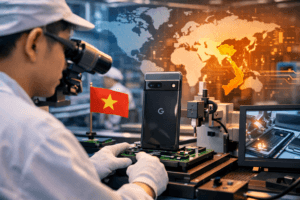
Vietnam’s Tech Ambition: How Google’s Pixel Shift Reshapes Global Smartphone Manufacturing
The journey from assembling components to creating flagship phones from scratch represents Vietnam’s biggest leap yet in the global technology hierarchy – and Google’s most decisive move to untangle itself from Chinese manufacturing.
In a strategic realignment that signals a new phase in global tech manufacturing, Google will begin developing and manufacturing its premium Pixel smartphones in Vietnam this year, according to a Nikkei Asia report . This move represents far more than a simple relocation of assembly lines—it involves transferring the crucial New Product Introduction (NPI) process for Pixel, Pixel Pro, and Pixel Fold devices to Vietnamese facilities, effectively building these flagship phones from scratch outside China for the first time .
While Google has maintained some production in Vietnam since 2022, the company has continued to rely on China for the vital NPI stage until now . This transition parallels Apple’s efforts to establish similar capabilities in India, as both American tech giants systematically reduce their dependence on Chinese manufacturing ecosystems amid escalating trade tensions and geopolitical uncertainties .
The Strategic Implications of NPI Relocation
What NPI Really Means
The New Product Introduction process represents the most critical stage in smartphone development, involving hundreds of engineers from Google and its suppliers working collaboratively to transform blueprints into manufacturable products . This phase encompasses designing production processes, verifying component compatibility, fine-tuning assembly techniques, and preparing for mass manufacturing.
For technology companies, maintaining control over NPI translates directly to maintaining quality standards and innovation capabilities. As Nikkei Asia reports, “if NPI fails, then it means there will be no new product for the year” . The decision to move this sensitive, knowledge-intensive process to Vietnam demonstrates unprecedented confidence in the country’s technical capabilities.
Google’s Manufacturing Strategy Shift
Google’s manufacturing evolution reveals a carefully calibrated strategy:
- Initial Phase (pre-2022): Complete reliance on China for both development and manufacturing
- Transition Phase (2022-2025): Gradual shift of production to Vietnam and India while keeping NPI in China
- Current Phase (2026 onward): Full NPI and manufacturing for premium devices moving to Vietnam, with budget Pixel A series remaining in China for now
This staggered approach has allowed Google to build experience with Vietnamese manufacturing ecosystems while mitigating risks. The company already mass-produces high-end smartphones in Vietnam and conducts some verification processes there, creating a foundation for more comprehensive operations .
Table: Google’s Manufacturing Shift Between China and Vietnam
| Aspect | Previous Model (China) | New Model (Vietnam) |
| Development (NPI) | All Pixel models developed in China | Premium models (Pixel, Pro, Fold) developed in Vietnam; A-series remains in China |
| Manufacturing | Mix of China and Vietnam production | High-end production shifting entirely to Vietnam |
| Supply Chain Role | Complete ecosystem from design to assembly | Expanding from assembly to full development |
| Strategic Importance | Primary manufacturing hub | Key diversification hub in “China+1” strategy |
The Push Factors: Why Google is Diversifying Production
Geopolitical and Trade Pressures
The accelerating shift away from Chinese manufacturing cannot be understood without examining the changing geopolitical landscape. According to Business Standard, “tariff decisions under the Donald Trump administration have disrupted supply chains since April 2025, forcing companies to rethink long-term manufacturing strategies” . This uncertainty has created compelling business logic for establishing alternative manufacturing hubs less vulnerable to trade disruptions between the world’s two largest economies.
Additionally, China has implemented tighter controls on exporting production equipment and relocating skilled workers, creating logistical hurdles for companies attempting to expand operations elsewhere . These restrictions have ironically accelerated the diversification efforts they were designed to prevent.
Supply Chain Resilience Imperative
The pandemic exposed critical vulnerabilities in concentrated supply chains, prompting a global reassessment of manufacturing dependencies. For Google, diversifying Pixel production represents a strategic investment in resilience rather than merely a cost-saving measure. By developing parallel capabilities in Vietnam, Google creates optionality that reduces the impact of regional disruptions, whether from health crises, natural disasters, or political tensions.
Android Police notes that this is “a process that must succeed in order for production to move along,” highlighting the calculated risk Google is taking to achieve greater long-term stability .
Vietnam’s Ascent in the Tech Manufacturing Hierarchy
Building Beyond Assembly
Vietnam’s progression in global manufacturing reflects a classic climbing-the-value-chain trajectory. The country initially attracted electronics assembly work due to competitive labor costs and favorable trade agreements. However, as AndroidHeadlines observes, “This isn’t just about final assembly either” . The NPI responsibility represents a qualitatively different level of engagement that brings with it higher-value engineering work, more advanced technical processes, and deeper integration into product development cycles.
For Vietnamese suppliers, “being involved in NPI is seen as a major achievement” that signals technical capability and reliability . This endorsement from a global technology leader like Google will likely attract additional investment and talent to Vietnam’s tech sector, creating a virtuous cycle of capability development.
Infrastructure and Ecosystem Development
Google’s decision builds upon Samsung’s established presence in Vietnam, where the Korean conglomerate produces a significant portion of its smartphones . This existing ecosystem of suppliers, logistics networks, and technical talent has created a foundation that Google can now leverage for its more complex NPI requirements. Vietnam has strategically positioned itself as a manufacturing alternative to China, offering comparable geographic proximity to component suppliers while providing diversification benefits.
According to Gizmochina, this shift “strengthens Vietnam’s position as a key technology manufacturing hub in the region” . The country is transitioning from being merely a cost-effective assembly location to becoming a genuine center of technological innovation and product development.
The China Conundrum: Gradual Disengagement
Strategic Retention of Budget Segment
Google’s approach reflects a nuanced, segmented strategy rather than a wholesale abandonment of Chinese manufacturing. The company will continue developing its lower-cost Pixel A series in China “for now,” recognizing the country’s continued advantages for certain product categories . This bifurcated approach allows Google to leverage China’s unparalleled manufacturing efficiency and scale for price-sensitive segments while developing alternative capabilities for premium devices where brand control and supply chain resilience justify additional costs.
Challenges in Manufacturing Migration
Despite the strategic imperative to diversify, significant practical challenges remain in replicating China’s manufacturing ecosystem elsewhere. As noted by multiple sources, China offers “unmatched manufacturing depth, skilled labour and a mature ecosystem that is difficult to replicate elsewhere” . Apple’s reported consideration of running parallel NPI processes in both China and India simultaneously acknowledges these challenges, requiring “double the investment but reduc[ing] the risk of production delays” .
Google faced similar obstacles, with efforts to “scale up smartphone production in Vietnam last year [being] delayed” due to restrictions on exporting equipment from China . These friction points illustrate that supply chain reconfiguration occurs gradually, with companies navigating both push and pull factors across multiple dimensions.
Consumer Impact and Product Implications
Potential Effects on Pixel Devices
For consumers, this manufacturing shift raises important questions about product quality, pricing, and availability. Historically, companies establishing new manufacturing hubs have faced initial quality control challenges as processes stabilize and workforces gain experience. However, Google’s gradual approach—building on existing Vietnamese production experience—may mitigate these transitional issues.
Android Police speculates that “it will be interesting to see just how good or bad the hardware is when the new phones land,” noting Google’s historical “hardware issues with its phones” while acknowledging the company “has gotten better over time” . The Pixel 11 series, expected later this year, will serve as the first test of Vietnam’s complete NPI capabilities for Google’s flagship devices .
Broader Market Implications
Google’s manufacturing realignment forms part of a broader industry transformation with implications extending beyond Pixel devices. As Business Standard notes, “If both Google and Apple succeed in carrying out NPIs outside China, it would mark a major milestone” demonstrating that “non-China supply chains are capable of handling the most complex parts of smartphone manufacturing” .
This successful diversification by industry leaders would likely encourage smaller companies to follow similar paths, potentially accelerating the restructuring of global electronics manufacturing. For Vietnam specifically, Google’s commitment could catalyze additional investments across the technology sector, helping the country capture more value within global supply chains.
Future Trajectories and Unanswered Questions
The Path Ahead for Google’s Manufacturing
Several key developments will shape the next phase of this transition:
- Pixel A Series Migration: Whether and when Google will move development of its budget models out of China remains uncertain. Economic considerations may dictate a longer timeline for this segment.
- Regional Expansion: With Vietnam established as an NPI hub, Google may explore additional diversification across Southeast Asia, potentially creating a networked manufacturing ecosystem rather than simply substituting one primary location for another.
- Innovation Diffusion: As Vietnamese engineers gain experience with cutting-edge smartphone development, the country may evolve from a manufacturing center to an innovation hub, potentially influencing future Pixel designs and features.
Global Supply Chain Reconfiguration
The broader implications extend far beyond Google or even the smartphone industry. As Gizmochina observes, “This move fits into a larger trend where tech companies are reshaping supply chains across Asia to balance economic and political risks” . This reconfiguration represents a fundamental shift in how global companies approach manufacturing strategy—prioritizing resilience alongside efficiency, and recognizing geopolitical factors as business continuity considerations.
The successful execution of complex NPI processes outside China would demonstrate that advanced manufacturing capabilities can be replicated in alternative locations, potentially encouraging more industries to pursue similar diversification strategies. This would mark a significant milestone in the evolution of global supply chains that have been centered on China for decades.
Redrawing the Tech Manufacturing Map
Google’s strategic shift of Pixel development and manufacturing to Vietnam represents more than a corporate sourcing decision—it’s a bellwether moment in global supply chain evolution. This move demonstrates that even the most complex electronics manufacturing processes can be successfully relocated when geopolitical, economic, and strategic factors align. For Vietnam, the transition from assembly partner to development hub validates years of investment in technical education and manufacturing infrastructure, positioning the country for more advanced roles in global technology value chains.
As consumers await the first Vietnamese-developed Pixels, the broader implications continue unfolding across the industry. Manufacturing geography is being rewritten, not through sudden revolution but through calculated, strategic decisions by companies navigating an increasingly complex global landscape. The success or challenges Google experiences in this transition will likely influence technology manufacturing strategies for years to come, potentially accelerating the emergence of a more distributed, resilient global production ecosystem less dependent on any single country or region.
You must be logged in to post a comment.