
Venezuela Crisis: A Mixed Bag of Risks and Opportunities for Indian Corporations
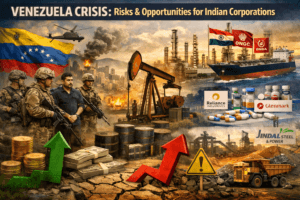
Venezuela Crisis: A Mixed Bag of Risks and Opportunities for Indian Corporations
The dramatic U.S. military intervention in Venezuela and the subsequent capture of President Nicolás Maduro have sent shockwaves through global markets. While India may be somewhat insulated from immediate economic fallout due to diminished trade ties, a cadre of prominent Indian corporations with enduring stakes in the South American nation now faces a complex new reality. For these companies, the upheaval presents a paradoxical mix of long-awaited financial recoveries and escalating geopolitical risks, reshaping their strategic calculus in one of the world’s most resource-rich yet volatile regions.
The Immediate Prize: Unlocking Billions in Frozen Assets
The most direct and quantifiable impact of the political shift centers on India’s state-run energy giants, particularly ONGC Videsh Ltd (OVL), the overseas investment arm of Oil and Natural Gas Corporation (ONGC). For over a decade, OVL’s investments in Venezuela have been effectively stranded due to sanctions and payment defaults.
- Substantial Unpaid Dues: OVL is owed approximately $536 million in accrued dividends from its 40% stake in the San Cristobal oilfield, with payments frozen since 2014. Analysts estimate the total receivable, including periods where audits were blocked, could approach $1 billion. A U.S.-led restructuring of Venezuela’s oil sector creates a plausible pathway for OVL to finally recover these massive outstanding sums.
- Market Anticipation: This prospect has not gone unnoticed by investors. Following the news, ONGC’s stock saw notable movement as the market priced in the potential recovery, which represents a significant financial catalyst for the company. Global brokerage Jefferies highlighted this as a key medium-term opportunity, noting that any recovery would bolster ONGC’s already strong cash generation.
Beyond Recovery: Strategic Opportunities Across Sectors
A potential normalization and revival of Venezuela’s hydrocarbon industry, under new oversight, could unlock strategic advantages for Indian companies beyond mere debt collection.
- Energy Sector: Revival of Production and Trade
A stable Venezuela could allow OVL to actively revive production at the San Cristobal field. Officials suggest that with the right equipment and investment—which could be relocated from ONGC’s operations in Gujarat—output could surge from a trickle of 5,000-10,000 barrels per day to 80,000-100,000 barrels per day. This would transform a dormant asset into a productive one.
For Indian refiners like Reliance Industries, Nayara Energy, and Indian Oil Corporation (IOC), a restart of Venezuelan crude exports offers a valuable diversification opportunity. These companies possess complex refineries ideally suited to process Venezuela’s heavy crude. Renewed access would help India strategically diversify its crude basket, reducing over-reliance on Middle Eastern or Russian supplies amid ongoing global trade negotiations.
- Pharmaceuticals: A Critical Humanitarian and Commercial Link
Indian pharmaceutical companies maintain a vital, if challenging, presence in Venezuela. Firms like Sun Pharma and Glenmark Pharma operate through local subsidiaries, while others like Cipla have historically exported essential medicines. This sector represents a critical humanitarian bridge, providing life-saving drugs to a population facing severe shortages.
A resolution to the crisis could normalize payment channels and regulatory processes, allowing these companies to securely expand their commercial operations and fulfill a pressing need. The exit of Dr. Reddy’s Laboratories in 2024 underscores the risks inherent in the old system, but a new framework could make the market viable again.
- Metals and Engineering: Assessing Long-Term Projects
Exposure in other sectors is more niche but significant. Jindal Steel & Power is involved with Venezuela’s largest iron-ore complex, an asset whose viability is tied to stable logistics and export infrastructure. Similarly, Engineers India Ltd. maintains a consultancy office in Caracas. For these firms, the primary question is whether a new political environment will foster conditions conducive to long-term industrial projects and contractual security.
Navigating the Minefield: Persistent Risks and Challenges
Despite the optimistic scenarios, the path forward for Indian companies is fraught with uncertainty. The immediate aftermath of a geopolitical event of this magnitude brings its own set of dangers.
- Legal and Contractual Quagmire: The restructuring of Venezuela’s state oil company, Petroleos de Venezuela SA (PdVSA), is all but certain. The sanctity of existing joint-venture agreements, including those held by OVL, IOC, and Oil India in projects like Carabobo-1, will be tested. There is a risk that stakes could be diluted or terms renegotiated under a new U.S.-influenced authority.
- Geopolitical and Sanctions Uncertainty: U.S. President Donald Trump has explicitly stated that sanctions on Venezuela’s oil remain in place for now. The timeline and conditions for their easing are unclear. Furthermore, the U.S. has previously threatened tariffs on nations buying Venezuelan crude, a policy that could resurface and impact future Indian imports.
- Operational and Security Risks: On-ground instability during a transitional period could pose security threats to assets and personnel. Additionally, Venezuela’s oil infrastructure has suffered from years of underinvestment and decay. A meaningful production revival requires massive capital injection and technical expertise, which will take time regardless of political changes.
A Comparative Look at Indian Corporate Exposure in Venezuela
The table below summarizes the varied stakes and potential implications for key Indian companies:
| Company | Sector | Nature of Exposure | Potential Upside | Key Risk |
| ONGC Videsh | Oil & Gas | 40% stake in San Cristobal field; 11% in Carabobo-1 | Recovery of ~$1B dues; Revival of production | Contract renegotiation; Slow sanctions relief |
| Indian Oil Corp. | Oil & Gas | 3.5% stake in Carabobo-1; Crude imports | Secure crude supply for refineries | Tariff threats on Venezuelan crude imports |
| Reliance Industries | Oil & Gas | Historical crude importer | Renewed access to favored heavy crude grade | Geopolitical compliance risks |
| Sun Pharma / Glenmark | Pharmaceuticals | Local subsidiary operations | Market expansion with normalized payments | Regulatory uncertainty during transition |
| Jindal Steel & Power | Metals | Involvement in iron-ore complex | Resumption and scaling of mining projects | Asset security; Export logistics disruption |
The Bottom Line: Cautious Optimism Amidst Uncertainty
The consensus among analysts, including think tanks like the Global Trade Research Initiative (GTRI), is that India’s macroeconomic exposure is limited. Trade volumes have shrunk dramatically, from over 400,000 barrels of oil per day to minimal levels, cushioning the broader economy from immediate shock. However, for the specific corporations with skin in the game, the situation demands vigilant scrutiny.
The current juncture is less about immediate financial impact and more about assessing the viability of long-term strategic assets. Investors and corporate boards must weigh the tantalizing prospect of unlocked value against the very real risks of legal disputes, political friction, and operational headaches in a country undergoing profound transformation.
The coming weeks will be critical. Clarity on the U.S. roadmap for sanctions and the structure of the new oil governance will determine whether Venezuela transitions from a symbol of stranded assets to a renewed pillar of energy security and strategic investment for engaged Indian firms. For now, a stance of cautious optimism, coupled with preparation for multiple outcomes, is the most prudent path forward.
You must be logged in to post a comment.