
Understanding India’s Forex Reserves Decline: Strategic Shift or Cause for Concern?
India’s foreign exchange reserves declined for the second consecutive week, falling by $1.877 billion to $686.227 billion as of November 28, 2025, primarily due to a $3.569 billion decrease in foreign currency assets as the Reserve Bank of India (RBI) likely intervened to stabilize the rupee; however, this drawdown is viewed as a strategic deployment from a position of strength, as reserves remain robust at over $686 billion—having grown by about $40 billion year-to-date—and are supported by a moderating current account deficit (eased to 1.3% of GDP) and strong foreign direct investment, even though foreign portfolio investors have been net sellers. The RBI is simultaneously bolstering its gold reserves, which rose by $1.613 billion, indicating a deliberate diversification strategy amidst global uncertainties, with the overall reserve level remaining sufficient to cover more than 11 months of imports, underscoring the economy’s substantial external buffer.
Understanding India’s Forex Reserves Decline: Strategic Shift or Cause for Concern?
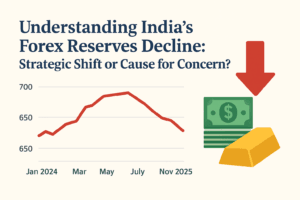
India’s foreign exchange reserves, a critical indicator of economic health and a buffer against global financial storms, have registered a second consecutive weekly decline, falling by $1.877 billion to $686.227 billion as of November 28, 2025. This dip, following a sharper $4.472 billion fall the week prior, marks a continuation of a trend that began after reserves hit an all-time high of $704.89 billion in September 2024. While headlines spotlight the drop, a deeper analysis reveals a complex picture of strategic gold accumulation, proactive currency management by the Reserve Bank of India (RBI), and underlying economic resilience that tempers immediate concern.
The Anatomy of the Decline: A Closer Look at the Components
The headline figure of a $1.88 billion drop tells only part of the story. A dissection of the reserve components reveals divergent movements that point to active management rather than passive depletion.
- Foreign Currency Assets (FCA): As the largest component, FCA saw a significant reduction of $3.569 billion, bringing it down to $557.031 billion. This category, held in currencies like the US dollar, euro, and yen, is most directly impacted by the RBI’s market interventions to manage the rupee’s value.
- Gold Reserves: In a striking counter-trend, the value of India’s gold holdings increased by $1.613 billion to $105.795 billion. This rise is attributed to both strategic purchases by the central bank and the appreciation in global gold prices amid ongoing economic uncertainties.
- Special Drawing Rights (SDRs) and IMF Position: These smaller components saw modest gains of $63 million and $16 million, respectively.
Table: Weekly Change in India’s Forex Reserve Components (Week ended Nov 28, 2025)
| Reserve Component | Value (USD Billion) | Weekly Change (USD Billion) |
| Total Reserves | 686.227 | -1.877 |
| Foreign Currency Assets (FCA) | 557.031 | -3.569 |
| Gold | 105.795 | +1.613 |
| Special Drawing Rights (SDRs) | 18.628 | +0.063 |
| IMF Reserve Position | 4.772 | +0.016 |
This composition shift is not new. In late October, reserves had fallen by a substantial $5.6 billion, driven by declines in both FCA and gold. The recent data, with gold rebounding, suggests a dynamic rebalancing act by the RBI, diversifying assets and potentially capitalizing on gold’s traditional role as a safe-haven asset.
Historical Context: From Vulnerability to Strength
To properly assess the current decline, one must view it within India’s remarkable multi-decade journey of reserve accumulation. The nation’s forex reserves have grown exponentially from a precarious low of $29 billion in 1998.
Table: Key Milestones in India’s Forex Reserve History
| Period | Key Development | Reserve Level & Context |
| Sept 1998 | Record Low | $29.05 Billion – Period of economic vulnerability |
| 2022 | Significant Annual Decline | Cumulative drop of $71 Billion |
| 2023 | Strong Recovery | Addition of approximately $58 Billion |
| Sept 2024 | All-Time High | $704.89 Billion – Peak level |
| 2025 (to date) | Net Increase | Reserves have grown by around $40 Billion year-to-date |
This historical perspective is crucial. The current level of over $686 billion, despite recent drops, represents a position of formidable strength. As RBI Governor Sanjay Malhotra has emphasized, these reserves are sufficient to cover over 11 months of merchandise imports, providing a robust safety net for the economy.
Driving Factors Behind the Fluctuations
Several interconnected global and domestic factors are influencing the ebb and flow of India’s reserves.
- RBI’s Currency Market Intervention: The primary reason for the drawdown in foreign currency assets is the RBI‘s active intervention in the foreign exchange market. The central bank sells dollars to prevent excessive volatility and a disorderly depreciation of the Indian rupee. This is a standard tool for maintaining export competitiveness and macroeconomic stability.
- Global Monetary Policy and Capital Flows: The global financial environment significantly impacts capital flows. Data shows that Foreign Portfolio Investors (FPIs) have turned net sellers, pulling out $0.7 billion from Indian equity markets between April and early December 2025. In contrast, Foreign Direct Investment (FDI) flows have strengthened, indicating continued long-term confidence in India’s economic fundamentals.
- Trade Dynamics and Current Account: India’s external balance presents a mixed picture. The Current Account Deficit (CAD) has moderated from 2.2% of GDP to 1.3%, supported by robust software services exports and strong remittance inflows. However, a widening merchandise trade deficit, with rising imports and contracting exports, creates underlying pressure that the RBI must manage.
Consequences and Forward Outlook: Stability Amidst Volatility
The strategic use of reserves has direct and indirect consequences for the broader economy.
- Rupee Stability: The RBI’s interventions aim to anchor the rupee, providing predictability for importers, exporters, and foreign investors. A stable currency is vital for controlling inflation, as India is a major importer of oil and electronics.
- Inflation and Interest Rates: By preventing a sharp rupee fall, the RBI helps manage imported inflation. This creates room for monetary policy maneuvers, such as the recent 25-basis-point repo rate cut to 5.25%, aimed at stimulating domestic growth.
- Investor Confidence: A large and well-managed reserve pile is a key indicator of a country’s ability to meet its external obligations. It reinforces investor confidence, which is essential for securing stable FDI and external commercial borrowing.
Looking ahead, the trajectory of India’s forex reserves will be shaped by the interplay of global commodity prices, the success of export promotion, and the RBI’s calibration between maintaining adequate buffers and supporting growth.
Analysts at Trading Economics project reserves to trend around $705 billion in 2026 and $710 billion in 2027. This forecast suggests that the current phase is viewed as a consolidation within a long-term uptrend, not the start of a steep decline.
Conclusion
The recent decline in India’s foreign exchange reserves is better understood as a strategic deployment and portfolio rebalancing rather than a symptom of economic weakness. The RBI is walking a tightrope, using its substantial reserves to smooth currency volatility, combat inflationary pressures, and maintain financial stability, all while strategically increasing its gold holdings. With reserves covering nearly a year of imports and strong FDI inflows continuing, India’s external sector retains significant resilience. For policymakers, businesses, and investors, the focus should remain not on weekly fluctuations but on the underlying strengths and the central bank’s adept management of a complex global economic landscape. The story of India’s forex reserves today is one of active stewardship of economic sovereignty in an uncertain world.
You must be logged in to post a comment.