
Under the Cover of Eid: How Settler Violence in the West Bank Is Redefining the Boundaries of Impunity
In a wave of coordinated violence during Eid al-Fitr celebrations, Israeli settlers torched homes and vehicles in several West Bank villages—including al-Fandaqumiya, Seilat al-Dahr, and Masafer Yatta—wounding multiple Palestinians while often acting under the protection of Israeli forces. These attacks are not random acts of vandalism but part of a systematic strategy to displace Palestinian communities and expand settlement outposts, enabled by a culture of near-total impunity in which perpetrators rarely face consequences. The timing, targeting of strategic areas, and military presence during the assaults underscore a broader pattern of state-tolerated coercion that is quietly redrawing the map of the occupied territory, inflicting generational trauma and eroding any remaining prospects for a just resolution.
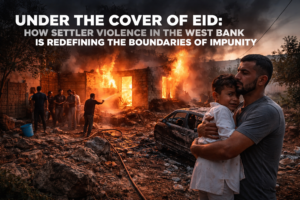
Under the Cover of Eid: How Settler Violence in the West Bank Is Redefining the Boundaries of Impunity
For Palestinian families in the occupied West Bank, the holy month of Ramadan and the subsequent celebration of Eid al-Fitr are traditionally moments of spiritual reflection, communal gathering, and respite. It is a time when the harsh rhythms of occupation—the checkpoints, the raids, the land disputes—are supposed to soften, if only slightly, under the weight of religious observance. But in the early hours of Saturday morning, as the moon marked the culmination of the fasting month, the villages of al-Fandaqumiya and Seilat al-Dahr witnessed a different kind of ritual: the torching of homes and the terrorizing of families under the cover of celebration.
The recent wave of attacks, which saw Israeli settlers set fire to residential properties and vehicles across the occupied West Bank, is not an isolated incident of spontaneous rage. Rather, it fits a growing and alarming pattern of organized, state-tolerated violence that is systematically reshaping the landscape of the Palestinian territory. While the international community focuses on the broader geopolitical tensions in the region, a more insidious transformation is occurring on the ground—a slow-burning war of attrition aimed at displacing Palestinian communities and expanding the footprint of illegal settlements.
A Night of Flames and Fear
According to local sources and verified footage, the violence erupted late Saturday, targeting the communities south of Jenin—a region that has become a frequent flashpoint for Israeli military raids and settler aggression. In al-Fandaqumiya, the assault was methodical. Witnesses described groups of masked settlers moving through the village with military precision, smashing windows before dousing interiors with accelerants. The goal seemed less about vandalism and more about psychological demolition: the destruction of the sanctity of the home.
Footage verified by independent journalists showed homes engulfed in massive flames, with residents desperately trying to contain the fires using whatever means they had—garden hoses, buckets of water, and bare hands. The attacks were not limited to property. In Seilat al-Dahr, a resident was physically assaulted, suffering wounds that required medical attention. The violence was compounded by the timing. Families celebrating Eid, many of whom had children dressed in new clothes for the festivities, were forced to flee their homes or engage in desperate firefighting efforts instead of visiting relatives.
Further south, in the Hebron hills, the pattern repeated itself. In Masafer Yatta—an area that has been under intense pressure for years due to Israeli military training zones and settler expansion—settlers stormed the area, wounding two Palestinians. The presence of Israeli forces during the incident is particularly telling. According to reports, the storming occurred under the protection of the military. This protection, often referred to as “escorted invasions,” transforms what might otherwise be considered criminal vandalism into a quasi-official act of coercion.
The Strategy Behind the Violence
To understand the gravity of these attacks, one must look beyond the immediate charred vehicles and broken windows. The violence is rarely random. It is frequently tied to specific strategic goals: the expansion of settlement outposts, the seizure of land classified as “state land,” or the displacement of communities to create “security buffers” around settlements.
The villages attacked—al-Fandaqumiya, Seilat al-Dahr, Qaryut, and Jalud—are located in areas of the West Bank that are crucial to the settler movement’s vision of territorial contiguity. These are not merely remote farms; they are corridors connecting major settlement blocs. By instilling fear in these communities, settlers aim to depopulate them, turning “price tag” attacks—a policy of retaliatory violence against Palestinians or Israeli security forces for government actions against settlements—into a permanent state of siege.
The attack on Jalud, where a vehicle was left a charred skeleton, is emblematic of this. Jalud has long been a target because it sits in a strategically sensitive area. When settlers burn a car or a home, they are sending a message that Palestinian existence in that geographic space is contingent on the settlers’ approval. It is an attempt to shift the status quo from one of co-existence under occupation to one of total exclusion.
The Role of Impunity
Perhaps the most critical element fueling this escalation is the near-total impunity afforded to perpetrators. Despite the violent nature of these acts—arson, assault, vandalism—arrests are rare, and convictions are even rarer. When Israeli forces are present at these scenes, as they were in Masafer Yatta, their role is often not to protect the Palestinian victims but to ensure that the attackers are not harmed by Palestinian resistance.
This dynamic creates a chilling calculus for Palestinian residents. They face a dilemma: if they defend their property with force, they risk being shot by soldiers or arrested and placed in administrative detention; if they do nothing, they lose their homes. This is not hyperbole. Over the past year, there have been numerous instances where Palestinians attempting to protect their land from settler attacks were either killed or detained, while the settlers who initiated the violence walked free.
This structural impunity is rooted in a complex legal framework. While international law considers all Israeli settlements in the West Bank illegal, Israeli domestic law often treats settler violence through a different lens. The military court system, which adjudicates both Palestinians and settlers, has historically shown leniency to settlers, citing “ideological motivations” or “mental state,” while Palestinians are tried under strict military orders. This double standard acts as a green light for extremists.
Beyond the Headlines: The Human Toll
While diplomatic cables and news reports often focus on the political implications of settlement expansion—such as the recent Amnesty International report on “global impunity” fueling annexation—the human cost is often abstracted. But in the villages south of Nablus and Jenin, the impact is visceral.
During Eid al-Fitr, which concluded this past weekend, the attacks did more than destroy physical property; they shattered the psychological safety net that families rely on during holidays. For children in these villages, the sound of breaking glass and the sight of masked men will now be associated with a day meant for joy and gift-giving. The trauma is generational.
Moreover, the attacks serve as a warning to the international activists and solidarity workers who occasionally visit the West Bank to document human rights abuses. By targeting villages known for hosting activists—as referenced in the “Israeli settlers violently attack foreign ‘solidarity activists’” coverage in recent months—the settlers aim to create an information blackout. If journalists and human rights monitors can no longer safely access these areas, the violence can continue unrecorded.
The Geopolitical Context
These attacks are not occurring in a vacuum. The backdrop of rising regional tensions—including recent escalations involving Iran and the specter of a wider conflict—provides a convenient smokescreen. When the world’s eyes are fixed on the Strait of Hormuz or the potential for a regional war, the slow-motion annexation of the West Bank accelerates.
As one analyst noted in related coverage, “Global impunity fuels Israel’s illegal push to annex West Bank.” The failure of the international community to impose meaningful consequences for settlement expansion and settler violence has created a permissive environment. Statements of condemnation from Western capitals, which rarely result in policy changes or sanctions, are dismissed by extremist settler leaders as empty rhetoric.
Furthermore, the composition of the Israeli government has empowered the settler movement. With key cabinet positions held by individuals who are themselves former leaders of the settler council, the distinction between the state and the settlement enterprise has blurred. What was once a fringe movement is now mainstreamed into the apparatus of the state, with budgets allocated for settlement expansion and military resources used to protect outposts that are illegal even under Israeli law.
Looking Ahead
The attacks on al-Fandaqumiya, Seilat al-Dahr, and Masafer Yatta are harbingers of a darker future. As the international community remains mired in diplomatic paralysis, the facts on the ground are being rewritten. The two-state solution, already on life support, is being buried under the rubble of burned homes and uprooted olive trees.
For Palestinians in the West Bank, the immediate reality is one of survival. The morning after the fires, residents sift through the ashes, salvaging what they can—a photograph, a piece of furniture, a door that didn’t burn completely. They rebuild, not out of optimism, but out of defiance. To leave would be to concede.
The question for the international community is whether it will continue to treat these incidents as isolated acts of vandalism or recognize them for what they are: a coordinated campaign of ethnic cleansing aimed at redrawing the map of the West Bank through terror. Until accountability is enforced—until settlers who commit arson and assault are treated as the criminals they are—the flames that lit up the night sky over Seilat al-Dahr will continue to spread, consuming not just homes, but any remaining hope for a just peace.
You must be logged in to post a comment.