
Under Cover of Eid: Settler Attacks Reveal a Blueprint for Erasure in the West Bank
Under Cover of Eid: Settler Attacks Reveal a Blueprint for Erasure in the West Bank
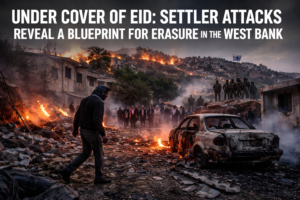
As the final days of Eid al-Fitr—a sacred period meant for reflection, forgiveness, and family—settled over the occupied West Bank, the skies over villages like al-Fandaqumiya and Seilat al-Dahr were lit not by festive lanterns, but by the orange glow of arson. In a series of coordinated attacks late Saturday night, Israeli settlers rampaged through Palestinian communities, torching homes, setting vehicles ablaze, and leaving a trail of trauma across the territory.
The attacks, which spanned from the northern city of Jenin down to the southern hills of Hebron, mark a stark escalation in what human rights organizations have begun to describe not merely as “settler violence,” but as a systematic, state-enabled campaign to displace Palestinian communities. For the residents of these villages, the infernos that consumed their property were not random acts of rage; they were the latest salvos in a grinding war of attrition aimed at making life in the West Bank untenable.
A Night of Fire and Impunity
According to the Palestinian Wafa news agency and verified footage obtained by Al Jazeera, the violence began late Saturday, coinciding with Eid festivities. In the village of al-Fandaqumiya, south of Jenin, armed settlers stormed the area, breaking windows and dousing homes in accelerants. As families scrambled to evacuate, residents attempted to confront the attackers and extinguish the spreading flames, but were reportedly overwhelmed.
Simultaneously, in the nearby town of Seilat al-Dahr, the pattern repeated. Settlers targeted multiple residences, physically assaulting a resident who attempted to defend his home, leaving him wounded. The scene was mirrored in Masafer Yatta, a cluster of herding communities south of Hebron that has long been a focal point of settler aggression. There, under the protection of Israeli forces—a recurring feature of such attacks—settlers wounded two Palestinians and arrested three others.
Further south, near the town of Haris, settlers blocked main roads, pelting Palestinian vehicles with stones. In Ramallah and Tuqu, similar incidents of stone-throwing were reported, creating a climate of fear for anyone with Palestinian license plates attempting to traverse the region’s fractured road network.
The imagery emerging from these attacks is visceral: charred skeletons of family cars, the melted facades of homes, and the desperate faces of men and women trying to salvage what remains of their lives during what was supposed to be a holiday.
Beyond the Headlines: The Strategy Behind the Violence
To view these attacks as isolated incidents of “price tag” vengeance—a term used to describe settler retaliation for government actions against outposts—is to miss the forest for the trees. The current wave of violence, which has surged dramatically since October 2023, operates within a clear strategic framework.
As Israeli organization B’Tselem has documented, the Israeli government is actively facilitating settler violence “as part of a strategy to cement the takeover of Palestinian land.” The timing of Saturday’s attacks is particularly telling. Striking during Eid al-Fitr—the “Festival of Breaking the Fast”—targets not just physical property but the very fabric of Palestinian cultural and religious life. It is a message that no moment of peace, not even a holy day, is safe from the encroachment of the occupation.
The geographical spread of the attacks—from Jenin in the north to Masafer Yatta in the south—highlights the systemic nature of the campaign. This is not the work of a few rogue actors; it is a coordinated effort spanning the length of the West Bank, often carried out with the logistical support or active protection of the Israeli military. The UN Human Rights Council recently warned that Israeli policies in the West Bank, including the “systematic unlawful use of force by Israeli security forces” and the demolition of Palestinian homes, are specifically aimed at uprooting communities.
A Shadow of Gaza: The West Bank’s Bleeding Wound
The intensification of settler violence cannot be divorced from the broader context of Israel’s genocidal war on Gaza. Since October 2023, more than 1,000 Palestinians have been killed by Israeli troops and settlers in the West Bank, according to the United Nations. This is not merely a spillover effect; it is a parallel front.
With the world’s attention focused on the destruction in Gaza, extremist settler movements have seen an opportunity to accelerate their long-held ambition: to create a reality in the West Bank that precludes the possibility of a contiguous Palestinian state. By attacking villages, burning crops, and displacing families, settlers are effectively redrawing the map on the ground, piece by piece.
The situation is exacerbated by a sense of impunity that has become institutionalized. In February, Israeli settlers defaced and set fire to a mosque near Nablus during Ramadan. Such acts of sacrilege rarely result in prosecutions. Human rights groups have long argued that Israeli authorities not only turn a blind eye to settler violence but actively facilitate it, creating a legal framework where Palestinians are criminalized for defending their land, while settlers are treated as civilians acting out of ideological conviction.
The Human Cost of Impunity
Behind the statistics of “1,000 killed” and “36,000 forcibly displaced” (a figure recently cited by the UN as displaced in the past year due to settler and army violence) are individual stories of loss. In Seilat al-Dahr, the man left wounded by the attack on Saturday is now recovering from physical injuries while grappling with the psychological terror of having armed intruders invade his home during a holiday.
In Masafer Yatta, the two wounded Palestinians represent a community that has faced near-constant harassment for years. The Israeli military’s designation of the area as a “firing zone” has been used to justify the demolition of homes and the forced displacement of hundreds of families. The presence of Israeli forces during Saturday’s attacks—protecting the settlers rather than the indigenous population—reinforces a brutal reality: in the occupied West Bank, Palestinians are not protected by the law; they are protected from the law.
The Red Crescent’s report of two Palestinians shot by live fire at the Jabara checkpoint south of Tulkarem on the same night adds a layer of military violence to the civilian-led settler attacks. It paints a picture of a territory where the distinction between settler aggression and state military action has effectively vanished.
A Region on the Brink
The attacks occurred against a backdrop of heightened regional tension. As Al Jazeera’s coverage indicates, the violence in the West Bank coincides with the ongoing war in Gaza and escalating confrontations with Iran. For many Palestinians, this confluence is deliberate. The argument put forth by Amnesty International—that “global impunity fuels Israel’s illegal push to annex West Bank”—suggests that the international community’s failure to impose meaningful consequences for actions in Gaza has emboldened actors in the West Bank.
As the smoke clears from the burnt homes in al-Fandaqumiya and the scorched cars in Jalud, the question remains: what will it take for the world to treat the slow-burning catastrophe in the West Bank with the same urgency as the war in Gaza?
For the residents of these villages, the answer feels distant. As they swept up the debris of their Eid holiday—the glass from smashed windows, the ashes of their belongings—they did so with the knowledge that without a fundamental shift in international accountability, next week, or next month, the settlers will likely return. And they will come bearing fire.
You must be logged in to post a comment.