
Unbreathable Air, Unbearable Work: The Human Cost of India’s Boiling Supply Chain
In the face of increasingly severe and frequent heatwaves in northern India, driven by climate breakdown, migrant workers like 25-year-old Neha Singh are trapped in a vicious cycle of survival, where extreme temperatures directly undermine their health, finances, and dignity. Her daily life involves a perilous, shadeless walk to a multinational company’s warehouse, where the brutal physical labor of walking 25km in heat-compromised areas is compounded by a cruel “thermal whiplash” from moving between extreme outdoor heat and overburdened cooling systems, leading to illness, public reprimands for missed targets, and a desperate fear of taking unpaid sick leave.
This crisis forces impossible choices, pitting health against livelihood, driving workers into debt to afford basic cooling, and revealing a stark failure of systems to protect the most vulnerable, underscoring the urgent need for workplaces and policies to adapt and prioritize human resilience over relentless productivity.
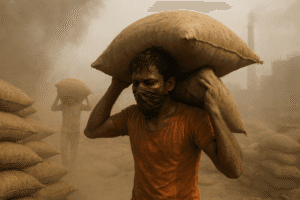
Unbreathable Air, Unbearable Work: The Human Cost of India’s Boiling Supply Chain
Meta Title: Inside India’s Heatwave Hell: Warehouse Workers and the Unseen Cost of Your Deliveries | Climate Crisis & Labor Rights
Meta Description: As climate breakdown supercharges heatwaves in India, migrant workers like Neha Singh face impossible choices: their health or their livelihood. This is a deep dive into the human cost powering our global economy in an era of extreme heat.
The 5:30 AM alarm in Manesar, Haryana, isn’t a gentle nudge into the day; it’s the starting pistol for a daily battle against the sun. For Neha Singh, a 25-year-old migrant worker, the pre-dawn hours are a frantic race against the rising mercury. By 6:00 AM, the water in the rooftop tank of her two-story building is already transforming from a respite into a scalding liability. There is no time for a cup of tea, no appetite for cooking in the top-floor room that has baked through the night. A cold, sugary drink is the only fuel before she steps out into an oven.
This is the new normal for millions of low-wage workers across Northern India, where climate breakdown is no longer a future threat but a present, physical reality. The story of Neha’s summer—a season where temperatures consistently hovered near 46°C (115°F) and touched a lethal 50°C (122°F)—is more than an anecdote about a heatwave. It is a stark case study in how interconnected crises—climate change, globalized supply chains, and systemic labor inequality—collide on the body of the individual worker.
The Furnace Walk: A Commute of Quiet Desperation
Neha’s journey to the multinational company’s warehouse is a 3-kilometer pilgrimage under a punishing sun. The streets, she notes, are eerily deserted. Shutters are drawn, and sensible people are hidden behind walls. But for Neha and countless others, the economy does not pause for the weather.
Her 30-minute walk is a testament to failed urban planning and neglected public infrastructure. There is no shaded corridor, no bus stop offering a moment’s refuge, not a single bench to rest aching feet. It is just an open road, the asphalt radiating stored heat, and the sun, a “direct” and unrelenting adversary. By the time she reaches the company gates, she is drenched in sweat, her body already depleted before her 10-hour shift has even begun.
This journey underscores a critical vulnerability. Migrant laborers, the backbone of India’s industrial and agricultural sectors, often live in low-quality, informal housing on urban peripheries. These areas, like Neha’s “rural neighbourhood,” are the first to suffer prolonged power cuts, further stripping away any chance of recovery. The walk to work becomes a forced march, a daily erosion of their physical and mental reserves.
The Thermal Whiplash: A Body Under Siege
Stepping into the air-conditioned warehouse offers a fleeting, deceptive relief. The 10-degree temperature drop is a shock to the system, a sensation she describes as life-saving in the moment. It’s here she can drink cold, filtered water—a luxury her rented room cannot provide.
But this relief is a trap. The “inbound” department where Neha works is a labyrinth of efficiency and physical exertion. Her job is to store 150 items per hour across 600 small cabins, spread over four floors connected by stairs. She estimates walking a minimum of 25 kilometers (16 miles) per day at a “fast pace” to meet her targets.
The catch? The storage area itself lacks adequate ventilation. The central cooling system is overwhelmed by the sheer scale of the space and the body heat of workers. The result is a brutal cycle of thermal whiplash: from the oppressive outdoor heat, to the chilly main areas, to the stifling, stagnant air of the storage corridors. Her body is constantly struggling to adapt, a physiological battle it is destined to lose.
“I first lost my voice, then caught a bad cold,” she recounts. The illness made it impossible to meet her punishing targets, leading to public reprimands from her manager. The system, optimized for maximum output, has no bandwidth for human frailty, even when that frailty is directly caused by the working environment.
The Invisible Tipping Point: Fever, Fear, and Solidarity
The breaking point came on a day she was feverish. After being yelled at for her slowed pace, she finished her shift and began the long walk home. “My feet were hurting badly. I had a fever; I couldn’t speak, couldn’t breathe, and was in tears.” This visceral description is more than a symptom list; it’s a portrait of a human body pushed beyond its limits.
Her refusal to call her family is a poignant detail that speaks volumes. Migrant workers bear a dual burden: their own physical suffering and the emotional weight of protecting their families from worry. To call home would be to risk being ordered back, to surrender the very income that justifies this suffering. So, she suffers in silence, relying on the solidarity of her roommate—another migrant woman facing the same ordeal.
This informal network of care is the only safety net they have. “We had to take care of each other since no one in the neighbourhood would help us,” Neha states. When the state and the corporation are absent, the community of workers becomes the last line of defense.
The Vicious Cycle: Health, Debt, and Precarity
The impacts of the heatwave are not confined to the body; they strike directly at the wallet, creating a vicious cycle of debt and precarity.
- Health Leads to Wage Cuts: Company policy, as Neha describes it, is brutally simple: a day off leads to a pay cut; three days off lead to termination. When workers faint or fall ill from the heat, they are forced to choose between their immediate health and their long-term livelihood. Many, she says, left for their villages “out of compulsion,” a retreat that represents a catastrophic loss of income for their families.
- The Poverty Premium: To survive, Neha and her roommate had to purchase a cooler—an unplanned capital expense that devoured their hard-saved money. This was followed by a skyrocketing electricity bill. The very tools needed for survival actively undermine their financial goal of sending money home. The poor end up paying more, in both health and wealth, to endure a crisis they did the least to create.
- The Nutritional Deficit: The heat sapped their will and ability to cook, leading to diets of aerated drinks and irregular meals. Her roommate’s weight plummeted from 45kg to 38kg—a dangerous decline that points to severe malnutrition and dehydration, further weakening them for the work they must perform.
A Call for a Resilient Future: Beyond Survival to Adaptation
Neha’s conclusion is not one of despair, but a clear-eyed plea for reason. “I think such summers will repeat,” she says. This acceptance is the most powerful argument for change. This is not a one-off event; it is the new baseline.
Her demands are simple, rational, and urgent:
- Climate-Adapted Workplaces: “Better ventilation in many spaces,” and an acknowledgment from companies that “such weather conditions” must be factored into workflow and target-setting. The work expected must be “proportional to what we can handle.”
- Investment in Worker Health: “Workers who stay fit can work better, right?” This is not a radical ask; it’s a fundamental principle of productive management. A healthy worker is a more reliable and efficient asset. Providing adequate breaks, cool drinking water, and realistic targets during extreme heat is not a perk; it is a sound business and moral imperative.
- Protection for the Most Vulnerable: She specifically calls for help for “migrant labourers,” who, disconnected from local support systems, are uniquely exposed.
Neha Singh’s story is a microcosm of a global challenge. The goods that move through climate-controlled warehouses in the West are often handled by workers like her, battling life-threatening heat in the Global South. As climate breakdown intensifies, the resilience of our global supply chains will be tested not by software or logistics, but by the simple, profound ability of a human body to withstand a 50-degree day, and then another, and then another. The question is no longer if we will adapt, but whether that adaptation will be built on the dignity and well-being of the workers who make the system run, or on their continued, silent suffering.
You must be logged in to post a comment.