
UN Headquarters Demolished: A Red Line Crossed in Jerusalem
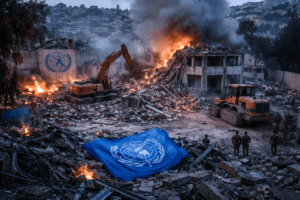
In January 2026, Israeli bulldozers demolished the East Jerusalem headquarters of the United Nations Relief and Works Agency (UNRWA), an act immediately condemned by the foreign ministers of 11 countries—including the UK, France, and Canada—as an “unprecedented” assault on a UN agency and a direct violation of international law. This demolition was the culmination of an escalating campaign by Israel, which had passed laws banning UNRWA’s operations and openly defied an International Court of Justice ruling obligating it to facilitate the agency’s critical humanitarian work. The international coalition framed the event not merely as an attack on Palestinian aid—underscoring UNRWA’s role as an indispensable provider of healthcare, education, and food for millions of refugees—but as a dangerous breach of UN inviolability that sets a perilous global precedent, warning that the erosion of protections for international organizations in one conflict zone threatens humanitarian operations worldwide.
UN Headquarters Demolished: A Red Line Crossed in Jerusalem
In the predawn hours of January 20, 2026, Israeli bulldozers entered the Sheikh Jarrah compound in occupied East Jerusalem and began demolishing the headquarters of the United Nations Relief and Works Agency (UNRWA). This act, captured in stark photographs, was not merely the destruction of buildings. It marked the most severe physical assault ever by a United Nations member state against the premises of a UN agency. Eleven countries—including major Western powers like the United Kingdom, France, Canada, and Japan—swiftly condemned the act as “unprecedented” and a direct attack on the international system itself. This demolition is not an isolated event, but the dramatic culmination of a calculated, multi-year campaign to dismantle the primary international institution sustaining Palestinian refugees, setting a perilous precedent for global humanitarian operations and the rule of law.
The Demolition: A Timeline of Escalation
The assault on the UNRWA headquarters was the latest and most brazen step in a series of escalating actions by Israeli authorities. The groundwork was laid through legislation.
- October 2024: The Israeli Knesset passed a law banning UNRWA operations in areas under Israeli control.
- December 2025: The Knesset approved strengthening amendments to this law, further impeding the agency’s work. These amendments forbade any contact between Israeli state entities and UNRWA, prohibited its presence, and even cut off utilities like water and electricity to its properties.
- January 14, 2026: Israeli forces entered and ordered the closure of an UNRWA health center in East Jerusalem, terrifying staff.
- January 20, 2026: Israeli forces, “under the watch of Israeli lawmakers,” stormed and began demolishing the UNRWA headquarters in Sheikh Jarrah, East Jerusalem.
- Following the Demolition: Reports emerged that the compound had been deliberately set on fire, intensifying the destruction.
The Israeli government justified the demolition by citing its new anti-UNRWA legislation and accusing the agency of ties to militant groups, claims repeatedly rejected by the UN and key donor states. UN officials stressed a critical fact that undermines Israel’s legal justification: the Israeli government does not, and has never, owned the land housing the UNRWA compound. The demolition and seizure, therefore, constitute a blatant seizure of UN property.
The International Condemnation: A Unified Front of Concern
The international reaction was swift and unusually unified across diverse geopolitical blocs. The joint statement issued by the foreign ministers of Belgium, Canada, Denmark, France, Iceland, Ireland, Japan, Norway, Portugal, Spain, and the United Kingdom framed the issue in stark terms of international law and humanitarian necessity.
Their core arguments were clear:
- Defense of UN Inviolability: They emphasized that the 1946 UN General Convention grants UN premises inviolability, a principle Israel is obligated to respect as a UN member state.
- Support for UNRWA’s Mission: The ministers reiterated “full support for UNRWA’s indispensable mission,” highlighting its role in delivering healthcare and education to millions, particularly in Gaza.
- Demand for Humanitarian Access: They called on Israel to abide by its obligations to facilitate aid into Gaza, stating conditions remain “dire” and supply “inadequate”.
The breadth of this coalition—spanning European, North American, and Asian nations—signals that this is not viewed as a partisan political issue, but a fundamental challenge to institutional and legal norms. The United States, however, was notably absent from this group, having voted against the recent UN General Assembly resolution that affirmed Israel’s legal obligations toward UN agencies.
The Legal Battlefield: Defiance of the International Court of Justice
The demolition places Israel in direct, open defiance of the highest legal authority of the United Nations. In a landmark advisory opinion rendered on October 22, 2025, the International Court of Justice (ICJ) issued a clear and comprehensive ruling on Israel’s obligations.
Key Obligations for Israel from the ICJ Advisory Opinion (Oct 2025):
| Obligation Category | Specific ICJ Finding |
| As an Occupying Power | Must ensure the population has essential supplies (food, water, medicine). |
| Must agree to and facilitate relief schemes, especially those by UNRWA. | |
| Must respect and protect all relief personnel and facilities. | |
| Is prohibited from using starvation as a method of warfare. | |
| As a UN Member State | Must cooperate in good faith with the UN and may not obstruct its functions. |
| Must ensure full respect for the privileges and immunities of the UN. | |
| Must ensure the inviolability of UN premises. |
The court explicitly stated that UNRWA has been an “indispensable provider of humanitarian relief in the Gaza Strip” and that Israel is obligated to facilitate, not hinder, its operations. UNRWA chief Philippe Lazzarini stated that Israel’s actions “fly in the face” of this ruling. The UN Secretary-General has condemned the anti-UNRWA laws as “inconsistent with the status and international legal framework applicable to UNRWA”.
The Human Impact: Targeting a Lifeline for Millions
Beyond the legal and political implications, the campaign against UNRWA has devastating human consequences. The agency is not a symbolic bureaucracy; it is the primary lifeline for 5.9 million registered Palestinian refugees across the Middle East.
- In Gaza: UNRWA runs schools for over 300,000 children, provides primary healthcare through dozens of clinics, and is the backbone of food and shelter distribution for a population facing catastrophic humanitarian conditions. The agency notes that 12,000 UNRWA staff, Palestinians themselves, remain on the ground in Gaza providing these critical services.
- A History of Suffering: The agency reports that more than 300 UNRWA staff have been killed since the recent conflict began. Demolishing its headquarters in Jerusalem is seen by many as an extension of this violence—an attempt to erase the institutional memory and presence of the refugee community.
- Dismantling Services: The forced closure of health centers and the threat of utility cutoffs to UN facilities create a reality where essential services are systematically dismantled, pushing an already vulnerable population deeper into crisis.
A Precedent with Global Repercussions
The true danger of this event extends far beyond the Israel-Palestine conflict. As Mara Kronenfeld of UNRWA USA warned, “What happens to UNRWA today can happen to any international organization tomorrow”. The precedent is chilling: if a member state can demolish a UN compound with relative impunity, the foundational principle of inviolability that protects diplomatic missions, humanitarian warehouses, and refugee camps worldwide is severely weakened.
The eleven nations, in their statement, were not just defending UNRWA; they were defending a rules-based international order. Their call for Israel to halt demolitions and restore the compound is a defense of the idea that international law and UN charters must bind the actions of all nations, especially within occupied territories. Silence in the face of such a breach, they imply, would be an invitation for similar actions in other global crises, eroding the protections that allow humanitarian work to function in conflict zones from Ukraine to Sudan.
The Path Forward: Restoration or Rupture?
The demands from the international community are clear: halt the demolitions, restore the UN premises, and repeal the laws designed to strangle UNRWA. The immediate call is for the physical restoration of the UNRWA headquarters and a guarantee of its inviolability.
However, the deeper conflict remains. For the Israeli government, UNRWA represents the enduring issue of Palestinian refugees, a narrative it seeks to end. For the UN and much of the world, UNRWA represents a practical and moral obligation to a population in acute distress, pending a just political solution. The demolition in Sheikh Jarrah has dramatically raised the stakes, transforming a bureaucratic and legal dispute into a stark physical confrontation between a state and the institutions of multilateralism.
The world is now watching to see whether this “unprecedented act” will be met with sufficient diplomatic pressure to enforce accountability, or if it will stand as a turning point where the protections afforded to international humanitarian work were irrevocably breached. The integrity of the global humanitarian system and the survival of millions may depend on the answer.
You must be logged in to post a comment.