
U.S. Weaponizes Aid: New $3.3B Bill for Israel Tightens Financial Screws on Palestinians
The recently unveiled U.S. State Department funding bill creates a stark dichotomy in American foreign aid, granting Israel $3.3 billion in unconditional military assistance as part of a longstanding agreement while imposing stringent new conditions on aid to the Palestinians. The legislation blocks security assistance for the West Bank and Gaza unless the U.S. Secretary of State certifies that Palestinians are meeting U.S. benchmarks and ending alleged abuses by their security forces.
Crucially, it also automatically cuts off aid if Palestinians support International Criminal Court investigations into Israeli nationals or pursue upgraded statehood status at the United Nations outside of negotiations with Israel. This move reinforces unconditional U.S. military support for Israel, directly challenges international legal avenues for Palestinian accountability, and uses financial leverage to tightly constrain the Palestinian Authority’s diplomatic strategy, all amidst fragile post-conflict planning for Gaza.
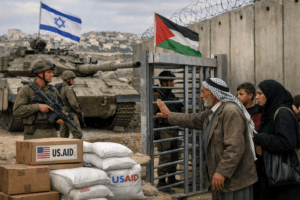
U.S. Weaponizes Aid: New $3.3B Bill for Israel Tightens Financial Screws on Palestinians
The allocation of American military aid has long been the most tangible expression of U.S. foreign policy in the Middle East. A new congressional spending bill, however, transforms this financial pipeline into a direct instrument of geopolitical coercion. By granting $3.3 billion in unconditional military grants to Israel while imposing strict, multi-layered conditions on Palestinian assistance, the legislation starkly delineates Washington’s priorities and its strategy for the region. This move comes amid a fragile transition to a “Phase Two” peace plan and escalating international legal battles, setting a contentious stage for the future of Israeli-Palestinian relations.
The Bill’s Core: Unfettered Aid for Israel, Conditional Funding for Palestinians
The recently unveiled National Security and State Department appropriations bill is a study in contrast. For Israel, the provisions are straightforward and generous. The bill allocates at least $3.3 billion in Foreign Military Financing (FMF) grants, to be disbursed within 30 days of enactment for the purchase of advanced American weapons systems. This sum is not extraordinary but routine; it represents the annual fulfillment of a 10-year, $38 billion Memorandum of Understanding (MOU) signed in 2016.
For the Palestinian Authority in the West Bank and Gaza, the framework is one of restrictions. U.S. security assistance is now blocked unless the Secretary of State certifies to Congress that Palestinians are:
- Meeting U.S.-set governance benchmarks.
- Taking concrete steps to end alleged “torture” and other abuses by Palestinian security forces.
The bill introduces two potent political triggers that would automatically cut off aid:
- The ICC Trigger: Assistance is blocked if Palestinians “initiate or actively support” investigations at the International Criminal Court (ICC) against Israeli nationals.
- The UN Membership Trigger: Funds are barred if Palestinians obtain “the same standing as member states or full membership as a state” at the United Nations outside of a negotiated agreement with Israel.
These conditions reflect a clear intent to use financial leverage to constrain Palestinian diplomatic and legal strategies on the world stage.
Context: A Flood of Aid and a Fragile Political Process
This annual appropriation is a single data point in a massive flow of resources. Since the escalation of hostilities in October 2023, the U.S. has provided or spent an estimated over $21.7 billion in military aid to Israel. This includes funding for missile defense, replenishment of U.S. stockpiles, and ammunition. Major new commitments are also in the pipeline, such as an $8.58 billion Foreign Military Sales contract with Boeing for 25 new F-15IA fighter jets for Israel, largely financed through U.S. FMF grants.
The bill emerges alongside a delicate and controversial diplomatic initiative. In mid-January 2026, the U.S. announced the launch of “Phase Two” of its Gaza plan, which had skipped key elements of its first phase, including a complete ceasefire. This new phase aims to establish a 15-member technocratic Palestinian committee to administer Gaza, led by former Palestinian Authority deputy minister Ali Shaath, and to begin a process of disarmament and reconstruction.
The challenges are immense. Hamas has reorganized since a fragile ceasefire and refuses to disarm without the establishment of a Palestinian state. The new Palestinian committee’s immediate focus is urgent humanitarian relief and clearing rubble—a task Ali Shaath grimly noted could take years. A 2024 UN report estimated that rebuilding Gaza’s destroyed homes alone could take until 2040 or longer.
The Domestic and International Backlash
The bill’s passage has been met with starkly different reactions, highlighting the deep global divide over the Israeli-Palestinian conflict.
Table: Contrasting Reactions to the U.S. Aid Bill
| Source | Position | Key Arguments |
| AIPAC (U.S. Lobby) | Strong Support | Reinforces “ironclad” U.S.-Israel ties; counters shared threats; includes bans on funding to UNRWA, ICC, and other bodies deemed anti-Israel. |
| International Human Rights Coalition | Strong Condemnation | Bill supports “genocide and colonial apartheid”; conditions and sanctions attack international law and silence victims; U.S. risks complicity in crimes. |
| UN Experts & Human Rights Bodies | Critical | Have previously condemned U.S. sanctions on ICC judges as an “attack on global rule of law” and warned that suppressing pro-Palestine advocacy undermines atrocity prevention. |
A broad coalition of global human rights organizations, including the International Service for Human Rights (ISHR) and the World Organisation Against Torture (OMCT), issued a solidarity statement framing the U.S. legislative and diplomatic moves as part of a “systematic trend of repression.”. They argue that by conditioning aid and sanctioning Palestinian rights groups engaged with the ICC, the U.S. is enacting “reprisals” that “deepen impunity” for alleged international crimes. These groups, alongside UN experts, have raised alarms about the “weaponization of antisemitism and counter-terrorism policies” to suppress fundamental rights and Palestine advocacy in Western countries.
The Machinery of Aid: How American Military Funding Actually Works
To understand the bill’s impact, one must look past the headline number to the mechanics of U.S. security assistance. Israel is the largest cumulative recipient of U.S. foreign aid since World War II, with over $310 billion in inflation-adjusted dollars. Crucially, Israel does not receive cash. The FMF program provides a credit that Israel must use to purchase U.S.-made defense articles.
This process involves two main channels:
- Foreign Military Sales (FMS): The U.S. government acts as an intermediary, procuring weapons (like the F-15 jets) and selling them to Israel.
- Direct Commercial Sales (DCS): Israel is one of the few nations allowed to use FMF grants to buy directly from U.S. defense contractors.
The system is designed to benefit both nations’ security establishments and defense industrial bases. As the Boeing contract shows, a massive $8.58 billion award to an American company in St. Louis is ultimately financed by U.S. taxpayer dollars allocated to Israel. While Congress has the power of the purse and can theoretically block sales, it has never successfully done so through a formal Joint Resolution of Disapproval. U.S. law also mandates that Washington uphold Israel’s “Qualitative Military Edge” (QME) over all regional threats, often requiring arms sales to Arab states to be offset with enhanced Israeli capabilities.
Strategic Implications and the Road Ahead
This funding bill locks in a U.S. posture of unconditional military support for Israel coupled with conditional, politically-constrained aid for Palestinians. Its passage signals that significant factions in Congress are more committed to leveraging financial pressure on the Palestinian Authority than to using aid to Israel as leverage for a change in Israeli policy, such as settlement expansion.
The ICC investigation trigger is particularly consequential. It places the Palestinian Authority in an impossible bind: forego a major international legal avenue for accountability or lose crucial U.S. security funding. This directly challenges the independence of international judicial bodies and aligns the U.S. with Israel’s campaign against the ICC’s jurisdiction.
Looking forward, all eyes are on the expiring 2016 MOU. Reports indicate Israel is already seeking a new 20-year aid agreement that could include joint research on defense technologies. The current bill, with its sweeping conditions, sets a precedent that will likely influence those future negotiations, cementing aid as a central, contentious pillar of the conflict for decades to come.
The ultimate contradiction lies in the simultaneous push for a new Palestinian governance structure in Gaza while financially and diplomatically constraining the broader Palestinian political project. As the technocratic committee grapples with apocalyptic devastation in Gaza, the U.S. Congress has passed a bill that ensures the political horizon remains firmly under Washington’s control, for one side, through sustenance, and for the other, through restraint.
You must be logged in to post a comment.