
Trump’s Gaza Gamble: As War with Iran Rages, Tenders for “Peace” Villages and a Foreign Troop Base Are Already Out
Despite the ongoing US-Israel war with Iran, former President Donald Trump’s postwar Gaza plan is quietly moving into an implementation phase, with the Board of Peace (BoP) already issuing tenders for refugee villages in Gaza, a base for a 20,000-strong international stabilization force, and a management headquarters in Israel, funded by an initial $60–70 million budget from regional sources rather than the US or Israel. The conflict with Iran has paradoxically accelerated the initiative by weakening Tehran and its proxy Hamas, potentially forcing the militant group into disarmament, and while diplomatic talks are currently paused due to war-related disruptions, the physical groundwork—including formal troop commitments from five countries—continues, signaling a high-stakes attempt to reshape Gaza through military pressure and concrete reconstruction.
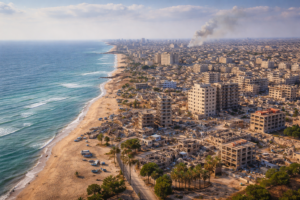
Trump’s Gaza Gamble: As War with Iran Rages, Tenders for “Peace” Villages and a Foreign Troop Base Are Already Out
In the smoke-filled skies of a Middle East once again ablaze with conflict, a startlingly concrete vision for a postwar Gaza is quietly taking shape—one brick, one tender, and one foreign soldier at a time.
It is March 2026. The United States and Israel are actively engaged in open conflict with Iran. Yet, according to sources speaking to The Jerusalem Post, the bureaucratic machinery of former President Donald Trump’s ambitious—and for many, controversial—postwar plan for the Gaza Strip is not just idling; it is accelerating.
While pundits and policymakers alike might assume that a regional war would shelve any talk of reconstruction and peace, the opposite appears to be true behind the scenes. The Board of Peace (BoP), an entity created to steward Trump’s vision, has moved from whiteboards and diplomatic cables to the tangible world of construction tenders, international troop commitments, and a multi-million-dollar bank account.
This isn’t just a policy proposal anymore. It’s a project with a budget, a headquarters, and a deadline mentality.
From Vision to Vertical Construction: The Tenders Are Out
According to sources close to the initiative, the BoP has already issued formal tenders for three distinct and critical physical projects. This marks a significant escalation from the theoretical “concepts of peace” often floated in Washington think tanks.
- Refugee Villages in Gaza: Perhaps the most human-centric of the tenders, these are not tent cities or temporary container homes. The language of “villages” suggests a deliberate attempt to create sustainable, permanent communities. This is a direct challenge to the status quo of the last two decades, which has seen Gaza’s population largely confined to sprawling urban refugee camps. The psychological weight of this cannot be overstated. For a population that has known only displacement and temporariness, the offer of a “village”—with its connotations of roots, community, and permanence—is a powerful, and potentially polarizing, symbol. It signals an intent to rebuild Gaza not as a giant prison or a militant stronghold, but as a habitable place.
- A Base for International Troops: This is the security backbone of the entire plan. The tender for a military base confirms that the anticipated International Stabilization Force (ISF) is not a vague promise but a logistical reality being planned for. The location, size, and specifications of this base will be a geopolitical statement in themselves. Will it be near the Israeli border, the Egyptian border, or the coast? Its very existence is designed to reassure Israel (by creating a buffer) and to deter Hamas (by establishing an immovable, armed presence).
- A Management Headquarters in Israel: The decision to base the operational nerve center in Israel, rather than in Gaza or a neighboring Arab country, is a powerful indicator of who the BoP sees as the primary security guarantor and logistical partner. This headquarters will likely be a hub of intense activity, coordinating the movements of troops, aid, and construction materials. It will be the bridge between the Israeli defense establishment, the international community, and the new governing bodies in Gaza.
These tenders represent the physical manifestation of the plan. They are the steel and concrete of a new order, moving forward even as Iranian steel rains down on the region.
The Paradox of War: Why Conflict with Iran Might Fuel Gaza’s Peace
At first glance, a war with Iran seems like the ultimate spoiler for any peace plan. However, sources and analysts point to a paradoxical dynamic: the conflict might be the very thing that makes the Gaza plan viable.
For months, the primary obstacle to the Trump plan has been Hamas itself. The core demand—that the terror group disarm, cede governance, and see its military infrastructure dismantled—was a non-starter. The group’s leadership, nestled comfortably and receiving support from Tehran, had little incentive to capitulate.
The war with Iran changes that calculus dramatically.
“The geopolitical powers in the Middle East are changing,” a senior Israeli official told the Post. “The Israel-US alliance will enable forcing Hamas into disarming more than it would prior.”
Here’s the brutal logic: If your primary benefactor and protector (Iran) is locked in a direct military confrontation with your enemy (Israel/US), and appears to be losing, your own position becomes perilously weak. The sources suggest that Hamas’s decision to largely stay on the sidelines during the current Iran conflict—failing to unleash a significant barrage of missiles in support of Tehran—is a sign of this weakness, not of newfound restraint. They are likely conserving what little power they have left, fearful of being utterly annihilated in the blowback from a wider war.
The war, therefore, acts as a pressure cooker. By weakening Iran, the US and Israel are effectively cutting the oxygen supply to Hamas. A defeated or severely diminished Iran cannot offer the same level of financial, military, or political backing. Isolated and battered, Hamas may find that the choice is no longer between dignity and surrender, but between a negotiated disarmament (with potential benefits for the Gazan population) and total oblivion.
The Anatomy of the International Stabilization Force (ISF)
The linchpin of the entire postwar strategy is the ISF. The confirmation that five countries have formally agreed to contribute troops is a monumental breakthrough. While their identities remain undisclosed, the implications are vast.
Who are these countries? Likely candidates include moderate Arab nations with the incentive to stabilize the region and counter Iranian influence—perhaps the UAE, Bahrain (both part of the Abraham Accords), or Morocco. There is also speculation that some Muslim-majority countries with no border with Israel, such as Indonesia, might see this as a humanitarian and peacekeeping mission.
A force of approximately 20,000 troops is not a symbolic gesture. It is a full-scale military intervention, albeit a stabilizing one. Their mandate, as described, is multi-faceted:
- Security: To prevent a Hamas resurgence and maintain order.
- Support Reconstruction: To provide a safe environment for construction crews to operate without being targeted or extorted.
- Assist Palestinian Police: To mentor and build a new, professional local security force untainted by militancy.
For Israel, the ISF is the golden bridge that allows for a withdrawal. The current government cannot be seen as “losing” Gaza or leaving a vacuum. Handing over security to a powerful, multilateral force provides the political cover needed to pull back troops while ensuring its citizens are not threatened from across the border.
The Human Element: The Villages and the Voids
Beyond the geopolitics and the military logistics lies the human story. The proposed “refugee villages” are perhaps the most radical element of the plan. For decades, the Palestinian refugee issue has been one of the most intractable in the conflict, centered on the “right of return.” Building new, permanent villages in Gaza for current residents could be interpreted in multiple ways.
To some, it is a humanitarian necessity—a pragmatic step to house people who have lost everything, offering them a life of dignity rather than a future of temporary shelters. It could be seen as an investment in the people of Gaza, separate from the political aspirations of Hamas.
To others, particularly those who hold onto the dream of returning to homes in what is now Israel, it could be seen as an attempt to make their refugee status permanent, to finalize their displacement. This is a deeply emotional and psychological fault line that the BoP will have to navigate with extreme care. A village built with concrete and care can be a home; a village imposed by outsiders can feel like a cage.
The Money and the Motive: Who is Funding This?
A crucial detail in the report is the funding source. The BoP has an initial budget of $60–70 million, allegedly not from the US or Israel, but from “other entities in the region.” This is a masterstroke of political engineering.
By having regional actors foot the bill, the plan avoids the stigma of being a purely “American-Zionist” imposition. It gives the participating Arab nations a tangible stake in the success of the project. It also puts their skin in the game. These countries likely see a stable, demilitarized Gaza as a bulwark against the Iranian-led “axis of resistance.” Investing in Gaza’s reconstruction is, in their view, investing in their own long-term security against revolutionary Shiite expansionism.
The Current Pause: A Bump in the Road or a Sign of Fracture?
The Reuters report that talks have been “put on hold” since the strikes on Iran began adds a necessary dose of reality. War disrupts everything. Travel bans, closed airspace, and the sheer focus of diplomatic and military minds on the immediate crisis make high-level negotiations nearly impossible.
However, the sources close to the BoP describe the delay as “brief and technical,” caused by flight disruptions. This distinction is critical. A “freeze” implies a loss of will. A “technical pause” implies that the will is still there, but the logistical means to execute it are temporarily unavailable. The fact that the tenders are still out, that the bank account is open, suggests the engine is still running, even if the driver has momentarily stepped on the brake.
Conclusion: A High-Stakes Roll of the Dice
What we are witnessing is a breathtakingly ambitious and high-risk strategy. The Trump administration’s postwar Gaza plan is moving forward on the premise that you must sometimes break eggs to make an omelet—or in this case, wage a war to make a peace.
The plan hinges on a series of interconnected assumptions:
- That the war with Iran will end in a decisive weakening of Tehran.
- That this weakening will force Hamas into a position of effective surrender regarding disarmament.
- That five (or more) nations are willing to commit troops to a potential quagmire.
- That the Palestinian population of Gaza, exhausted by war, will accept a new order administered by international forces and funded by regional powers.
It is a plan built on the back of military might, driven by the engine of geopolitics, and aiming for a destination of lasting peace. Whether the tenders for those villages will ever result in homes where children can play without fear of war, or whether the base for international troops will become a new flashpoint, is a question that will define the Middle East for a generation. For now, in the midst of war, the blueprints are being drawn, the contracts are being let, and the future of Gaza is being tendered out to the highest—or perhaps the most determined—bidder.
You must be logged in to post a comment.