
Trump’s 25% Tariff on Iran’s Partners: A New Front in Global Economic Warfare
President Trump’s announcement of a 25% tariff on any country trading with Iran represents a significant escalation of economic pressure, directly targeting major partners like India, China, and the UAE to isolate Tehran.
This move forces affected nations into a difficult strategic choice between maintaining crucial economic and strategic ties with Iran—such as India’s development of the Chabahar Port—and facing prohibitive new costs for accessing the vital U.S. market, with India potentially confronting cumulative tariffs as high as 75%. The policy, framed as a response to Iran’s internal crackdown on protesters, risks accelerating the fragmentation of the global economic order, imposes severe human costs within Iran, and may ultimately push nations toward alternative trading blocs, thereby undermining the very economic unity the U.S. seeks to enforce.
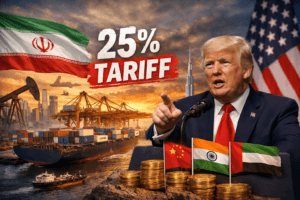
Trump’s 25% Tariff on Iran’s Partners: A New Front in Global Economic Warfare
When a U.S. president declares a 25% tariff on any nation trading with Iran, the implications extend far beyond a simple trade policy update. This move signals a new phase in the Trump administration’s “maximum pressure” campaign, one that directly targets not just Iran but its entire network of economic partners. For countries like India, China, and the UAE, this announcement forces an immediate and difficult strategic calculus: recalibrate long-standing relationships or face punishing costs in the critical U.S. market. This policy, born from a complex mix of geopolitical pressure and domestic protest dynamics within Iran, has the potential to reshape trade alliances and accelerate the fragmentation of the global economic order.
The order, announced via a Truth Social post that President Trump described as “final and conclusive,” is characteristically broad and leaves many questions unanswered. Yet, its intent is clear: to economically isolate Iran by threatening its trading partners. For nations already navigating a precarious geopolitical landscape, this adds a new layer of risk and complexity, potentially elevating tariffs to levels not seen in modern peacetime trade.
The Economic Impact: By the Numbers
While the tariff threat is global, its impact will be felt most acutely by Iran’s key economic lifelines. China stands as Iran’s most significant partner, importing over $14 billion in Iranian goods (predominantly oil) in the year to October 2025. Turkey and the United Arab Emirates follow as major destinations for Iranian exports. For these nations, the U.S. tariff creates an immediate dilemma, forcing a cost-benefit analysis between their Iranian economic interests and access to the lucrative American consumer market.
For India, the stakes are particularly nuanced. The total bilateral trade volume with Iran—approximately $2.31 billion in 2024—is modest in the context of India’s global commerce. However, the composition of this trade reveals critical dependencies and strategic interests.
Table: Key India-Iran Trade Data (2024)
| Category | Value (USD) | Key Commodities |
| India’s Exports to Iran | $1.25 Billion | Cereals (especially rice), tea, pharmaceuticals, machinery |
| India’s Imports from Iran | $1.06 Billion | Organic chemicals, edible fruits & nuts (e.g., pistachios), mineral fuels |
The real threat to India lies in the cumulative effect of U.S. tariffs. Indian exports already face a 50% levy—comprising a 25% “reciprocal” tariff plus an additional 25% imposed for continuing to purchase Russian oil. A new, separate 25% tariff for trading with Iran could theoretically push the total duty on some Indian goods to 75%, a rate that would be functionally prohibitive for many exporters. U.S. officials have not clarified whether these tariffs would be additive, but the ambiguity itself is a powerful tool of economic coercion.
The Strategic and Diplomatic Quagmire
The tariff announcement cannot be divorced from the turbulent political situation inside Iran. Widespread protests erupted in late December 2025, initially driven by a collapsing currency and soaring inflation. The rial has lost half its value against the dollar in less than a year, with food price inflation exceeding 70%. While President Trump has framed his aggressive posture—including threats of military intervention—as support for these protesters, analysts note a stark irony: decades of U.S. sanctions have been a primary contributor to the economic despair fueling the unrest.
For partner nations, this creates a diplomatic tightrope. They must balance:
- U.S. Pressure: Adherence to Washington’s escalating demands or face severe market access penalties.
- Regional Stability: Maintaining functional relationships with Iran, a significant regional power.
- Domestic Economic Interests: Protecting key export sectors and strategic investments.
India’s predicament epitomizes this challenge. Its development of Iran’s Chabahar Port is a cornerstone of its regional strategy, providing a vital trade route to Afghanistan and Central Asia while bypassing Pakistan. The project has previously operated under a U.S. sanctions waiver, recognized for its role in humanitarian access and regional development. The new tariff threat casts a shadow over this arrangement, forcing India to weigh the strategic value of Chabahar against the broader cost to its U.S. trade relationship.
The Compliance Frontier and Legal Shadows
For multinational corporations and financial institutions, the announcement expands an already daunting compliance landscape. The U.S. Treasury’s Office of Foreign Assets Control (OFAC) is intensifying its focus on “gatekeepers”—lawyers, accountants, and investment advisors—holding them responsible for policing sanctions evasion. The proposed tariff, acting as a secondary sanctions measure, would further complicate transactional due diligence.
A major legal cloud hangs over the policy itself. The Trump administration has relied on the International Emergency Economic Powers Act (IEEPA) to justify sweeping tariffs. This legal theory is currently under challenge at the U.S. Supreme Court. A ruling against the administration could not only invalidate this new tariff but also force the U.S. government to refund an estimated $130 billion in previously collected duties, throwing its entire economic pressure toolkit into disarray.
Table: Potential Cumulative Tariff Impact on Key Iranian Partners
| Country | Existing U.S. Tariffs | New Iran-Related Tariff | Potential Total Tariff | Primary Risk |
| China | Average ~30.8% | +25% | ~55% or more | Reignition of full-scale trade war; rare earth export retaliation |
| India | 50% (25% reciprocal + 25% for Russian oil) | +25% | Up to 75% | Crippling of key export sectors (e.g., basmati rice); strategic blow to Chabahar project |
| Turkey | Varied | +25% | Significant increase | Further strain on fragile economy and NATO alliance relations. |
| UAE | Varied | +25% | Significant increase | Disruption of major re-export and logistics hub. |
The Human Cost and a Fragmented Future
Beyond the high politics and macroeconomic data, the ongoing pressure campaign has a profound human dimension. Research indicates that sanctions have contributed to a shrinking Iranian middle class, pushing professionals into poverty and “vulnerable employment”. They have disrupted medical supply chains, leading to drug shortages and price hikes, and have even been linked to declining environmental standards and public health outcomes. The very citizens President Trump claims to “help” have borne the brunt of the policies he has championed.
Looking ahead, the global response will signal the future of economic alignment. China has already stated it will “take all necessary measures” to protect its interests. The move may further solidify a bifurcated economic world, where nations are forced into increasingly exclusive spheres of influence. For the U.S., the risk is that aggressive unilateral measures could accelerate the very de-dollarization and alternative financial system development it seeks to prevent, as seen in Iran’s use of shadow tankers and yuan-based oil sales.
In conclusion, President Trump‘s 25% tariff threat is more than a trade barrier; it is a geopolitical forcing mechanism. It tests the limits of unilateral economic power, the resilience of international alliances, and the strategic autonomy of nations caught between competing giants. Whether it succeeds in further isolating Iran or merely accelerates the unraveling of a coherent global trading system will be one of the defining economic stories of the coming year. The ultimate cost will be measured not only in tariffs paid but in diplomatic relationships broken, strategic projects abandoned, and the continued suffering of ordinary people caught in the crossfire of economic warfare.
You must be logged in to post a comment.