
Tragedy on the Road to Medina: A Community in Hyderabad Grieves After Pilgrimage Bus Crash Claims 45 Lives
A tragic bus accident near Medina, Saudi Arabia, has claimed the lives of at least 45 Indian pilgrims, predominantly from the city of Hyderabad, after their vehicle collided with an oil tanker in the early hours of November 17, 2025, resulting in a devastating fire. The group of 54 had recently traveled from Hyderabad for the Umrah pilgrimage, with 46 on the ill-fated bus; only one passenger from that vehicle is known to have survived, while eight others had chosen to travel separately.
The incident has provoked a wave of grief in India, with national leaders, including the Prime Minister and External Affairs Minister, expressing condolences and confirming that the Indian missions in Saudi Arabia are providing full support, while authorities in Telangana have established helplines and control rooms to assist the numerous distraught families, one of which lost 18 members across three generations in the catastrophe.
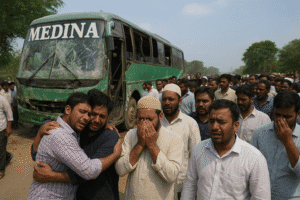
Tragedy on the Road to Medina: A Community in Hyderabad Grieves After Pilgrimage Bus Crash Claims 45 Lives
The sacred journey of Umrah, a pilgrimage of devotion and peace, has been shattered by an unimaginable horror on the desert roads of Saudi Arabia. In the early hours of Monday, a bus carrying 46 Indian pilgrims from the holy city of Mecca to Medina transformed into a scene of incineration and death after a catastrophic collision with an oil tanker. The accident, occurring around 1:30 AM IST, is feared to have killed 45 of the passengers, the vast majority of whom were from the southern Indian city of Hyderabad, leaving a trail of grief that stretches from the Arabian desert to the bustling neighborhoods of Telangana.
A Journey of Faith Turns into a Nightmare
The group of 54 pilgrims had departed from Hyderabad on November 9, their hearts filled with the anticipation of a spiritual sojourn scheduled to last until November 23. Their pilgrimage was following the traditional route, moving from Jeddah to Mecca and then onwards to the Prophet’s Mosque in Medina. However, in a twist of fate that now seems providential, eight members of the larger group opted to travel separately to Medina. This decision spared them from the tragedy that befell the others.
The 46 who boarded the ill-fated bus never reached their destination. According to initial reports, the bus collided with an oil tanker on the highway near Medina. The impact, combined with the highly flammable nature of the tanker’s cargo, is believed to have caused a massive, fast-moving fire that engulfed the bus, leaving little chance of escape for those inside. The confirmation of the devastating toll came from V.C. Sajjanar, the Commissioner of Police in Hyderabad, who somberly detailed the travel plans and the fatal separation of the group.
The Human Toll: A Single Family Loses 18 Members
Behind the staggering number of 45 dead lies a tapestry of individual lives, family stories, and profound personal loss that has plunged entire communities into mourning. The scale of the tragedy is perhaps most starkly illustrated by the story of one family. Shaik Nazeeruddin, a retired railway employee, embarked on what was to be the pilgrimage of a lifetime with 17 members of his own family across three generations. He was accompanied by his wife, his son, three daughters, and his grandchildren—a multi-generational testament to their shared faith.
His nephew, Mohammed Aslam, encapsulated the family’s shock and despair, stating, “Whether it was an accident or what happened we do not know, but total 18 members… were in the bus.” In a single, fiery moment, a family’s lineage was irrevocably altered, with only one son, currently in the United States, remaining from the immediate family unit. This story is not an isolated one; it is a microcosm of the collective grief gripping Hyderabad, where distraught relatives descended on travel agencies in the pre-dawn hours, desperately seeking information about their loved ones.
A Nation Mourns: Leaders Express Grief and Mobilize Support
The news of the tragedy sent shockwaves through the highest echelons of the Indian government. Prime Minister Narendra Modi expressed his deep sorrow, stating, “Anguished by the loss of lives in the unfortunate bus accident in Medinah, Saudi Arabia. My condolences to the bereaved families and prayers with the injured.” He assured the nation that the Indian Embassy in Riyadh and the Consulate in Jeddah were providing “all possible assistance” and were in close touch with Saudi authorities.
External Affairs Minister S. Jaishankar, who is currently on a diplomatic visit to Russia, also voiced his shock. “Our Embassy in Riyadh and Consulate in Jeddah are giving the fullest support to Indian nationals and families affected by this accident,” he affirmed. This high-level attention underscores the magnitude of the incident and the government’s commitment to navigating the complex international logistics of repatriating the deceased and supporting the survivors.
Closer to the epicenter of the loss, Telangana Chief Minister A. Revanth Reddy expressed his shock and directed state officials, including the Chief Secretary and the Director General of Police, to immediately ascertain the full details of the tragedy. He has prioritized determining the exact number of victims from Telangana and has instructed officials to coordinate closely with the Union Ministry of External Affairs and the Saudi Embassy to expedite relief measures and the repatriation process.
Condolences poured in from across the political spectrum, with Vice President C.P. Radhakrishnan, Congress president Mallikarjun Kharge, and Andhra Pradesh Chief Minister N. Chandrababu Naidu all expressing their heartfelt sympathies to the bereaved families.
The Grueling Task Ahead: Repatriation and the Question of Accountability
In the immediate aftermath, the focus has shifted to the monumental tasks of identification, repatriation, and providing solace to the grieving. The Indian mission in Jeddah has established a control room to coordinate assistance, a critical step in managing the flow of information and support. Simultaneously, a control room has been set up in the Telangana Secretariat in India, providing helpline numbers (+91 79979 59754 and +91 99129 19545) for distressed families seeking information.
The Telangana Bhavan in New Delhi has also activated its own dedicated control room, with senior officials like Liaison Head Vandhana and PRO Ch. Chakravarthi serving as points of contact for families, demonstrating a multi-layered governmental response to the crisis.
However, as the initial shock subsides, difficult questions will inevitably arise. The circumstances leading to the collision are yet to be fully detailed by Saudi authorities. Investigations will likely scrutinize factors such as driver fatigue, road conditions, vehicle maintenance, and the timing of the travel—the accident occurred in the dead of night. For the families left behind, understanding how and why this happened will be a crucial, albeit painful, part of their long journey toward closure. The role and responsibility of the travel agencies that organized the pilgrimage will also come under intense scrutiny.
A Community’s Resilience Tested by Unimaginable Loss
The city of Hyderabad, with its rich Islamic heritage and a large population that regularly undertakes the Umrah pilgrimage, is no stranger to sending its sons and daughters on this spiritual journey. But it is entirely unaccustomed to receiving them back in coffins, and in such devastating numbers. The tragedy has struck at the very heart of the community’s social and religious fabric.
The pain is not just about the loss of life, but the loss of life in a state of piety. These pilgrims were on one of the most revered journeys a Muslim can undertake, a time meant for purification and drawing closer to God. The cruel irony of meeting such a violent end on the path between Islam’s two holiest cities adds a profound layer of spiritual and emotional anguish to the grief.
As the complex process of identifying the victims and repatriating their remains begins, the community in Hyderabad and across India must now confront a sorrow of immense proportions. They do so with the support of state and national institutions, but the true burden of loss will be borne in the quiet of their homes, in the empty chairs at family gatherings, and in the prayers that will now be offered for the departed, rather than alongside them. The road to Medina was meant to be a path to divine blessing; it has become, instead, a highway of heartbreak, the aftermath of which will be felt for generations.
You must be logged in to post a comment.