
Tragedy in Paradise: Goa Nightclub Fire Exposes Deadly Gap Between Safety Rules and Enforcement
A catastrophic midnight fire at the Birch by Romeo Lane nightclub in Goa’s Arpora district claimed at least 25 lives, with most victims believed to be staff members trapped in the kitchen and staircase areas. The blaze, suspected to have been ignited by a gas cylinder blast in the packed venue, exposed a series of flagrant safety failures, including a complete lack of emergency exits, the absence of a valid fire safety certificate, and allegations that the club was operating illegally on protected coastal land without proper permits.
The tragedy, which prompted national outrage and condolences from Prime Minister Modi, has ignited urgent calls for stricter enforcement of building and safety codes, highlighting a deadly pattern of neglect where existing regulations are routinely ignored, resulting in preventable loss of life.
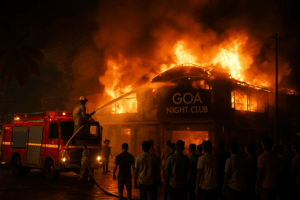
Tragedy in Paradise: Goa Nightclub Fire Exposes Deadly Gap Between Safety Rules and Enforcement
The aftermath of the deadly fire at Birch by Romeo Lane nightclub in Arpora, Goa, on December 8, 2025. Image: A blackened and destroyed nightclub structure with emergency personnel investigating the scene.
A weekend of revelry in the popular tourist enclave of Arpora, Goa, turned to tragedy in the early minutes of Sunday, December 7, 2025. A catastrophic fire at the Birch by Romeo Lane nightclub claimed the lives of at least 25 people, leaving behind a trail of grief and urgent, uncomfortable questions about safety, regulation, and accountability in one of India’s premier party destinations.
In the immediate aftermath, as smoke still clung to the air, two starkly different narratives of the disaster emerged. One pointed to a routine gas cylinder blast; the other described a sudden eruption of flames on a packed dance floor. What united them was a horrifying outcome: a frantic rush for safety that led dozens into a fatal trap, exposing a nightclub that, by design and neglect, was a disaster waiting to happen.
The Night That Turned to Chaos
The sequence of events paints a picture of rapid escalation and systemic failure.
- The First Moments: Around midnight, with an estimated 100 people on the dance floor enjoying a live music performance, chaos broke out. Eyewitness Fatima Shaikh described a “sudden commotion as the flames started erupting,” forcing a panicked stampede for the exits.
- A Fatal Misstep: In the blinding confusion and smoke, some patrons, disoriented, ran downstairs toward the ground-floor kitchen instead of toward an exit. They found themselves trapped alongside kitchen staff, with no way out as the blaze intensified.
- A Delayed Response: The nightclub’s location in the narrow backwaters of the Arpora river proved disastrous for rescue efforts. Fire engines could not reach the venue and had to be parked roughly 400 meters away, hose lines stretched to their limit as precious minutes ticked by.
The timeline below summarizes the critical moments of the disaster and the immediate official response.
timeline
title Timeline of the Goa Nightclub Fire & Response
section Dec 7, 2025
Midnight (~00:00) : Fire erupts at Birch by Romeo Lane<br>during a packed live music event.
Early Morning Hours : Firefighters battle blaze;<br>25 fatalities confirmed, mostly from suffocation.
section Dec 8, 2025
Morning : Goa CM Pramod Sawant visits site,<br>confirms major safety violations.
PM Modi announces compensation,<br>Goa police register offence, arrest four.
Afternoon : Goa SDMA issues state-wide<br>safety advisory to all clubs.
Delhi Police orders review<br>of safety measures in the capital.
A Cascade of Systemic Failures
As investigators sifted through the charred wreckage, a clearer picture emerged of the violations that turned an accident into a mass-casualty event. Chief Minister Pramod Sawant stated plainly that the club “had not complied with fire safety norms”. The specifics, however, reveal a profound breakdown.
- Trapped with No Escape: A police report noted the venue lacked an emergency exit door on both the ground and deck floors, a fundamental safety requirement. This single failure turned the kitchen into a death trap.
- Illegitimate from the Start: The tragedy was compounded by revelations that the club may have been operating illegally. Roshan Redkar, sarpanch of the Arpora-Nagoa panchayat, stated that inspections had found no permission to construct the club on the site, which was on eco-sensitive saltpan land within a Coastal Regulation Zone. A demolition notice had been issued but was later stayed by higher authorities.
- The Inherent Danger of Nightclubs: Experts note that nightclubs are, by nature, high-risk environments. They often feature combustible soundproofing foam, decorative materials, pyrotechnics, and low lighting, which can disorient patrons during an emergency. The presence of a basement, as this club had, is particularly dangerous due to poor ventilation and difficult escape routes.
The table below details the specific safety failures identified in the aftermath of the fire:
| Failure Category | Specific Violation / Issue | Consequence |
| Structural & Legal | Built allegedly without proper construction permits; located on eco-sensitive CRZ land. Demolition notice was stayed. | Operation of an unauthorized structure that bypassed basic regulatory scrutiny. |
| Fire Safety Compliance | Operated without a valid Fire No-Objection Certificate (NOC). Lacked emergency exits on ground and deck floors. | No formal oversight of fire safety measures; trapped victims had no secondary escape route. |
| Emergency Access | Situated in narrow backwater lanes; fire tenders had to park 400m away. | Critical delay in firefighting response, allowing the blaze to grow unchecked. |
| Crowd & Risk Management | Witness reports of overcrowding (≈100 on dance floor). Use of highly flammable temporary materials (e.g., palm leaves) in construction. | Panic and confusion during evacuation; fire spread with extreme speed. |
The Human Toll and the Search for Answers
The majority of the victims were young staff members who worked in the club, many of whom lived in on-site staff quarters. For survivors like Jayesh Diukar, a member of the kitchen staff, the morning after was spent in stunned silence, staring at the empty staff quarters, “scared to know how many staff have died”. Officials confirmed that most victims died not from burns, but from suffocation, trapped in the smoke-filled basement and ground floor.
The political and administrative response was swift but highlighted a pattern of closing the stable door after the horse has bolted.
- Immediate Actions: Chief Minister Sawant ordered a magisterial inquiry and announced an ex-gratia payment of ₹5 lakh to the families of the deceased. Four managers of the club were arrested.
- Systemic Reforms Promised: The Goa State Disaster Management Authority (SDMA) issued a sweeping advisory to all clubs, mandating internal safety audits within seven days and strict compliance with fire safety norms. Calangute MLA Michael Lobo announced a fire safety audit of all nightclubs in the area.
- National Repercussions: The tragedy sent shockwaves beyond Goa. In Delhi, police immediately instructed all clubs and restaurants to review their fire safety measures, with promises of intensified checks before the Christmas and New Year celebrations.
A Recurring Nightmare and the Path Forward
The Arpora fire is not an isolated incident but part of a grim national pattern. As former Delhi Fire Services chief Atul Garg explained, nightclubs present a unique challenge: “High ambient noise levels from music, combined with strobe lights… significantly reduce the audibility and visibility of traditional fire alarm signals”. This creates a deadly gap between a system being technically present and being effective in an emergency.
Opposition leader Rahul Gandhi called the incident a “criminal failure of safety and governance,” a sentiment that resonates with a public weary of preventable tragedies. The fundamental question arising from the ashes of Birch by Romeo Lane is not about drafting new rules, but about why existing rules are so blatantly ignored and unenforced.
As Goa—and India—mourns another unnecessary loss of life, the real test will be whether the promised audits and advisories lead to sustained, rigorous enforcement, or if the memory of this tragedy will fade until the next one inevitably strikes. The empty staff rooms in Arpora stand as a silent testament to the human cost of neglect, a cost that the vibrant, life-affirming spirit of Goa cannot afford to pay again.
You must be logged in to post a comment.