
Tragedy at a Wedding: How a Gaza School Strike Reveals the Fragility of Ceasefire and Peace
Tragedy at a Wedding: How a Gaza School Strike Reveals the Fragility of Ceasefire and Peace
Table 1: Key Facts of the Gaza School Strike Incident
| Aspect | Details |
| Date of Incident | 19 December 2025 |
| Location | Gaza Martyrs School, al-Tuffah neighbourhood, Gaza City |
| Event | Wedding celebration for displaced families |
| Reported Cause | Shelling from an Israeli tank |
| Fatalities | 6 Palestinians, including a 4/5-month-old infant, a 14-year-old girl, and two women |
| Emergency Access | Blocked for over two hours |
A Celebration Shattered by Shelling
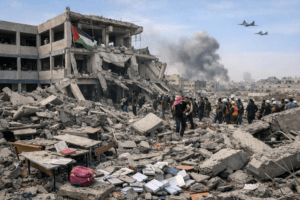
In the al-Tuffah neighbourhood of Gaza City, a place where the echoes of war had, for a brief period, softened, a gathering was taking place. Displaced families, seeking refuge in the Gaza Martyrs School, had come together to celebrate a wedding. For a moment, the school’s second floor, a shelter from a two-year-long conflict, transformed into a space for joy and community—a rare glimpse of normalcy.
This fragile moment was shattered on December 19, 2025, by the impact of an Israeli tank shell. The attack killed at least six people and injured several others. Among the dead was five-month-old Ahmed al-Nader, whose brother would later be photographed carrying his tiny body. A 14-year-old girl and two women also lost their lives. Witnesses described the scene as one of sudden, unprovoked violence. “It was a safe area and a safe school and suddenly… they began firing shells without warning, targeting women, children and civilians,” said Abdullah Al-Nader, a relative of the infant victim.
For the families, the tragedy was compounded by what followed. Israeli forces reportedly blocked ambulance and civil defense crews from reaching the site for more than two hours, delaying the evacuation of the wounded and the recovery of the dead. According to civil emergency services, they could only retrieve the bodies after the United Nations Office for the Coordination of Humanitarian Affairs intervened with Israeli authorities. “We gathered the remains of children, elderly, infants, women, and young people,” recounted Nafiz al-Nader, another relative. “Unfortunately, we called the ambulance and the civil defense, but they couldn’t get by the Israeli army.”
The Incident in the Context of a “Bloodbath” Ceasefire
The strike on the school did not occur in a vacuum. It was, by multiple accounts, one of hundreds of violations of a U.S.-brokered ceasefire that had taken effect on October 10, 2025. While the ceasefire brought a reduction in large-scale hostilities, it failed to stop the bloodshed entirely.
The statistics paint a grim picture of the so-called truce period:
- Rising Toll: Gaza’s health ministry reported that at least 395 Palestinians had been killed by Israeli fire between October 10 and December 19. Other sources, including the Palestinian Civil Defence and the WAFA news agency, placed the number at over 400 killed since the ceasefire began.
- Scale of Violations: Gaza’s Government Media Office stated that Israel had violated the ceasefire agreement more than 730 times through continued attacks by air, artillery, and direct fire.
- Civilian Impact: The broader war’s toll is staggering. Since the conflict escalated in October 2023, over 70,660 Palestinians have been killed, with women and children comprising roughly half of the fatalities. More than 171,000 have been injured.
For many in Gaza, the technicality of a “ceasefire” rings hollow. As Nafiz al-Nader starkly put it outside al-Shifa Hospital, “This isn’t a truce, it’s a bloodbath.”
A Pattern of Targeting Education and Culture
The attack on the Gaza Martyrs School is tragically emblematic of a wider pattern of destruction targeting Gaza’s social and educational infrastructure. According to a report by a UN Human Rights Council-mandated commission, Israeli forces have damaged or destroyed more than 90 percent of schools and university buildings across Gaza.
This systematic destruction has made education impossible for over 658,000 children. Navi Pillay, Chair of the UN Commission, stated that this constitutes a concerted campaign that “will harm the present generations and generations to come, hindering their right to self-determination.” The Commission found that such actions could amount to war crimes and the crime against humanity of extermination.
The report also documented the military use of educational institutions. It noted cases where Israeli forces seized and used schools as bases, including converting part of a university campus into a synagogue for troops. While the commission also documented a single instance of Hamas using a school for military purposes—a violation of international law—the scale of the destruction points to a broader strategy.
This historical context is crucial. The 2025 strike on a school shelter eerily echoes a past tragedy from the 2008-2009 Gaza War, when Israeli tank shells struck a UN school in the Jabaliya refugee camp, killing more than 40 people. Then, as now, the school was a known shelter for civilians.
International Diplomacy and Stalled Peace Efforts
Remarkably, the school strike coincided with high-level international talks meant to salvage and advance the peace process. On the same day, senior officials from the United States, Egypt, Qatar, and Turkey were gathering in Miami, Florida, to discuss the next phase of the Gaza agreement.
The peace plan, announced by U.S. President Donald Trump in September 2025, envisioned a path toward a more stable Gaza. Its second phase includes formidable challenges: the deployment of an international stabilization force, the establishment of a technocratic government in Gaza, the disarmament of Hamas, and a full Israeli withdrawal from the territory.
However, the continuous violence on the ground is undermining these diplomatic efforts. Turkish Foreign Minister Hakan Fidan, a participant in the Miami talks, explicitly stated that Israel’s repeated violations were “making the process incredibly more difficult” and “endangering the peace plan.” The mediators’ joint statement urged “all parties to uphold their obligations, exercise restraint, and cooperate with monitoring arrangements.”
Hamas, for its part, has stated its commitment to the ceasefire despite Israeli violations. Following a meeting in Istanbul, the group stressed “the urgent need to halt these continuous violations” and highlighted the “critical priority” of bringing in winter aid to save people “from death by cold and drowning.”
Legal Repercussions and the Quest for Accountability
The incident adds to a growing body of alleged violations that are the subject of intense international legal scrutiny. Israeli Prime Minister Benjamin Netanyahu and former Defense Minister Yoav Gallant are wanted by the International Criminal Court (ICC) for alleged war crimes and crimes against humanity. Simultaneously, Israel is defending itself at the International Court of Justice (ICJ) against a case filed by South Africa accusing it of genocide.
The UN commission’s findings on the destruction of schools lend weight to these cases. Its call for Israel to “immediately cease attacks on cultural, religious, and educational institutions” and to comply with ICJ orders underscores the growing institutional consensus that the conduct of the war may violate international law.
The Human Cost Beyond the Headlines
Behind the numbers and legal terms lies an unfolding humanitarian catastrophe exacerbated by the winter weather. Hundreds of thousands of displaced Palestinians face rain, cold, and flooding without adequate shelter. Aid agencies warn that Israeli restrictions are preventing life-saving assistance from reaching those in need.
The UN World Food Programme (WFP) has described a chaotic and dangerous aid distribution system, with convoys facing delays, interception by desperate civilians, and looting. Philippe Lazzarini, head of the UN agency for Palestinian refugees, has called the system “humiliating” and a “daily death trap,” forcing hungry people to walk miles for food while excluding the most vulnerable.
Conclusion: A Wedding, a War, and the Flicker of Peace
The strike on the Gaza Martyrs School is a microcosm of the entire conflict. It encapsulates the precariousness of civilian life in Gaza, where even a ceasefire and a school shelter offer no guarantee of safety. It highlights the systemic erosion of civic infrastructure—the schools, universities, and cultural sites that form the bedrock of any society. It demonstrates how military actions on the ground can derail delicate diplomatic processes happening continents away.
Most poignantly, it contrasts the universal human desire for celebration, family, and future—symbolized by a wedding—with the brutal reality of a war that has claimed tens of thousands of lives. As mediators continue their talks and legal bodies pursue their investigations, the words of a grieving relative in Gaza remain the most powerful indictment: a truce that is, in practice, a continuous bloodbath. The path to a lasting peace appears to require not just complex political agreements, but a fundamental recommitment to the principle that civilians, especially children seeking education or families seeking joy, must be protected without exception.
You must be logged in to post a comment.