
Track Record: How India’s ₹1.3 Lakh Crore Rail Safety Push Could Fuel These Three Strategic Plays
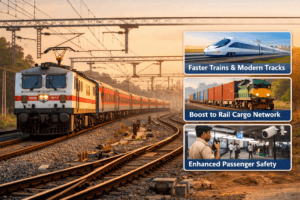
Track Record: How India’s ₹1.3 Lakh Crore Rail Safety Push Could Fuel These Three Strategic Plays
The Indian Railways, a network that pulses with over 23 million passengers daily, is on the cusp of its most significant safety overhaul in history. With the upcoming FY27 Union Budget reportedly earmarking a staggering ₹1.3 lakh crore for safety—a sum constituting nearly half of the railways’ total capital expenditure—the signal is clear: safety is not just a priority; it’s an imperative driving a generational upgrade.
At the core of this transformation is Kavach, the indigenous Automatic Train Protection (ATP) system. More than just a technological tool, Kavach represents a strategic shift towards self-reliance in critical safety infrastructure. For investors, this isn’t merely a government spending story; it’s a deep dive into a niche, high-barrier sector where a handful of early movers are vying for a multi-decade opportunity. Let’s move beyond the ticker symbols and examine the strategic positioning, competitive moats, and tangible risks of three key players in this space.
The Landscape: A ₹50,000 Crore Marathon, Not a Sprint
Understanding the opportunity requires framing it correctly. The planned deployment of Kavach across 40,000+ km of high-density routes is a phased marathon extending to 2030-32. With an estimated market potential of ₹50,000 crore, this creates a long revenue runway. However, this is a government-centric, tender-driven business. Growth will be lumpy, dictated by project award cycles and technological version upgrades. The recent transition from Kavach version 3.2 (for speeds up to 110 kmph) to the more advanced v4.0 (for 160 kmph) exemplifies how technological milestones can dictate order flow, creating temporary pauses and subsequent surges.
The investment thesis, therefore, hinges on identifying companies with not just current orders, but the technical credibility, financial stamina, and strategic vision to navigate this long, complex journey.
- HBL Power Systems Ltd.: The Scalable Veteran
The Strategic Position: HBL isn’t a newcomer to Kavach; it’s a foundational architect. With two decades of development behind it, the company has transitioned from concept to certification leader, being one of the first two firms qualified for the critical v4.0 standard. This isn’t just a product line for HBL; it’s a flagship system that currently anchors its growth.
The Real Insight: HBL’s story is one of scaled execution and forward planning. Its order book of approximately ₹4,000 crore (covering thousands of kilometers of track, locomotives, and stations) provides near-term visibility. Management’s guidance of steady Kavach revenues of ₹1,300-1,500 crore annually through FY28 reflects an understanding of the system’s absorption capacity.
However, the most compelling aspect of HBL’s strategy is its acknowledgment of post-FY28 revenue transition. The company is already actively developing its Train Management Systems (TMS) and Centralised Train Control businesses. These segments, while smaller in contract value initially, offer sticky, recurring revenue opportunities and help diversify away from a pure Kavach dependency. This demonstrates a mature, lifecycle approach to the railways business.
The Risk Factor: Execution is key. Managing a ₹4,000 crore orderbook in a sector plagued by logistical and bureaucratic challenges is a monumental task. Any significant delays or cost overruns could impact profitability. Its valuation, while below its own historical median, still commands a premium to the industry, leaving little room for stumbles.
- Kernex Microsystems Ltd.: The Focused Pure-Play
The Strategic Position: Kernex offers the most concentrated exposure to the Kavach theme. As one of the three original OEMs that co-developed the system, its technical DNA is deeply intertwined with the programme. Its specialization in end-to-end railway safety systems, from embedded software to physical tower installation, makes it a turnkey solutions provider.
The Real Insight: Kernex’s strength is its deep technical specialization and high entry barriers. The requirement for Safety Integrity Level (SIL) 4 certification—the highest safety rating—creates a formidable moat. Its recent v4.0 approval unlocks its massive ₹2,563 crore order book, which provides visibility for over a decade. The company is also looking ahead, developing next-generation components for future train control systems, ensuring it stays on the technological frontier.
The Risk Factor: This is the quintessential “monopsony trap.” Kernex’s fortunes are almost entirely hitched to a single client: Indian Railways. This exposes it to intense price competition during tenders (where the lowest bidder often wins), potential payment delays, and the overarching risk of policy shifts. Its high return ratios are impressive but must be viewed through the lens of this extreme customer concentration. An investor here is making a direct bet on the unwavering and timely expansion of the Railways’ Kavach budget.
- Concord Control Systems Ltd.: The Agile Challenger
The Strategic Position: Concord enters the v4.0 arena as the certified challenger. Operating primarily through its associate company, Progota India, it has secured the crucial developmental vendor status, allowing it to bid for up to 20% of future tender quantities.
The Real Insight: Concord’s potential lies in its cost leadership and high-margin profile. It claims to be one of the lowest-cost SIL-4 system providers globally. Coupled with the potential for 25-30% EBITDA margins from Kavach, this positions it as a potentially highly profitable niche player. Its recent ₹19.5 crore field trial order is a critical first step toward full certification and larger commercial orders. A consolidated order book exceeding ₹450 crore (against FY25 revenue of ₹124 crore) points to strong near-term growth traction.
The Risk Factor: This is a story of potential versus proof. As the newer entrant, Concord has to prove its execution capabilities at scale. The transition from a successful 53-km trial to pan-India deployment is a colossal leap. Its current sky-high valuation (a P/E over 80x), which dwarfs its peers and its own history, prices in flawless execution and massive future order wins. Any misstep in trials, certification delays, or failure to secure large tenders could lead to significant valuation compression.
The Investor’s Conundrum: Valuation vs. Visibility
The table below crystallizes the trade-offs:
| Company | Core Proposition | Key Strength | Primary Risk | Valuation Context |
| HBL Power | Scalable, diversified systems integrator | Massive order book, forward planning for post-Kavach revenue | Execution complexity at scale | Premium to industry, but a discount to its own history. |
| Kernex | Focused, technical pure-play | Technical moat, decade-long visibility | Total dependence on a single, powerful client | In line with historical and industry multiples. |
| Concord | High-margin, low-cost challenger | Cost leadership, attractive margin profile | Unproven execution at scale; “hope” priced in | Extreme premium; demands perfect execution. |
The Bottom Line: Reading the Signals Ahead
The record safety budget is a powerful catalyst, but it is not a blanket guarantee of success for all involved. The coming years will be a test of execution, financial resilience, and strategic agility.
- For the risk-averse investor seeking relative stability and scale, HBL’s diversified approach and proven track record may offer a more balanced pathway.
- For the investor comfortable with high client concentration in exchange for direct theme exposure, Kernex represents a focused bet on the inevitability of Kavach’s rollout.
- For the speculative investor with a higher risk appetite, Concord offers a potential high-reward option, provided its field trials and subsequent bids are executed flawlessly.
Ultimately, the ₹1.3 lakh crore figure is the headline, but the real story is in the gritty details of tender awards, kilometers deployed, and balance sheets that can withstand the unique cycles of government infrastructure projects. As the Kavach network expands, these companies won’t just be laying down trackside equipment; they will be laying down the proof of their long-term investment thesis. Investors would do well to watch the order flow and execution metrics as closely as they watch the budget announcements.
You must be logged in to post a comment.