
Tiny but Mighty: How Nanoparticle Size Could Revolutionize Rice Nutrition and Combat Global Zinc Deficiency
Tiny but Mighty: How Nanoparticle Size Could Revolutionize Rice Nutrition and Combat Global Zinc Deficiency
In the quiet laboratories of agricultural research institutes, a revolution is brewing—one so small it’s measured in billionths of a meter. Scientists have discovered that when it comes to fortifying the world’s most important staple food crop with essential nutrients, size truly matters. And the most exciting news? The smallest particles are packing the biggest punch.
The Silent Epidemic on Our Plates
Every day, billions of people sit down to meals built around rice—that humble grain that has sustained civilizations for thousands of years. But here’s the uncomfortable truth that rarely makes it to dinner table conversations: that bowl of white rice, while filling, is silently contributing to one of the world’s most pervasive health crises.
Zinc deficiency affects an estimated 17% of the global population, with rates soaring past 30% in regions where rice is the dietary cornerstone. This isn’t merely a statistic—it represents hundreds of millions of children whose growth may be stunted, whose immune systems can’t fight off preventable diseases, whose cognitive development never reaches its full potential.
The World Health Organization has long recognized this crisis, but solutions have proven elusive. Traditional approaches—dietary supplements, industrial fortification of processed foods—struggle to reach the rural poor who need them most. What if the solution could be grown directly into the crop itself?
A New Dawn for Biofortification
Enter biofortification, the process of enhancing the nutritional content of crops during growth rather than after harvest. For years, researchers have explored various approaches—conventional breeding, genetic modification, traditional zinc fertilizers. Each has shown promise, but also limitations.
Then came nanotechnology, that controversial and often misunderstood field that manipulates materials at the atomic scale. Could nanoparticles—zinc oxide particles so small that thousands would fit across a single human hair—offer a way to deliver zinc more effectively to rice plants, and ultimately, to the people who depend on them?
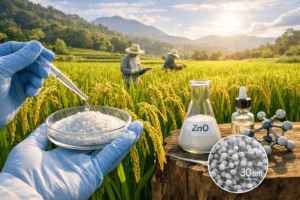
A groundbreaking study on two popular basmati rice varieties—Pusa Basmati-1121 and Pusa Basmati-1509—has now provided answers that are turning heads in the agricultural science community. The research, conducted across multiple growing seasons, compared zinc oxide nanoparticles of three different sizes: 30 nanometers, 40 nanometers, and 95 nanometers.
The results were unambiguous: smaller is better.
The Size Advantage
Think of it like the difference between trying to water your garden with a few large boulders versus thousands of tiny pebbles. The boulders might contain the same volume of material, but they’ll sit on the surface, largely inaccessible. The pebbles, by contrast, can filter down into the soil, work their way into root systems, and deliver their contents precisely where needed.
When researchers applied 30 nm zinc oxide nanoparticles to the soil, the results were dramatic. Photosynthetic rates jumped by more than 23% compared to untreated plants. Stomatal conductance—essentially how well plants “breathe”—improved by nearly 39%. Chlorophyll content increased by up to 47%, and carotenoids, those powerful antioxidants that give plants their golden hues, surged by 46%.
These aren’t just laboratory curiosities. They translate directly to plant health and, ultimately, to grain production. The 30 nm treatment increased tillers per hill by 46%, productive tillers by 25%, panicle length by up to 20%, and grain weight per panicle by more than 36%. Total yield per hill jumped by nearly one-third.
Beyond Yield: The Nutrition Factor
But the real story—the one that matters for those billions of rice consumers—lies in what happened to the grains themselves. The 30 nm zinc oxide nanoparticles increased grain zinc content by approximately 57% compared to control plants.
Let that sink in: a 57% increase in the zinc content of the final food product, achieved simply by changing how zinc is delivered during growth.
Even more intriguing, the nanoparticles reduced phytic acid content in the grains. Phytic acid is what nutritionists call an “antinutrient”—it binds to minerals like zinc and iron in the digestive tract, preventing their absorption by the human body. By simultaneously increasing zinc content and decreasing phytic acid, the nanoparticles effectively doubled down on nutritional impact.
The Science Behind the Magic
Why do smaller nanoparticles work better? The answer lies in basic physics and chemistry. As particles shrink, their surface area relative to volume increases exponentially. A 30 nm particle has dramatically more surface area per unit of mass than a 95 nm particle. More surface area means more interaction with soil chemistry, more points of contact with root hairs, and more efficient uptake by plant transport systems.
The nanoparticles essentially act as tiny delivery vehicles, protecting zinc from soil interactions that would otherwise render it unavailable, then releasing it gradually as plants need it. This slow-release mechanism explains another finding from the study: the treated plants showed sustained improvements throughout their life cycle, not just an initial growth burst.
Root development told a particularly compelling story. Plants treated with the smallest nanoparticles developed longer roots, greater surface area, and increased root volume. A healthier root system means better access to water and all soil nutrients, creating a virtuous cycle of improved plant health.
A Tale of Two Cultivars
The study’s inclusion of two different basmati varieties adds depth to the findings. Pusa Basmati-1121 and Pusa Basmati-1509 are both premium varieties prized for their aroma and grain quality, but they differ in growth duration and some physiological characteristics. Remarkably, both responded similarly to the nanoparticle treatments, suggesting the approach could work across diverse rice types.
This matters because basmati rice occupies a special place in global agriculture. Grown primarily in the Indian subcontinent, it commands premium prices in international markets. If farmers can simultaneously improve yields, enhance nutritional content, and maintain the grain quality characteristics that make basmati valuable, the economic implications are substantial.
Environmental Considerations
No discussion of nanotechnology in agriculture would be complete without addressing environmental concerns. Critics rightly ask: what happens to these nanoparticles after they’ve done their job? Do they accumulate in soil? Affect beneficial microorganisms? Leach into groundwater?
The study’s authors acknowledge these questions and call for long-term research to examine precisely these issues. However, the early indications are encouraging. Because zinc is an essential nutrient for both plants and soil microorganisms, and because plants actively take up the nanoparticles, accumulation may prove less problematic than with some other nanomaterials.
The comparison to conventional zinc fertilizers is instructive. Traditional zinc sulfate applications often result in significant portions of the zinc becoming fixed in soil forms unavailable to plants—essentially wasted. Nanoparticles, by maintaining zinc in more bioavailable forms, might actually reduce the total amount of zinc entering agricultural systems while improving delivery to crops.
The Road to Farmers’ Fields
Translating these findings from research plots to farmers’ fields presents both opportunities and challenges. Zinc oxide nanoparticles remain more expensive than conventional zinc fertilizers, though costs have fallen dramatically as manufacturing processes improve. The quantities needed are small—because the nanoparticles work efficiently, application rates can be lower than traditional fertilizers.
For smallholder farmers who grow most of the world’s rice, any additional input cost must be justified by corresponding benefits. A 30% yield increase certainly helps, but so does the potential for premium pricing of zinc-enriched grain. Forward-thinking agricultural companies are already exploring certification schemes for biofortified crops, creating market incentives for nutritional quality alongside traditional quality parameters.
Beyond Rice: Implications for Global Nutrition
While this study focused on basmati rice, its implications extend far beyond a single crop or region. The same principles could apply to wheat in South Asia, maize in sub-Saharan Africa, beans in Latin America—any staple crop where zinc deficiency compromises human health.
The World Health Organization estimates that zinc deficiency contributes to more than 450,000 child deaths annually. It weakens immune systems, increases the severity of diarrheal diseases, and impairs cognitive development in ways that last a lifetime. Addressing this deficiency through agricultural interventions rather than post-harvest fortification or supplementation offers advantages in sustainability and reach.
The Broader Nano-Agriculture Revolution
Zinc biofortification represents just one frontier in the broader application of nanotechnology to agriculture. Researchers are exploring iron nanoparticles for combating anemia, selenium nanoparticles for antioxidant enhancement, and even combination approaches that deliver multiple nutrients simultaneously.
The precision that nanotechnology enables—delivering the right nutrient, in the right amount, at the right time, to the right part of the plant—aligns perfectly with the goals of sustainable intensification. We need to produce more food, with higher nutritional quality, using fewer inputs and causing less environmental damage. Nanotechnology offers tools to pursue all these goals simultaneously.
A Personal Perspective
Walking through rice paddies in northern India, where basmati has been cultivated for centuries, one senses the weight of tradition. Farmers here have selected seeds, managed water, and nurtured crops using knowledge passed down through generations. Introducing nanotechnology into this context might seem jarring—a high-tech solution for a timeless practice.
Yet the farmers themselves often express the most openness to innovation. They know better than anyone that their crops face changing conditions—shifting rainfall patterns, deteriorating soil quality, evolving pest pressures. They understand that continuing to do things exactly as their forebears did may no longer be sufficient to maintain productivity.
What nanotechnology offers isn’t a replacement for traditional knowledge but a complement to it. The same farmers who can read subtle signs of nutrient deficiency in their crop’s appearance can learn to apply nanoparticles with precision. The same communities that have shared seeds for generations can share knowledge about biofortification.
Looking Forward
The study’s authors appropriately call for additional research on long-term effects, soil health implications, and potential ecological impacts. Science advances through careful validation, not premature celebration. But the results to date justify optimism.
We stand at an intriguing intersection: the ancient human practice of rice cultivation meeting the frontier technology of nanoscale engineering. If we navigate this intersection wisely—with appropriate attention to safety, equity, and sustainability—we may finally make meaningful progress against the hidden hunger that afflicts billions.
The next time you see a bowl of rice, consider what it represents. Not just sustenance, but the accumulated knowledge of millennia—and now, perhaps, the precision of nanotechnology applied to humanity’s most fundamental need. In those tiny grains, delivered by even tinier particles, lies hope for healthier generations to come.
You must be logged in to post a comment.