
TikTok’s American Detour: A $14 Billion Deal That Redefines Tech, Politics, and Power
TikTok’s American Detour: A $14 Billion Deal That Redefines Tech, Politics, and Power
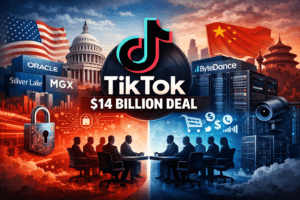
In a landmark agreement that concludes a five-year standoff, TikTok has signed a deal to transfer its U.S. operations to a new entity controlled by a consortium of American investors. This complex arrangement, valued at approximately $14 billion, saves the app from a looming ban but simultaneously reshapes it into a novel corporate and political entity. The deal, brokered under intense political pressure, creates a bifurcated TikTok—one governed by U.S. national security interests, while its Chinese parent company retains crucial business ties and technological roots.
The Anatomy of a “Qualified Divestiture”
The core of the agreement is the creation of “TikTok USDS Joint Venture LLC,” a new U.S.-based company slated to begin operations on January 22, 2026. This structure was approved by President Donald Trump as a “qualified divestiture” under a 2024 law that demanded ByteDance sell its U.S. operations or face a ban. The law aimed to sever TikTok from its Chinese parent over fears that user data and the powerful content algorithm could be exploited by the Chinese government.
The ownership structure is a carefully negotiated patchwork designed to give American investors majority control while allowing ByteDance to retain a significant stake:
| Owner/Investor Group | Stake in New U.S. Joint Venture | Notes |
| Oracle, Silver Lake, MGX Consortium | 45% (15% each) | American-led managing investors. MGX is a state-backed fund from Abu Dhabi. |
| Affiliates of Existing ByteDance Investors | 30.1% | Allows pre-deal investors to maintain economic interest. |
| ByteDance | 19.9% | The maximum stake permitted under the deal’s foreign ownership limits. |
| Other New Investors | 5% | Unnamed group of additional investors. |
A new, seven-member board of directors, with a majority of American members, will govern this joint venture. Its mandate is squarely focused on national security: overseeing U.S. data protection, algorithm security, content moderation, and software assurance.
However, this is far from a clean break. Critics argue the arrangement resembles a “franchise deal” more than a true sale. Jim Secreto, a former Treasury official involved in TikTok policy, noted, “The law requires a clean break from ByteDance. This structure doesn’t meet that standard”. The underlying algorithm—the “secret sauce” that powers TikTok’s addictive feed—will still be owned by ByteDance in Beijing, though a copy will be licensed to the U.S. venture.
A Political Power Play and Media Consolidation
The deal’s significance extends far beyond corporate restructuring into the realm of high-stakes politics and media power. The lead investor, Oracle, is founded and controlled by Larry Ellison, a billionaire and prominent ally of former President Trump. Ellison’s family is simultaneously extending its influence across American media, with his son David leading Paramount Skydance and making a bid for Warner Bros. Discovery.
This convergence has sparked alarm among some lawmakers and watchdogs. Senator Elizabeth Warren sharply criticized the move, writing, “Trump wants to hand over even more control of what you watch to his billionaire buddies”. The concern is that control over a major news and culture platform for over 170 million Americans—43% of U.S. adults under 30 regularly get news from TikTok—is consolidating within a small circle of politically connected figures.
The path to this deal was paved by a series of executive actions by President Trump. After a ban mandated by Congress technically took effect in January 2025, Trump issued multiple orders delaying enforcement while his administration negotiated this specific outcome. The final agreement, reached in principle in September 2025, gave him wide latitude to determine whether the terms satisfied national security concerns.
The Business Split: Security vs. Revenue
One of the most revealing aspects of the deal is the clear separation between national security oversight and commercial control. While the new U.S. joint venture manages data and content safety, the lucrative heart of the business—e-commerce (TikTok Shop), advertising, and marketing—will remain under the control of ByteDance’s global entities.
As explained in an internal memo from TikTok CEO Shou Zi Chew, the U.S. venture will operate independently on security matters, while “TikTok global’s U.S. entities will manage global product interoperability and certain commercial activities”. For employees and advertisers, this means business as usual; one staffer remarked they weren’t “anticipating much change”.
This bifurcation explains the deal’s $14 billion valuation, which is significantly lower than some earlier estimates that reached $50 billion. Investors are paying for control over data and content governance, not for the app’s primary revenue streams, which remain with ByteDance.
What Changes for 170 Million American Users?
For the average user, the immediate experience of scrolling through TikTok is expected to remain largely unchanged. The deeper shifts will occur behind the scenes:
- Algorithmic Retraining: The U.S. joint venture will be responsible for “retraining the content recommendation algorithm on U.S. user data.” The stated goal is to ensure the “content feed is free from outside manipulation”. This process aims to create a version of the algorithm influenced solely by American user behavior and subject to U.S. oversight.
- Data Storage: All U.S. user data will be migrated to and stored within a secure cloud environment run by Oracle on American soil. This fulfills the long-discussed “Project Texas” proposal to create a domestic data fortress.
- Content Moderation: Ultimate authority for reviewing and approving content moderation policies within the United States will rest with the new American-controlled board. This raises subtle but important questions about free speech. As Georgetown law professor Anupam Chander points out, an American-owned TikTok might censor or hide speech permissible on the global platform, potentially limiting content that its American owners dislike.
An Unresolved Global and Geopolitical Experiment
The deal creates an unprecedented global experiment: two versions of the world’s most influential social media app. One version, for American users, will be governed by a U.S. board with Oracle as its “trusted security partner”. Another version, for the rest of the world’s billions of users, will remain fully under ByteDance’s control.
Key questions remain unresolved. China has been conspicuously quiet about the final details, despite Trump’s September announcement of a framework agreement. Chinese cybersecurity regulators have previously asserted that the algorithm must remain under Chinese control. Whether this licensing arrangement satisfies Beijing’s own laws and strategic interests is still unclear.
Furthermore, the deal’s compliance with the letter of the 2024 U.S. law is contested by experts who argue it sidesteps Congressional intent for a full severance. Its durability may depend on the political winds, potentially facing challenges if the administration changes.
The TikTok deal represents a hybrid solution to a 21st-century problem. It avoids an abrupt ban that would disrupt millions of users and businesses, but it does so by inventing a new, complex model of shared governance. It transfers control over national security concerns to a U.S.-led group but leaves core technology and revenue engines with a Chinese company. It placates political demands in Washington while testing the limits of technological and commercial separation.
In the end, the deal is less a sale and more a strategic accommodation. It reflects the interconnected reality of the global digital economy, where complete decoupling is often impractical. As TikTok embarks on its American detour, it becomes a live case study in whether technology, data, and influence can be successfully partitioned along national lines in an inherently borderless digital world.
You must be logged in to post a comment.