
‘They Were Just Driving Home’: The West Bank Family Erased by Bullets as World Looks to Iran
Israeli forces killed four members of a Palestinian family—a mother, father, and their two young children aged five and seven—by shooting them in the head as they drove in their car near the village of Tammun in the occupied West Bank on March 15, 2026, while two other children in the vehicle survived with injuries, according to Palestinian Health Authorities. The incident occurred amid a broader surge of violence since the U.S.-Israeli war with Iran began on February 28, with the Palestinian Health Ministry reporting that settlers have killed at least five Palestinians during this period, often exploiting wartime movement restrictions and military roadblocks that prevent ambulances from reaching victims quickly. The Israeli military stated it is investigating the reports, but rights groups warn that the diversion of global attention to the wider regional conflict has created an environment of impunity, allowing for such attacks on Palestinian civilians to proceed unchecked.
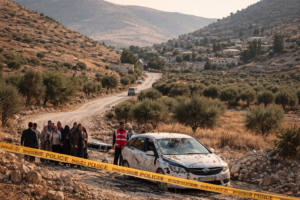
‘They Were Just Driving Home’: The West Bank Family Erased by Bullets as World Looks to Iran
In the village of Tammun, nestled in the northern reaches of the occupied West Bank, there is a silence today that is heavier than the gunfire that shattered it. It is the silence of a home that has lost its heartbeat. On Sunday morning, the family next door was whole. By midday, the father, the mother, and two of their children were gone, their lives extinguished in a hail of bullets as they sat in their car.
According to the Palestinian Health Authorities, the victims were identified as 37-year-old Rami al-Ahmad, his 35-year-old wife, Layla, and their two youngest children—five-year-old Youssef and seven-year-old Fatima. All were shot in the head. Two other children, aged 9 and 11, who were also in the vehicle, survived but sustained injuries. They are now recovering in a hospital in Nablus, orphaned, their childhoods shattered along with their bodies.
The Israeli military stated it is “looking into the reports.” But for the people of Tammun and for millions across the region, the facts on the ground are devastatingly clear. This was not a crossfire. This was not a clash. This was a family driving from one place to another, erased from existence in a moment of state-sanctioned violence that the world, distracted by the thunder of a wider war, is struggling to see.
The Anatomy of a Tragedy on a “Normal” Road
The road leading into Tammun is not a front line. It is a dusty, unremarkable artery that connects the village to the agricultural lands that have sustained its families for generations. On Sunday morning, the al-Ahmad family was traveling this familiar route. Initial reports from local sources and the Palestinian Health Ministry suggest they were returning home from a visit with relatives or tending to their land—a mundane errand that turned into a death sentence.
Witnesses, too terrified to speak on the record for fear of reprisal, have conveyed a horrifying sequence to local human rights workers. They describe a sudden incursion by Israeli military vehicles. Without warning, they claim, gunfire erupted, directed at the al-Ahmad family’s civilian car. The precision of the shots—all four fatal wounds were to the head—paints a picture not of suppressive fire, but of targeted killing.
The two surviving children, pulled from the back seat soaked in the blood of their parents and siblings, are now the sole, traumatized witnesses to the slaughter. “They are in a state of deep shock,” a medic at the Rafidia Surgical Hospital in Nablus told reporters. “The 11-year-old keeps asking why his mother and father are sleeping and why they won’t wake up. He doesn’t yet understand that he is an orphan.”
A Dual-Front War: The Settler Violence Amid the Chaos
This brutal military action was not an isolated incident. It is the bloody crescendo of a wave of violence that has swept across the West Bank since the outbreak of the U.S.-Israeli war with Iran on February 28. The conflict, which has seen missiles fly over the Middle East and global powers hold their breath, has provided a dark and convenient cover for a second, less-publicized front: the systematic targeting of Palestinian civilians by Israeli settlers.
The Palestinian Health Ministry reports that at least five Palestinians have been killed by settlers in the West Bank since the war began. But statistics fail to capture the reign of terror that has descended upon rural communities.
“We are seeing a strategic exploitation of the chaos,” explains a Ramallah-based human rights researcher who asked to remain anonymous due to the sensitivity of the situation. “The Israeli military has imposed severe curfews and movement restrictions, citing security concerns related to the Iran war. Settler groups know the military’s attention—and the world’s attention—is elsewhere. They are using this window of opportunity to attack, to intimidate, and to seize land with near-total impunity.”
Sunday’s violence began the night before, when the Health Ministry reported that settlers killed one Palestinian in a separate attack. These night raids often involve groups of armed settlers entering Palestinian villages, torching cars, uprooting olive trees—the lifeblood of the Palestinian economy—and opening fire on homes. When residents call for help, they often find their path blocked. The military roadblocks, ostensibly set up to prevent Iranian infiltration or wartime movement, now serve as a barrier to ambulances, preventing medics from reaching the wounded in time.
This was the context into which the al-Ahmad family drove on Sunday morning. The area around Tammun had likely been simmering with tension. The military, already on high alert due to the regional war, operates with hair-trigger responses. Whether the family’s car was mistaken for a threat, or whether they simply entered a “sterile zone” at the wrong moment, the result is the same: four dead, two children maimed for life, and a community in mourning.
The Collapse of the Healthcare System Under Dual Pressure
The tragedy is compounded by the sheer inability of the Palestinian health system to cope. Years of blockade, resource scarcity, and the ongoing conflict have left hospitals in the West Bank perpetually on the brink. The new war with Iran has only tightened the noose.
The two injured al-Ahmad children survived because, eventually, an ambulance managed to navigate the labyrinthine roadblocks. But the rights groups’ warning—that these barriers are costing lives—is not hyperbole. For every victim who makes it to a hospital, there are stories of those who bleed out at checkpoints, waiting for permits or for soldiers to verify their identities.
The strike that killed the family of four is a devastating blow to a community that relies on its families for resilience. In Palestinian society, the family unit is the ultimate sanctuary, the bearer of memory, and the source of hope. By killing the parents and the youngest children—the future—these attacks aim to sever the generational chain. They send a message that no one is safe, not even in a car, not even with your children.
The International Silence and the “Useful Distraction”
Perhaps the most chilling aspect of this incident is the timing. On the same day the al-Ahmad family was killed, headlines across the world were dominated by other stories from the region: a Venezuelan opposition leader’s denouncement of amnesty, the death of 12 medical staff in an Israeli strike on a health center in southern Lebanon, and the WHO chief confirming that strike. The world is saturated with the chaos of a multi-front conflict.
This saturation creates what analysts call a “hierarchy of horrors.” The deaths in Lebanon, part of a direct confrontation with Hezbollah, are seen as strategic. The deaths in the West Bank are increasingly viewed as tragic but predictable background noise.
This is a dangerous fallacy. The violence in the West Bank is not a separate issue from the Iran war; it is a direct consequence of it. The diversion of Israeli military resources, the heightened state of alert that lowers the threshold for using lethal force, and the empowerment of extremist settler movements who see the war as a divine opportunity to fulfill expansionist dreams—all of these are interconnected.
Hamas, in a separate statement on Sunday, urged Iran to stop “targeting neighboring” countries while supporting Tehran‘s right to defend itself against the U.S. and Israel. The statement highlights the tangled web of alliances and enmities. But for a five-year-old boy named Youssef, buried today in a small grave next to his mother and father, these geopolitical calculations mean nothing. He is a casualty of a war he did not start, killed by forces he could not comprehend.
What Happens Now? The Seeds of the Next Intifada
The international community, including the United States, Israel’s primary ally now engaged in a direct war with Iran, has a history of calling for “restraint” in the West Bank. But restraint requires a functioning deterrent, a power that can hold actors accountable.
With the Israeli military stretched thin and the world’s gaze fixed on Tehran, the West Bank is becoming a vacuum filled by violence. The killing of the al-Ahmad family is not an outlier; it is the new normal. If the Israeli military’s investigation into this incident follows the pattern of recent history, it is likely to result in a closed-door review, a statement of regret for the loss of innocent life, and no charges.
Just last week, the Israeli Military dropped charges against soldiers accused of sexually assaulting a Palestinian detainee, a decision that sent a clear message of impunity to the troops on the ground. In such an environment, the value of Palestinian life plummets.
For the people of Tammun, the future is bleak. They will bury their dead. They will tend to the two surviving children, who will carry the trauma of this day for the rest of their lives. And they will wait. They will wait for the world to remember them, for the media to turn its cameras away from the rockets and back to the occupied streets, and for a justice that has, for decades, remained stubbornly out of reach.
As the sun set over the West Bank on Sunday, casting long shadows over the checkpoints and the settlements and the villages, the silence in the al-Ahmad home was deafening. It was the sound of a family erased, a future stolen, and a conflict that, despite a world war raging around it, remains at its brutal, unresolved core. The victims are not just statistics in a ministry report. They are Rami, Layla, Fatima, and Youssef—a mother, a father, and two children who were simply driving home.
You must be logged in to post a comment.