
‘They Frightened My Daughters’: Inside the Night Armed Settlers Descended on a Palestinian Village
Armed Jewish settlers descended on the Palestinian hamlet of Susiya in the southern West Bank on Tuesday night, using clubs, rocks, and flammable liquid to set vehicles ablaze and terrorize residents, with security footage showing approximately two dozen masked individuals coordinating the 20-minute attack before melting back into the darkness before security forces arrived. The assault, which left families hiding in terror with children unable to sleep, represents the latest escalation in surging settler violence since October 2023 that has killed 18 Palestinians and injured over 1,200, and comes amid accusations that such attacks are part of a systematic pressure campaign to displace communities like Susiya—featured in the Oscar-winning documentary “No Other Land”—from land where Israeli settlement expansion continues under a hardline government that has played down the violence while advancing policies critics say enables it, leaving residents like Fatima Al-Nawaja and Halima Abu Eid to rebuild yet again with no arrests made and only international condemnation from visiting European diplomats who declared “there has to be an end to this.”
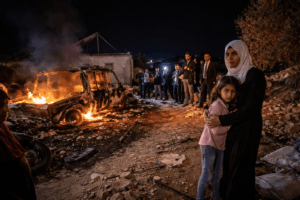
‘They Frightened My Daughters’: Inside the Night Armed Settlers Descended on a Palestinian Village
Security footage reveals coordinated attack on Susiya, where residents say terror tactics aim to drive them from their land
SUSIYA, West Bank — The security camera mounted outside Fatima Al-Nawaja’s home captured everything: the silhouettes of approximately two dozen figures moving through the darkness, the glint of glass bottles catching moonlight, the sudden orange glow as her family’s truck became an inferno.
It was just after 8 p.m. on Tuesday when the men in black descended on this Palestinian hamlet in the hills of the southern West Bank. They moved with purpose, some carrying clubs and rocks, others clutching white containers that security footage shows them splashing against vehicles before igniting.
“They came like an army,” Al-Nawaja, 43, told The Associated Press the following morning, standing near the charred skeleton of what had been her family’s primary means of transportation and income. “We hid inside with the lights off, whispering so the children wouldn’t cry. My youngest kept asking why the bad men were here to hurt us.”
By dawn, when a delegation of European diplomats arrived to survey the damage, the truck was a burned-out shell. A caravan nearby had been torched. Rocks had shattered windows. And the psychological wounds—less visible but perhaps more enduring—had been carved into another generation of Palestinian children who now understand that darkness can bring armed men to their doorstep.
The Attack, Minute by Minute
The timestamped footage obtained by the AP provides a rare, unfiltered window into the reality of life for Palestinians in Area C of the West Bank, where approximately 500,000 Israeli settlers live alongside an estimated 300,000 Palestinians—often in conditions of escalating tension and violence.
At 8:03 p.m., the first camera shows figures emerging from the rocky hillside that surrounds Susiya. They’re dressed in dark clothing, their faces partially obscured. Within minutes, they’ve spread through the village’s outskirts where vehicles are parked.
One settler is seen crouching beside a truck, pouring liquid from a white bottle onto its tires. Another follows with what appears to be a lighter. The truck ignites almost instantly, flames illuminating the scene as additional settlers move toward residential structures.
A second camera angle shows settlers surrounding a parked car, beating its windshield with clubs until the glass spiders into opacity. Someone kicks violently at the door of a caravan. Rocks sail through the air toward a home, toward the security camera itself, toward anything that represents the Palestinian presence in this contested landscape.
The entire operation lasted approximately 20 minutes before the settlers melted back into the darkness from which they came. By the time Israeli security forces arrived, the village was left to count its losses and comfort its terrified residents.
A Community Under Pressure
Susiya is no stranger to such nights. This village, whose name has become synonymous with the Palestinian experience in the occupied territories, was featured prominently in “No Other Land,” the Oscar-winning documentary that brought international attention to the systematic pressures facing communities like it.
Just under a year ago, one of that film’s directors was hospitalized after being beaten during a settler attack on the village. That incident, like Tuesday’s, was documented, reported, and condemned by international observers. And like Tuesday’s, it resulted in no apparent consequences for the perpetrators.
“The soldiers come after, always after,” said Halima Abu Eid, another Susiya resident, gesturing toward the burned vehicles. “They ask questions, they take notes, they leave. And the settlers know this. They know there is no price to pay.”
The Israeli military confirmed that soldiers and police responded to reports of fire in the area Tuesday night. In a statement, officials said officers searched for suspects but did not indicate whether any were found or arrested. An investigation, they said, has been opened.
For residents of Susiya, that investigation will likely follow a familiar pattern. “We’ve seen this movie before,” Abu Eid said bitterly. “They investigate, they file papers, and then next month or next year, the settlers come again. The only thing that changes is which of our belongings they burn.”
The Broader Context: Rising Violence Since October 7
Tuesday’s attack did not occur in a vacuum. According to the United Nations humanitarian office (OCHA), settler violence has surged dramatically since October 7, 2023, when Hamas’s attack on Israel sparked the ongoing war in Gaza.
The numbers tell a stark story: 18 Palestinians killed by settlers since the war began, at least 1,225 injured. In just the first two weeks of February 2026 alone, OCHA documented 86 settler attacks across the West Bank resulting in property damage and injuries. Those incidents displaced 146 people, injured 64 Palestinians, and damaged 39 vehicles, more than 800 olive trees, as well as water networks and schools.
The pattern is consistent enough to be predictable: settlers arrive after dark, often masked, armed with weapons ranging from rocks to firearms. They target vehicles, agricultural infrastructure, and sometimes homes. They leave before security forces can intervene. And the cycle continues.
“It’s not random violence,” explained a European diplomatic source who requested anonymity to discuss the sensitive situation. “What we’re seeing in places like Susiya is systematic pressure designed to make life so unbearable, so dangerous, that Palestinians will eventually leave. The international community recognizes this. The question is what to do about it.”
International Condemnation, Local Reality
By Wednesday morning, the burned vehicles in Susiya had become a backdrop for diplomacy. Alexander Stutzman, the European Union representative for Gaza and the West Bank, stood amid the damage and delivered a message that residents have heard many times before.
“This is not a good image for anyone, and it’s not a good image for Israel either,” Stutzman told reporters after viewing the security footage. “There has to be an end to this.”
The diplomat’s words, while firm, offered little comfort to families now without transportation in a region where public transit is virtually nonexistent and distances to hospitals, schools, and markets are measured in kilometers through military checkpoints.
“The truck wasn’t just for work,” Al-Nawaja explained. “It was how we got my father to his dialysis appointments in Yatta. It was how we brought building materials when we tried to repair our home after the last time. It was how we survived.”
Her family’s situation illustrates the cascading consequences of such attacks. A burned vehicle means lost income. Lost income means inability to repair damage. Unrepaired damage makes the community appear more vulnerable, potentially inviting further attacks. And through it all, families must decide whether to rebuild or whether the costs of staying have finally exceeded the benefits.
Political Dimensions: Settlements and Sovereignty
The violence in Susiya unfolds against a backdrop of accelerated settlement expansion under Prime Minister Benjamin Netanyahu‘s hardline government. While Netanyahu has characterized settler violence as the work of “a small group of extremists,” his administration has simultaneously advanced policies that critics say encourage and enable such attacks.
Since taking office, the government has accelerated the legalization of unauthorized settlement outposts, approved thousands of new housing units in existing settlements, and transferred significant civil authority in the West Bank from military to civilian control—a move critics describe as de facto annexation.
“These aren’t separate issues,” said a Palestinian community leader who asked to be identified only by his first name, Ahmed, citing security concerns. “When the government builds more settlements, when soldiers protect settlers but not us, when leaders in Jerusalem call this land ‘Judea and Samaria’ and treat us as temporary residents in our own homeland—what do they expect will happen?”
The hilltops surrounding Susiya offer a visual answer to Ahmed’s question. In recent years, new settler outposts have appeared on nearly every strategic high point, their red-roofed houses and water towers visible from the village below. Between these outposts and the Palestinian homes lies a no-man’s-land where violence can occur with minimal warning and minimal consequence.
Human Cost: The Terror That Doesn’t End
As diplomats spoke and officials investigated, Abu Eid sat in her damaged home, trying to calm children who had spent the night huddled under blankets, listening to the sounds of their community under attack.
“I have daughters,” she said quietly. “They frightened them. They couldn’t sleep at all. Every sound makes them jump now. Every shadow is a settler coming to burn something else.”
The psychological impact of such attacks is less measurable than property damage but no less real. Children in Susiya have grown accustomed to violence in ways no child should. They’ve learned which nights are most dangerous, which directions to run, which doors lock properly.
“My son asks me why they hate us,” Al-Nawaja said. “He’s 10 years old. How do I explain to a 10-year-old that people who worship the same God, who live just over that hill, want to hurt him just for being who he is?”
The question hung in the morning air as smoke still rose from the burned truck.
Resilience in the Face of Pressure
Despite the attack, despite the years of accumulated trauma, despite the burned vehicles and shattered windows, residents of Susiya insisted they would not leave.
“We are steadfast,” Abu Eid declared, using a word that carries deep resonance in Palestinian culture—sumud, the quality of remaining rooted in one’s land despite overwhelming pressure to depart. “They can burn our trucks. They can break our windows. They can frighten our children. But we will rebuild. We will stay.”
Her vow reflects a calculation that extends far beyond personal preference. In the complex legal landscape of the West Bank, absence can be exploited. Land left untended can be declared “state land.” Structures not rebuilt can be permanently lost. For Palestinians in Area C, presence is itself a form of resistance.
“We know what happens to villages where people give up,” Al-Nawaja added. “We’ve seen the ruins. We’ve heard the stories. So we stay. Not because it’s easy—because the alternative is worse.”
The Unanswered Question
As Wednesday faded into Thursday, life in Susiya began its halting return to normal. Children went to school. Women prepared meals. Men surveyed damage and began calculating the costs of repair.
But the fundamental question that hangs over this village and dozens like it remained unanswered: Will anyone be held accountable?
The security footage is clear. The timestamps are precise. The attackers’ methods are visible. And yet, residents have little expectation that Tuesday’s perpetrators will face justice.
“Maybe if they were Palestinians attacking a settlement, the army would be here before the flames went out,” Ahmed suggested. “Maybe the whole area would be closed. Maybe there would be arrests, interrogations, long prison sentences. But for us? We get investigations. We get diplomats who say they’re concerned. We get burned trucks and frightened children and promises that next time will be different.”
He paused, looking toward the hills where settler outposts glowed in the fading light.
“The next time always comes,” he said. “That’s the one thing we can count on.”
You must be logged in to post a comment.