
‘They Came with the Soldiers’: The Systematic Dismantling of Palestinian Life in the West Bank
In a wave of coordinated violence across the occupied West Bank, Israeli settlers—operating under the protection of the Israeli military—attacked multiple Palestinian villages on February 13, 2026, wounding at least 54 people, vandalizing homes and vehicles, and systematically destroying hundreds of ancient olive trees that represent both the economic livelihood and cultural heritage of Palestinian communities. The assaults, which saw soldiers firing tear gas and live ammunition at unarmed residents attempting to defend their land, unfolded against the backdrop of Israel’s newly approved plans to extend state authority over more of the occupied territory—a move condemned by the UN as de facto annexation that accelerates forced displacement. These attacks represent an intensification of the violence that has killed over 1,050 Palestinians in the West Bank since October 2023, revealing how military protection enables settler colonialism while international condemnation remains toothless, leaving communities like Talfit to confront a systematic erasure designed to make life so unbearable that Palestinians will abandon their ancestral homes.
‘They Came with the Soldiers’: The Systematic Dismantling of Palestinian Life in the West Bank
For the farmers of Talfit, the olive groves are more than just trees. They are the living embodiment of their history, their livelihood, and their claim to a land that is slowly being stolen from them, one violent incursion at a time.
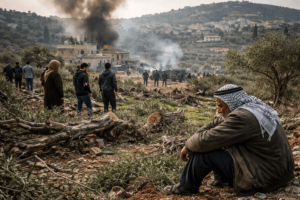
The quiet of a February morning in the occupied West Bank was shattered not by thunder, but by the sound of stones hurled through windows and the screech of metal being battered. In the village of Talfit, south of Nablus, residents woke up to a familiar terror: an invasion by Israeli settlers, protected by the Israeli military. By the time the sun had fully risen, at least 54 Palestinians lay wounded across several communities, their homes violated, their cars vandalized, and their ancient olive groves reduced to splintered wreckage.
The attack on Friday was not an isolated outburst of communal violence, but a violent crescendo in a long-running symphony of dispossession. It unfolded against a backdrop of international condemnation for the Israeli government’s latest push to cement its control over the occupied territory—a move human rights experts have denounced as de facto annexation. To understand the breaking of windows in Talfit, one must understand the decades-long strategy to break the spirit of a people.
The Olive Tree as a Target
In the aftermath of the attack, the air in Talfit hung heavy with the acrid smell of tear gas and the dust kicked up by military vehicles. Villagers, many still trembling with adrenaline and shock, began to survey the damage. But the most devastating scene lay just beyond the village perimeter, on the rolling hillsides that have been tended by their families for generations.
There, the attackers had not just stolen olives; they had waged war on the trees themselves. Using axes, chainsaws, and sheer brute force, they had systematically felled approximately 300 olive trees near the town of Turmus Aya, and countless others in the outskirts of Talfit. These were not saplings; they were ancient, gnarled sentinels, some perhaps a century old, their roots sunk deep into a soil that holds the bones of their ancestors.
“An olive tree is not like a tomato plant. You cannot just plant another one and get fruit next year,” explained Mahmoud Awad, a 67-year-old farmer from Talfit, his voice cracking with a grief that went beyond material loss. He stood by the remains of a tree his grandfather had planted. It would take another decade for a new tree to reach a fraction of its maturity. “They know this. This is why they do it. They don’t just want our land; they want to erase our memory from it.”
This act of arboricide is a hallmark of settler violence. The olive tree is the economic and cultural lifeblood of the Palestinian West Bank. It represents sumud, the deeply rooted concept of steadfastness and resilience in the face of occupation. By destroying these trees, the settlers are not just vandalizing property; they are attacking the very foundation of Palestinian existence on the land, severing the tangible link between a people and their homeland. For the families who rely on the annual olive harvest for their income and sustenance, it is an act of economic warfare, pushing them further toward the brink of poverty and displacement.
Under the Army’s Watchful Eye
Perhaps the most chilling detail of Friday’s attacks, and one echoed by villagers in Talfit, is the role of the Israeli military. Witnesses describe settlers arriving in waves, often emerging from nearby illegal outposts, and descending on the Palestinian farmland. When the residents—unarmed farmers and their families—rushed to defend their property, they were met not by soldiers intervening to stop the vandals, but by soldiers firing tear gas canisters and live ammunition directly at them.
“They came with the soldiers,” said Amina Hassan, a young woman from Talfit, pointing toward a field now littered with rocks and empty tear gas canisters. “The settlers were smashing our cars, throwing stones at our homes. When my brothers went out to stop them, the army shot at them. They are not protecting us. They are protecting the people attacking us.”
This dynamic transforms the Israeli military from an occupying force into an active participant in the transfer of land from Palestinian to Israeli control. The settlers, often armed and radicalized, act as the forward infantry, pushing Palestinians off their land. When the Palestinians resist their own dispossession, the army steps in to suppress that resistance, framing it as a threat to “security.” The legal framework of occupation, which obligates the occupying power to protect the civilian population, is inverted to facilitate their persecution.
The injuries sustained by the 54 Palestinians on Friday range from severe bruises from beatings and stone-throwing to respiratory distress from tear gas and, critically, gunshot wounds. With the nearest hospitals often inaccessible due to checkpoints and the unpredictable closure of roads by the military, even basic medical aid becomes a challenge. In the fragile ecosystem of the West Bank, a wound from a soldier’s bullet can be a death sentence, or a one-way ticket to a life of disability, with little to no recourse for justice.
Beyond the Headlines: A Life Under Siege
The international headlines often capture the dramatic spikes in violence, but they fail to convey the grinding, day-to-day reality of life under occupation—a reality that has only intensified since October 7, 2023.
According to the latest UN figures, over 1,050 Palestinians have been killed in the West Bank by Israeli troops and settlers in the last two and a half years. But behind each number is a story: a father shot at a checkpoint on his way to work, a child hit by a stray bullet while playing near her home, a teenager stoned to death by settlers while herding sheep. Tens of thousands more have been forcibly displaced from their homes, their communities wiped from the map in what Human Rights Watch has condemned as war crimes.
This displacement is often slow and bureaucratic. It begins with settler violence that makes life unbearable. It continues with military orders declaring vast swathes of land “closed military zones” or “firing zones,” making it illegal for Palestinians to access their own property. It is cemented by the demolition of homes built without permits, which are nearly impossible for Palestinians to obtain from the Israeli Civil Administration. The goal is clear: to make the cost of staying so high that leaving becomes the only option.
“They are trying to suffocate us,” said Ibrahim Darwish, a shopkeeper in Turmus Aya, whose olive trees were destroyed. “They control our water, our electricity, our ability to move from one village to the next. They take our land for settlements, and when we try to live on what’s left, they burn it. They want us to feel like strangers in our own home.”
The Politics of Annexation: A Green Light for Violence
The latest wave of attacks cannot be separated from the political developments in Israel. This week, the government approved plans to effectively extend its authority over more of the West Bank. While stopping short of a formal declaration of annexation, the move grants the Israeli civil administration greater control over land management, paving the way for the expansion of illegal settlements and the further entrenchment of the occupation.
For the international community, this is a clear violation of international law, specifically the Fourth Geneva Convention, which prohibits an occupying power from transferring parts of its own civilian population into the territory it occupies. For UN human rights chief Volker Turk, it represents a dangerous acceleration of an already illegal reality. “If these decisions are implemented, they will undoubtedly accelerate the dispossession of Palestinians and their forcible transfer,” he warned.
For the settlers in the hills, however, these political moves are interpreted as a green light. The rhetoric from senior Israeli officials, often promising to “deepen roots” in the land or referring to the West Bank by its biblical names Judea and Samaria, fuels the ideology of the most radical among them. When the state signals that the land is rightfully theirs, violence against the “trespassing” Palestinians is seen not as a crime, but as a patriotic duty. Friday’s rampage was the direct, violent enactment of an annexationist policy.
The Shadow of Gaza
The violence in the West Bank is inextricably linked to the war in Gaza. For the past 16 months, the world’s attention has been fixed on the genocidal war that has killed tens of thousands and reduced the Gaza Strip to rubble. But for Palestinians in the West Bank, the war has been a constant, terrifying presence. It has provided cover for an intensified crackdown.
Military raids have become more frequent and more lethal. Checkpoints have hardened, strangling the economy. And settler violence has surged with impunity. The feeling among Palestinians is that while the world watches Gaza burn, their own existence is being quietly erased. The same military apparatus, the same political ideology, and the same international silence that enabled the destruction in Gaza is now being turned on them with renewed vigor.
“They think we are just watching,” said a young man in Talfit, who asked not to be named for fear of reprisal. “But we know that what is happening in Gaza is our future. They are testing the world’s reaction. And so far, the world has shown them that they can do whatever they want.”
The International Response: A Chorus of Condemnation, A Silence of Action
The condemnations from the UN and human rights groups are swift and principled. Volker Turk’s words are powerful: “We are witnessing rapid steps to change permanently the demography of the occupied Palestinian territory, stripping its people of their lands and forcing them to leave.”
But for the people of Talfit, whose homes are now marked with shattered windows and whose livelihoods lie in splinters on the hillside, words are not enough. They do not stop the next wave of settlers. They do not rebuild the century-old trees. They do not heal the wounds from the soldiers’ bullets.
The international community, particularly nations with significant leverage over Israel, remains paralyzed. The United States, while occasionally issuing statements of concern, continues to provide billions in military aid and shields Israel from accountability at the UN Security Council. European nations, while critical, have failed to impose meaningful sanctions or take concrete steps to protect Palestinian civilians or hold violent settlers accountable.
This diplomatic vacuum is a death sentence for the two-state solution, and increasingly, for the hope that Palestinians can live in freedom and dignity in their own land. As the settlers carve their names into the ruins of Palestinian homes and the ashes of their olive groves, they are not just building illegal outposts. They are building a future of permanent conflict, where the only law is the law of the strongest, and the only rights are those enforced by the barrel of a gun.
In Talfit, as night fell on Friday, the village was quiet. But it was the tense, fragile quiet of a community holding its breath. The settlers had retreated for now, back to their hilltops. But in the darkness, the farmers knew they would return. The trees are gone, but the land remains. And as long as they draw breath, they will fight to stay on it, armed with nothing but their steadfastness against a foe with the full might of a modern military behind it. This is the tragic, unequal equation of life in the occupied West Bank.
You must be logged in to post a comment.