
‘They Came to Kill’: The Unfolding Terror in Masafer Yatta Claims Another Life
‘They Came to Kill’: The Unfolding Terror in Masafer Yatta Claims Another Life
The air in the South Hebron Hills has a deceptive stillness to it. At dawn, it carries the scent of wild thyme and dew-kissed dust, a landscape of rolling limestone hills and deep wadis that has remained largely unchanged for centuries. But beneath this ancient calm lies a reality of relentless, grinding pressure. And on Saturday evening, that pressure erupted into a moment of pure, unambiguous horror that has left one family shattered and a community bracing for the next attack.
Amir Mohammad Shanaran, 28, is dead. His older brother, Khaled, 33, is fighting for his life in a Hebron hospital, his body riddled with gunshot wounds. Their only crime, according to witnesses and local sources, was being near their own home in the herding community of Khirbet Wadi Al-Rakhim, a tiny speck on the map in the volatile expanse of Masafer Yatta.
According to anti-settlement activist Osama Makhamreh, who arrived at the scene shortly after the attack, the brothers were fired upon by a group of armed Israeli colonists from the nearby settlement of Susya. This was not a confrontation born of a sudden argument or a dispute over grazing land. This was, by all accounts, a predatory act. “They opened fire at them while they were near their home,” Makhamreh told WAFA. “It was an execution.”
With Amir’s death, the number of Palestinians killed by Israeli settlers since the beginning of 2026 has risen to four. The grim tally since October 7, 2023, now stands at 40. But statistics, however stark, fail to capture the singular, irreplaceable loss of a 28-year-old man, the screams of a brother watching his sibling fall, or the terror that now grips the children of Khirbet Wadi Al-Rakhim.
The Geography of Fear: Life in the Firing Line
To understand what happened to the Shanaran brothers, one must understand Masafer Yatta. It is not just a place on a map; it is a concept, a battleground, and a testament to Palestinian sumud (steadfastness). Located in Area C of the West Bank, which is under full Israeli military control, this region is a patchwork of small Palestinian herding communities, or khirbets, and increasingly aggressive Israeli settlements.
For decades, the residents of Masafer Yatta have lived under the constant threat of displacement. The Israeli military designates much of their land as a “firing zone” (Firing Zone 918), using a 1980s-era Ottoman law argument to justify the expulsion of the very communities that have lived in the caves and on the land for generations. The irony is a bitter pill to swallow: a people fighting for the right to live on their ancestral land are often treated as trespassers in their own home, their existence criminalized while the international community looks on.
Khirbet Wadi Al-Rakhim is one of these communities. It is a place of simple, traditional life. Families live in tents and caves, herding sheep and goats across the fragile terrain. There is no electricity grid, no running water. The children walk miles to reach schools that are frequently threatened with demolition. Life here is a daily negotiation with survival. But it is their life, their heritage, their home.
Perched on a nearby hilltop, overlooking this pastoral landscape, sits the settlement of Susya. Unlike the temporary, precarious existence of the Palestinian villagers, Susya is a permanent, thriving community with modern infrastructure, connected to the Israeli national grid and protected by the Israeli military. From its vantage point, the Palestinian homes below are not seen as neighboring communities, but as obstacles to expansion, or worse, as a threat to be managed.
This topographical reality creates a dynamic of constant friction and intimidation. Settlers from Susya and its surrounding outposts are known for their involvement in price-tag attacks—acts of violence meant to exact a political and civilian price for any Israeli government action seen as favorable to Palestinians. These attacks range from the uprooting of olive trees—the lifeblood of the Palestinian agricultural economy—to the poisoning of wells, the torching of crops, and the physical assault of shepherds.
Saturday evening’s attack was not an isolated incident of “escalating violence.” It was the logical, bloody conclusion of a system that has fostered and protected settler violence for years.
The Attack: An Evening Shattered
The sun was beginning its descent over the hills, casting long shadows across the wadi. For the Shanaran family, it was the end of another day of hard work. There is no indication that Amir and Khaled were doing anything other than existing. They were near their home—perhaps tending to their animals, perhaps simply enjoying the last of the day’s light after the chores were done.
Witnesses describe a sudden, shocking turn of events. A group of armed individuals from the Susya settlement descended upon the area. These were not stone-throwing youths, as is sometimes reported in less severe incidents. These were individuals carrying military-style weapons. Without warning or provocation, they opened fire.
The sound of gunfire in the quiet hills is terrifying and unmistakable. It is a sound that carries for miles, a sound that signals death. For the residents of Khirbet Wadi Al-Rakhim, it is a sound that has become far too familiar, a sonic landmark of their oppression.
Amir Mohammad Shanaran, just 28 years old, was hit. The bullets tore through him, ending a life of potential, of dreams, of connection to this difficult land. He fell, his blood soaking into the very soil his family has likely walked for generations.
His brother Khaled, witnessing the murder of his sibling, became the next target. The gunmen turned their weapons on him, riddling his body with bullets. He collapsed, critically wounded, fighting for every breath as his lifeblood spilled onto the ground.
The armed colonists then reportedly retreated back towards the settlement of Susya, leaving the two brothers lying in the dust.
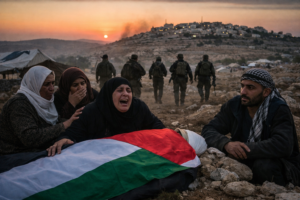
The aftermath was chaos and heartbreak. The sounds of wailing women and shouting men replaced the gunfire. Khaled was rushed, clinging to life, towards medical care. The journey from such a remote, isolated community to a hospital in Hebron is long and fraught with checkpoints, a cruel delay for a man in desperate need of trauma care. Amir had no such journey. He was already gone.
The Human Toll Beyond the Body Count
The killing of Amir Shnaran and the maiming of his brother Khaled is a profound tragedy for their family. But the ripples of this violence extend far beyond their immediate circle.
In a community as tight-knit as Khirbet Wadi Al-Rakhim, everyone is family. The children who witnessed the attack, or who heard the shots and then the screams, will carry that trauma for the rest of their lives. The fear that now grips the community is paralyzing. If a man can be shot dead steps from his own home in broad daylight, with no recourse, then no one is safe. The psychological impact is a weapon of mass displacement, often more effective than any bulldozer.
The “Wall and Settlement Resistance Commission” tracks the numbers, and the numbers are damning: four since January, forty since the Gaza war began. But each of those forty is a story that has been brutally cut short. Amir was 28. What were his plans? Was he engaged to be married? Was he the primary breadwinner for his aging parents? Did he have a passion for poetry, for his flock, for the history of his land? These are the details that are lost when we only report the statistics. He was a son, a brother, a neighbor, a Palestinian whose entire existence was an act of resistance in the face of an occupation determined to erase him.
The critical injury of Khaled adds another layer of cruel uncertainty. His survival is precarious. If he lives, he may face a lifetime of disability, a permanent, physical reminder of the violence that killed his brother. His family, already mourning, must now rally to care for him, their resources stretched impossibly thin.
The Settler Violence Ecosystem
This attack did not occur in a vacuum. It is a direct consequence of an environment where armed settlers operate with impunity. They are rarely, if ever, arrested or prosecuted for violence against Palestinians. The Israeli military, which is present in the area to “protect” all citizens, often acts as a de facto shield for the settlers, intervening only when Palestinians attempt to defend themselves or their land.
The international community, including the United States and the European Union, routinely condemns settler violence and has even imposed sanctions on specific individuals and groups. Yet, on the ground, the reality remains unchanged. The settlers are emboldened, feeling the full backing of the most extreme elements of the Israeli government, which includes ministers who openly call for the annexation of the West Bank and the encouragement of further settlement expansion.
The use of the word “colonists” is precise. These are not civilians living in disputed territory. They are citizens of a foreign power, Israel, living in occupied land in violation of international law (specifically the Fourth Geneva Convention), which prohibits an occupying power from transferring parts of its own civilian population into the territory it occupies. Their presence is the primary driver of conflict in the West Bank, and their armed elements act as a paramilitary vanguard for land confiscation.
A Community on the Edge
In the wake of the shooting, the residents of Masafer Yatta are not just mourning; they are waiting. They are waiting for the next attack. They are waiting for the Israeli army to arrive—not to arrest the killers, but perhaps to declare the area around the Shanaran home a “closed military zone” to prevent anyone from documenting the aftermath. They are waiting for the international condemnations that will change nothing.
The killing of Amir Mohammad Shanaran is a stark reminder that the conflict in Palestine is not just about rockets and military operations in Gaza. It is also about the slow, systematic, and often violent erasure of Palestinian life in the West Bank. It is about a 28-year-old man who will never see the sun rise over the hills of his home again. It is about a brother fighting for his life in a hospital bed, haunted by the image of his sibling’s murder.
As the sun sets on another day in Masafer Yatta, the lights of the Susya settlement will flicker on, a beacon of privilege and power on the hill. Down in the wadi, in Khirbet Wadi Al-Rakhim, the only light comes from a cooking fire, and the only sound is the quiet, determined sobbing of a family plunged into an unimaginable darkness. The world may move on to the next headline, but for them, the terror has only just begun.
You must be logged in to post a comment.